


Leopard Roundray
Urobatis pardalis · Gulf of Papagayo, Costa Rica
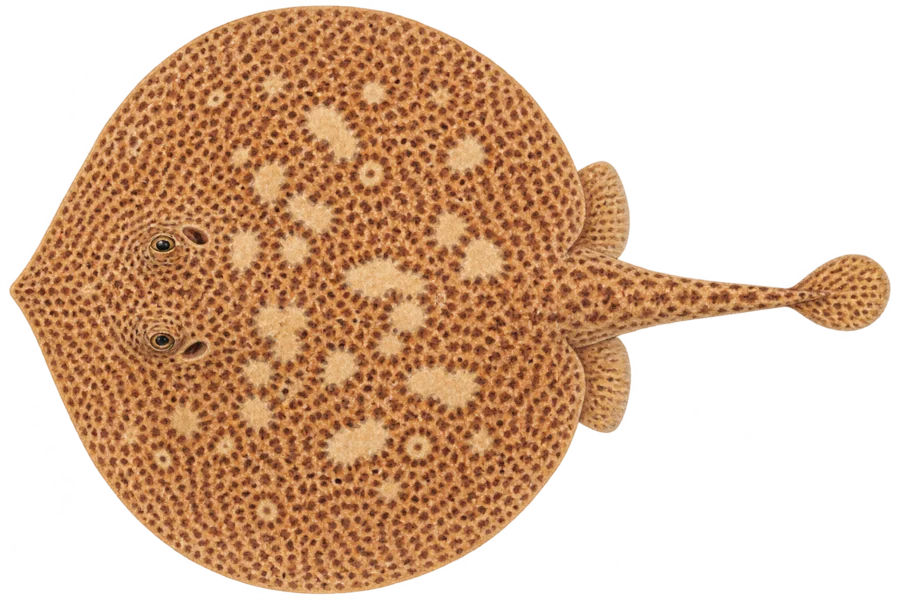
Look for a round, sand-colored ray with a short tail and a rounded tail fin. The back looks like a maze when you get a good look: small dark spots and wavy lines run between larger pale blotches. It’s a good reason to slow down and look twice at what seems like an ordinary patch of reef.
How to tell it apart
The disc is almost round, with a slight point at the snout. Look for a short, sturdy tail rather than a long whip. If you’re taking a photo, try for the whole animal from above without crowding it. The outline and tail help tell it from other roundrays; the markings alone can be deceptive.
Six things worth noticing
- Its species name, pardalis, points to that leopard-like pattern.
- Some of the pale marks join up, breaking up the pattern in a way that’s easy to miss at a glance.
- The dorsal skin is smooth, without rows of little thorns.
- One adult female from Papagayo measured about 15 inches from snout to tail. That’s one recorded animal, not a size limit.
- The species was formally described in 2015, but that Papagayo museum specimen was collected back in 1969.
- The species description notes that the pattern can look stronger or fainter on different individuals, so it pays to check the tail too.
Papagayo field note
Researchers documented this ray at Isla San José in the Gulf of Papagayo, in water less than seven feet deep. That’s a documented record, not a guarantee you’ll see one at that site. Watch without touching, moving, or crowding a ray.
Want to get sharper ID photos without getting closer? See Stuart Scuba’s Underwater Photographer course and our Costa Rica dive trip archive.




