


Fish identification archive / Raja Ampat
Latticed Butterflyfish
Chaetodon rafflesii
Raja Ampat field guide
Two things to tell your dive buddy
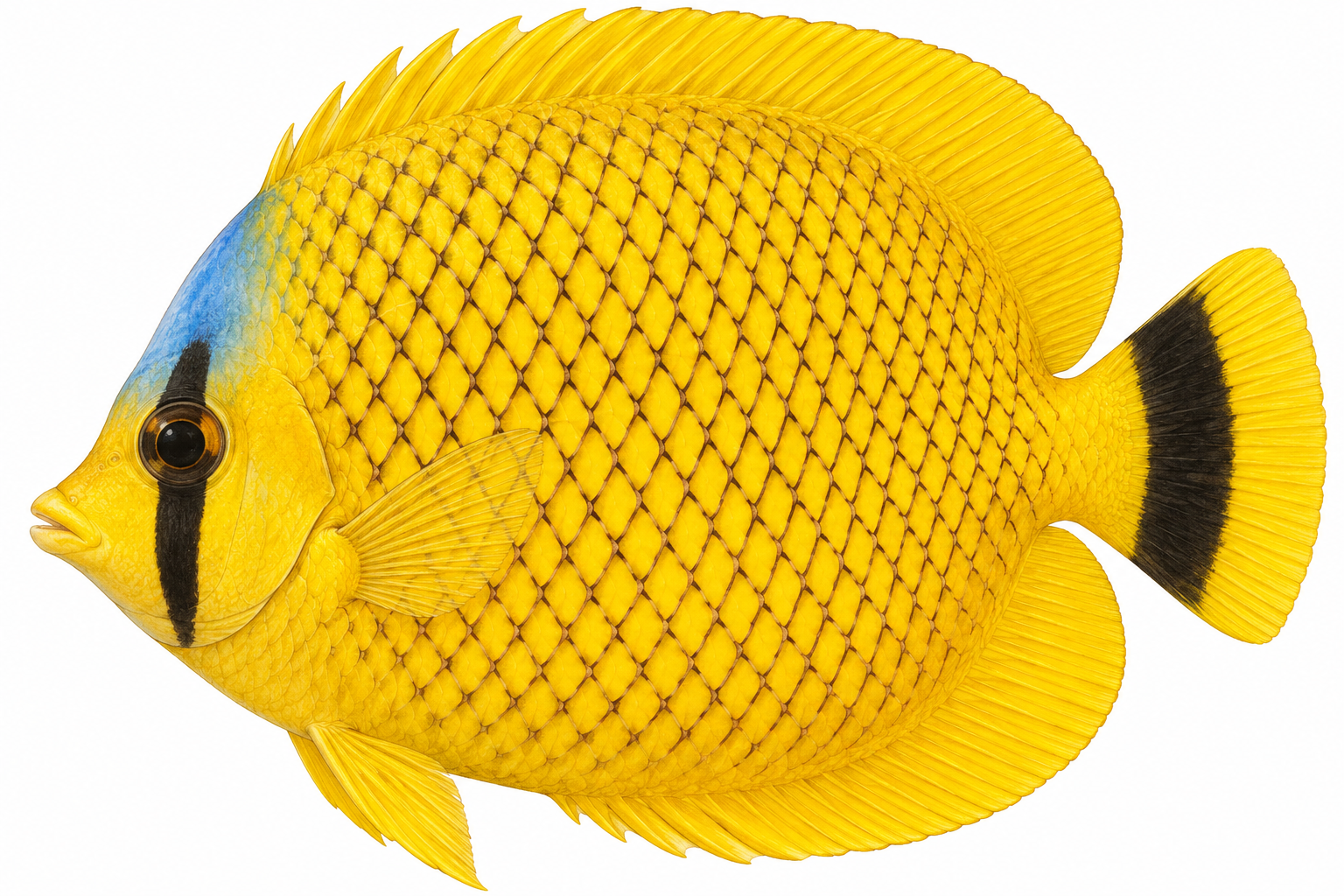
- The lattice is built from individual scale margins. What looks like a net painted over the fish is a repeated small-scale pattern.
- It feeds on coral polyps, anemones and polychaete worms. Sheltered coastal reefs, including lower-visibility sites, are part of its habitat.
How to identify it
Yellow butterflyfish with dark scale edges forming a lattice, blue forehead, black eye band and broad black bar across the tail.
Habitat and where to look
Sheltered coastal reefs, including sites with reduced visibility.
Daily habits and behavior
Often seen in pairs. The dark edges of individual scales produce the lattice pattern that becomes obvious in a clear side view.
What is on the menu?
Coral polyps, anemones and polychaete worms.
Mating and the next generation
Butterflyfish family context: eggs are released into open water, and the larvae spend an early drifting stage away from the adult reef habitat. This is not a Raja Ampat spawning-calendar prediction.
Look-alikes and identification traps
Confirm both the blue forehead and the broad black bar across the tail. Yellow color and a dark eye band alone are shared by many butterflyfishes.
Try this observation
Look for the blue forehead and cross-hatching together; do not chase it to obtain a perfectly clear photograph.
Raja Ampat occurrence
Recorded in Raja Ampat; regional occurrence does not guarantee an encounter on a particular dive. This guide does not imply that every site, itinerary or season offers the same chance of an encounter.
Observe, do not disturb
Keep a respectful distance, leave the animal an unobstructed route and follow your dive guide. Do not touch, feed, chase or collect wildlife. Identification does not establish permission to harvest or food safety; Florida harvest labels do not apply to this Indonesian guide.
Sources and review
Reviewed November 18, 2026.
Read the lattice one scale at a time
Dark edges on the scales form a fine grid across the yellow sides. A broader dark stripe through the middle of the tail helps confirm what you saw when the fine grid is hard to make out.
SDI Underwater Photographer offers practice framing the flank and tail together without crowding the fish.
Make your next dive happen
Dive With UsTrain With UsExplore the Raja Ampat tripShop With Us
Questions? (772) 600-8288 or info@stuartscuba.com.




