


Rough Star Coral
Isophyllia rigida · Mussidae · Stony coral · Cayman Islands Fish ID
How to identify it
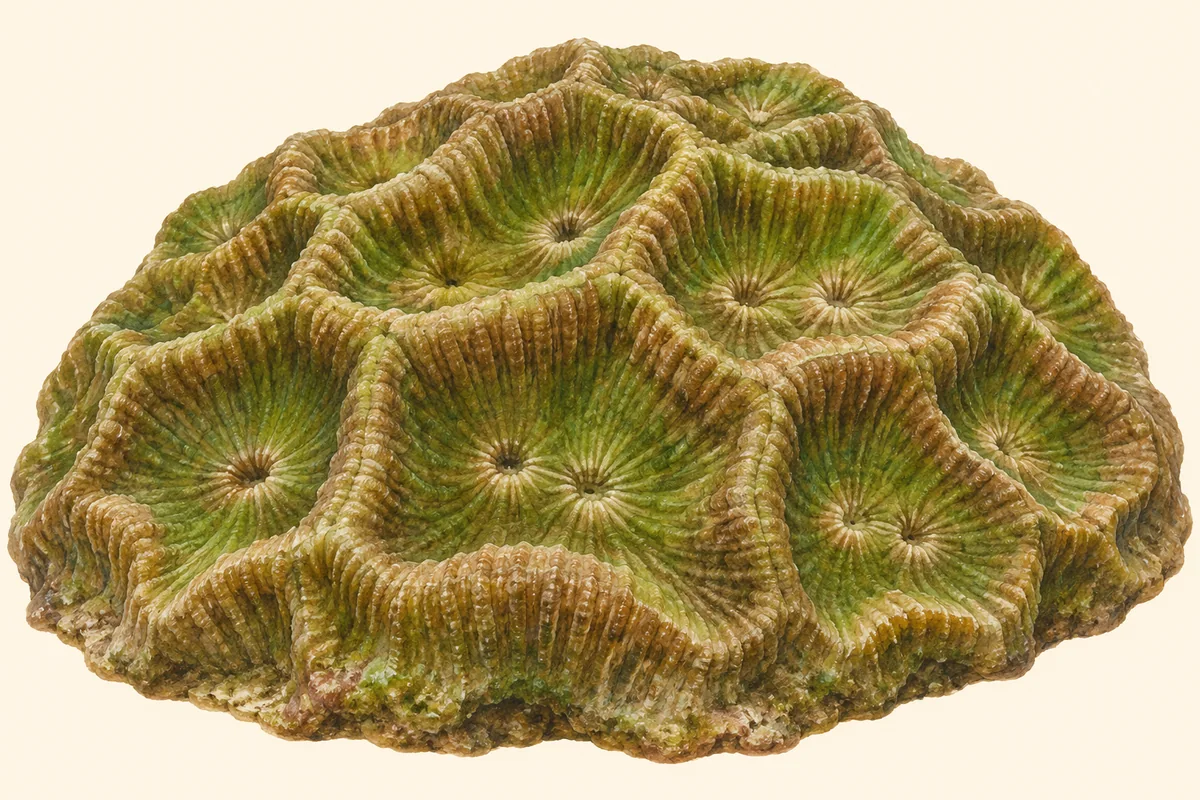
Rough star coral forms a low mound or crust patterned with deep angular cups. The heavy walls look like a coarse honeycomb, and each cup tends to hold one or two centers. Sinuous cactus coral is more likely to show short, wavy valleys instead.
Sinuous cactus coral typically has short connected valleys; rough star coral more often shows discrete polygonal cups.
Learn to observe reefs without touching
SDI Coral Conservation is the place to start if you want to learn about coral habitats and how to observe them responsibly.
Start with the colony’s outline and the pattern of its coral cups. Look from a position where you can keep your fins and camera clear of the colony.
- Keep your fins and camera clear: Advanced Buoyancy Control focuses on trim, weighting and hovering.
- Build a broader skill set: Advanced Adventure introduces several specialties, including deep diving and navigation, with opportunities to refine buoyancy.
- For deeper recreational dives already in your plans: Deep Diver focuses on planning depth and managing breathing gas. It’s not needed to identify coral on a shallow dive.
- Record the details: Underwater Photography covers lighting and still-image composition. Underwater Video covers framing and steady footage. Use either without resting gear on the reef.
Cayman Islands records
Researchers documented it at two Little Cayman survey sites. Those records do not establish a broader island distribution.
Fun facts
- Its old scientific name, Isophyllastrea rigida, still appears in older field reports.
- It can grow as a crust rather than a rounded dome.
- Each thick-walled depression may contain one or two centers.
- Green, blue-green and pink tones occur, so shape is the better clue.
- The Little Cayman field records are from two reef survey sites, not every reef around the island.
See more on your next dive
Use a close-up angled across the surface to make the deep cup walls visible.




