


Hairtail Fangblenny
Meiacanthus crinitus
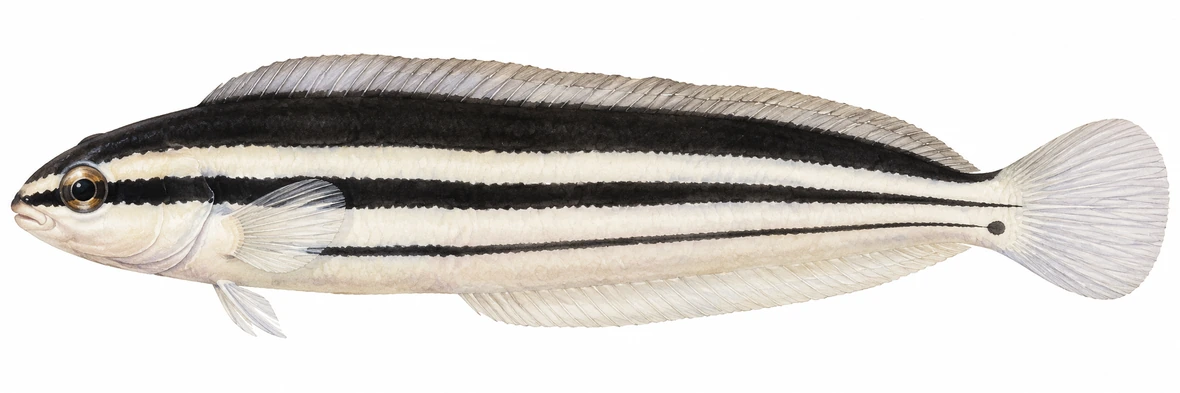
Two details worth remembering
- Its local occurrence is supported by museum specimens from named Raja Ampat islands, not merely an Indo-Pacific range map.
- It is not a Raja Ampat endemic: later research documented it farther east, including the Solomon Islands.
How to identify it
A pale fangblenny with bold dark longitudinal bands that narrow near the tail base; the lower band typically finishes in a small separated spot. It lacks a dark stripe along the anal-fin base.
Where to look
Documented directly at Kri and Wai in Raja Ampat, including specimens from 1–10 m. Earlier survey observations place it on sheltered coral reefs.
Natural history
Search the sheltered reef rather than assuming a small striped fish is a juvenile of a larger species. A careful tail-base photograph is particularly valuable.
Look-alikes
Meiacanthus limbatus has a dark chin and a dark anal-base stripe. The thin endings of the body stripes and isolated lower spot are important checks for crinitus.
What to watch for underwater
Photograph the tail base and anal-fin base without cornering the fish; these details are more useful than a distant striped silhouette.
Recorded in Raja Ampat
This species has a published Raja Ampat record. A regional record does not guarantee a sighting on a particular dive.
Sources: birdsheadseascape.com species reference · mapress.com species reference · indopacificimages.com species reference · Regional survey record
I saw this and want to share
Back to Raja Ampat Fish ID · Dive Raja Ampat with Stuart Scuba




