


Fish identification archive / Green Porcelain Crab
Green Porcelain Crab
Petrolisthes armatus
I saw this
Spotted this marine animal? Share the guide with your dive buddies. Review your caption before posting.
For Instagram, copy the caption and link into your own post or message. Nothing is posted automatically and this does not record a verified sighting.
Fun facts
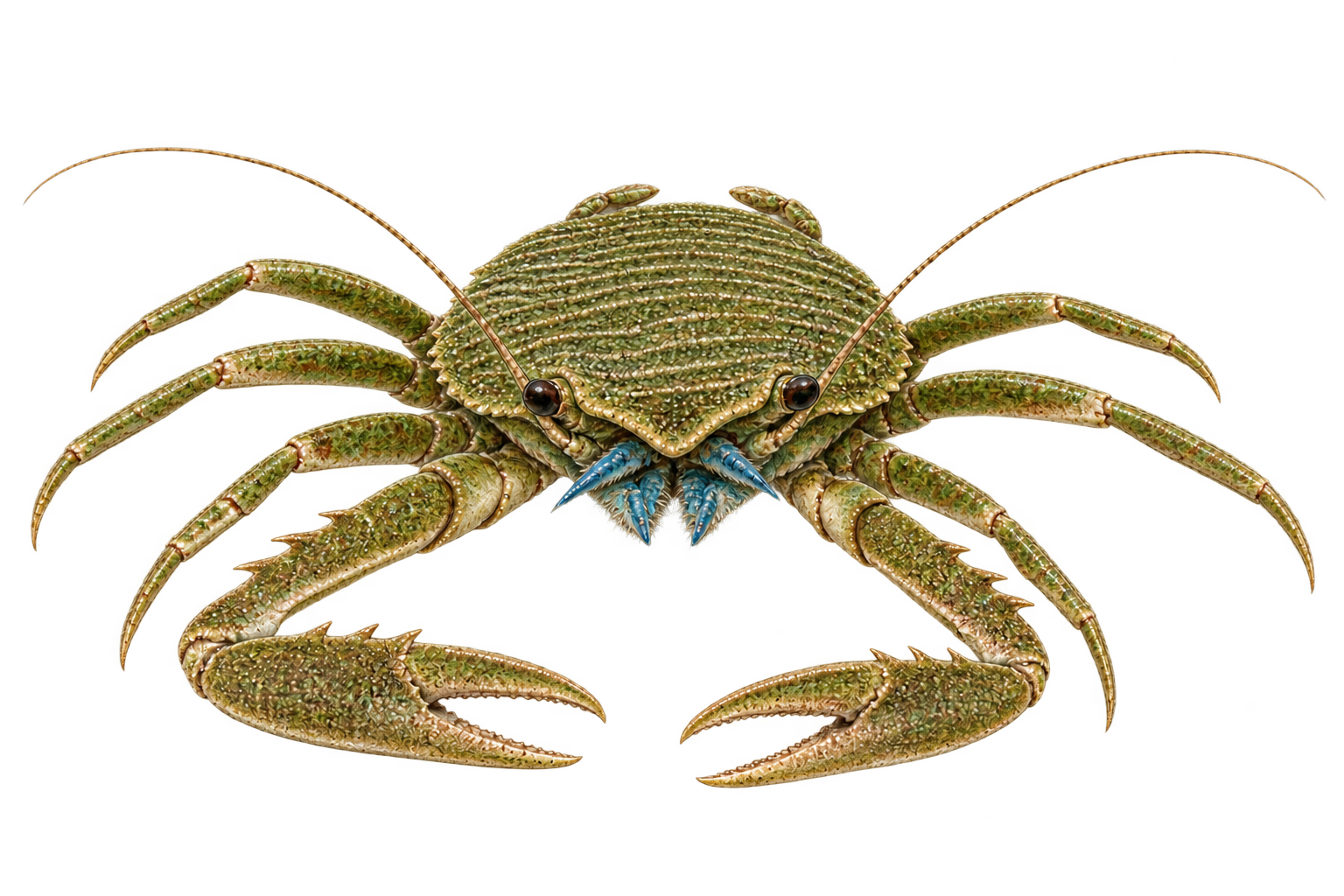
- The mouthparts are bright blue, even when the shell looks brown rather than green.
- Its claws are long and slim, with little spines on the wrist right behind them.
- The last pair of walking legs is tucked away and much smaller than the others.
- It belongs with the anomurans, the group that includes hermit crabs, rather than with true crabs.
- Its mouthparts gather tiny algae and drifting organic particles from the water instead of grabbing big meals with those claws.
- A female carries eggs under her body. The young spend time drifting as larvae before becoming little bottom-dwellers.
The best view comes from hovering just far enough away to see the crab feed. Practice the kind of controlled hover that keeps fins and equipment off the bottom in Advanced Buoyancy Control.
Treasure Coast records
Smithsonian records document this species at Fort Pierce worm reefs and Hutchinson Island in 1974–1975. These historical records establish regional occurrence, not guaranteed sightings or a verified Blue Heron Bridge record.
Identification and look-alikes
Look for a rounded, finely ridged carapace, elongated claws and blue mouthparts. Colour varies from brown to olive or dark green. The fourth walking-leg pair is reduced. Porcelain crabs belong to Anomura, rather than the true-crab group.
Use several clues
A colour match alone is not an identification. Photograph the body outline, claws and mouthparts without moving the animal. Compare those features with the source account before assigning a species name.
Habitat and habits
This small coastal crab occupies shallow rocky habitats, oyster reefs and mangroves. Look carefully at existing openings from a stable position; do not overturn rocks or break oyster clumps to expose wildlife.
How big is it?
The Smithsonian account lists a maximum carapace width of 14 mm. That measures the shell across the body, not its full span including claws and legs.
Feeding: a small suspension feeder
It filters phytoplankton and detritus from the water. Watch natural feeding rather than offering food or stirring up sediment for a photograph.
Mating, eggs and young
Females brood eggs beneath the abdomen. Young pass through planktonic larval stages before becoming bottom-crawling juveniles. Reproductive output varies with body size and location; this guide does not assign a Florida-wide breeding season.
Observe without handling
Never turn an animal over to inspect its eggs. If the features are hidden, record an uncertain identification and leave the animal undisturbed.
Plan a careful marine-life dive
Ask Stuart Scuba about a dive suited to your experience and current conditions. Keep fins and equipment clear of the habitat, leave room for surge and let small animals retreat. A good sighting does not require a close-up at any cost.
Record the date, location, approximate depth and visible features in your dive notes. Use the sharing controls above to send friends this Stuart Scuba guide; a shared caption is not a verified scientific sighting.
Harvest, protection and eating safety
Can it be hunted or collected?
RED CC: Do not harvest. Stuart Scuba recommends observation only under our Conservation and Common Sense approach. This is our recommendation, not a claim that the species has blanket legal protection.
Florida seasons and site rules
Our leave-in-place recommendation applies all year and is not a legal closed season. Check current species, collection-method and location rules with FWC. Do not interpret this guide or a directory colour as harvest permission.
Is it safe to eat?
We do not recommend this animal as a food target and make no species-specific food-safety claim.
Check current FWC marine-life guidance
Sources and review
Reviewed November 13, 2026. Historical locality evidence is distinguished from current sightings. Regional range expansion is not a reason to assume that every population has the same conservation or legal status.
- Smithsonian Environmental Research Center: Petrolisthes armatus identification, ecology and locality records
- Florida FWC marine-life guidance
Make your next dive happen
Dive With Us
Explore local charters and plan a dive suited to your experience.
View dive calendarTrain With Us
Build your fish identification, buoyancy and diving skills.
Explore trainingTravel With Us
Discover upcoming dive adventures and trip details.
Explore dive travelShop With Us
Browse equipment for your diving and ask our team for help choosing.
Explore dive gearReview current dates, availability, prices, inclusions and requirements on each listing before booking or buying.
Call us now
Ask about marine life identification
Marine Life Identification
Ask about dates, prerequisites or your next step. An inquiry does not reserve a place. Please provide your own contact details; do not include medical, payment or a child's personal information.
We use these details to respond to your inquiry. This form does not sign you up for marketing.
Explore more with Stuart Scuba
Open Water course options · Advanced Adventure training · Technical training · Professional training · All courses · Local dives · Dive trips · Facebook · Instagram · YouTube
Your surface-interval essentials
Questions for Stuart Scuba? info@stuartscuba.com
Check the Stuart Scuba Weather Center · Play scuba trivia
Weather and wildlife vary. Confirm current conditions, trip requirements and departure details with the operator.
Plan Your Next Dive with Stuart Scuba
Dive With Us
Explore upcoming local charters and choose a dive that fits your experience.
Before you book
Check the individual listing for departure time, requirements and availability.
Travel With Us
Find upcoming dive adventures and start planning your next trip.
Plan your trip
Review dates, inclusions and trip details on the travel calendar.
Stay Connected with Stuart Scuba
 Follow pageShare
YouTube
SubscribeWatch & shareFollow on InstagramView & share post
Follow company news, training updates, and dive stories.
Follow on LinkedInGoogle Reviews
See Stuart Scuba’s current Google rating and review count below. Open the listing in Google Maps to browse customer reviews.



