


Golden Trevally
Gnathanodon speciosus
Two details worth remembering
- Adults have no teeth in the jaws: the strongly protruding mouth is a better clue to their feeding method than the powerful jack-shaped body.
- A yellow juvenile beside a shark is not automatically a pilotfish. Golden trevally juveniles also use large animals as moving shelter.
How to identify it
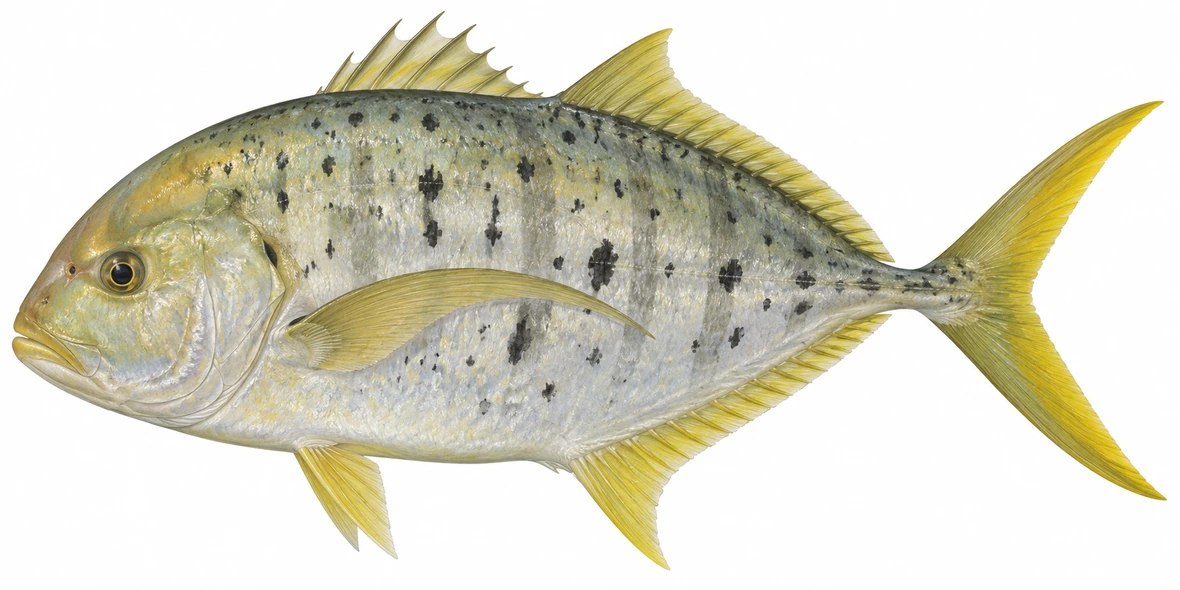
Young fish are vividly yellow with dark vertical bars. Adults become silver-grey, with black blotches and weaker bars. Thick, fleshy lips and a strongly extendible mouth are useful close-view features.
Where to look
Reef and inshore habitats. Juveniles may accompany sharks, turtles or other large animals, while very small fish can shelter near jellyfish.
Natural history
Feeds near the bottom on small crustaceans and molluscs; government accounts also record fishes.
Look-alikes
Compare with orange-spotted trevally: golden trevally juveniles have bold dark bars, while orange-spotted trevally is diagnosed by orange spotting or an orange colour phase.
What to watch for underwater
If a large animal passes, observe its companions from the same respectful distance; note yellow bars and the blunt, fleshy-lipped head.
Recorded in Raja Ampat
This species has a published Raja Ampat record. A regional record does not guarantee a sighting on a particular dive.
Sources: fishesofaustralia.net.au species reference · Regional survey record · journals.australian.museum species reference · dlnr.cnmi.gov species reference
I saw this and want to share
Back to Raja Ampat Fish ID · Dive Raja Ampat with Stuart Scuba




