


Fish identification archive / Raja Ampat
Giant Moray
Gymnothorax javanicus
Raja Ampat field guide
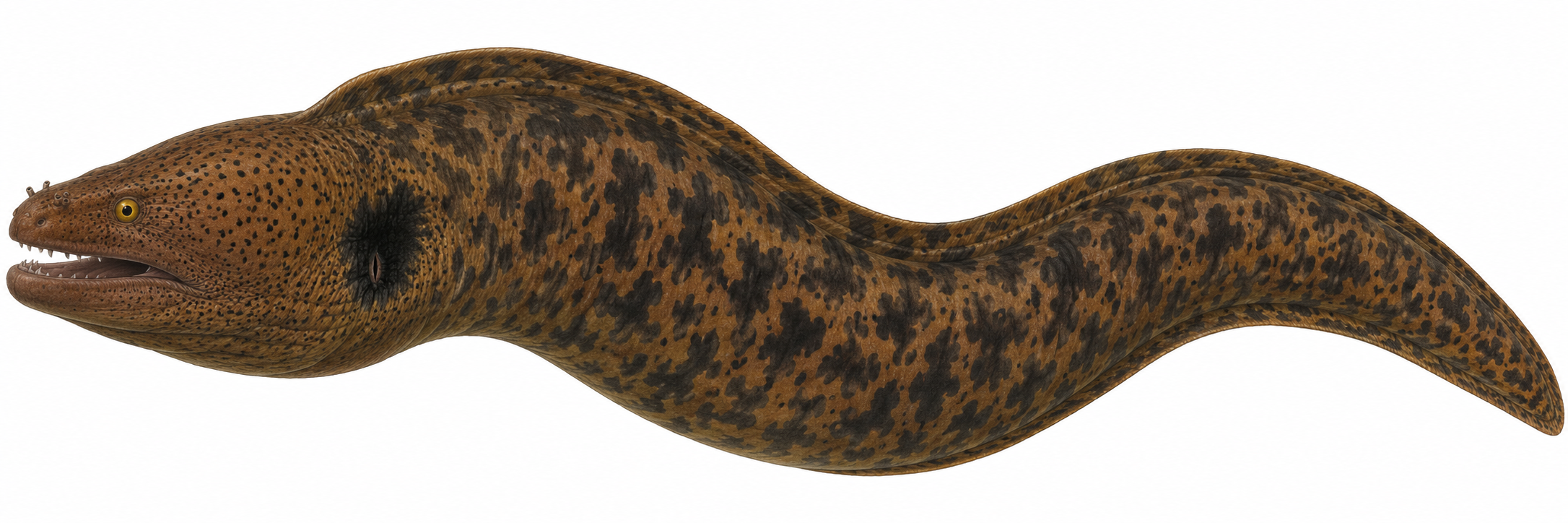
Two things to tell your dive buddy
- Young fish are tan with large dark spots.
- The gill patch can remain visible when much of the eel is concealed.
How to identify it
A large brown moray with dark head speckles, leopard-like body marks and a conspicuous black patch at the gill opening.
Habitat and where to look
Tropical reef habitats.
Daily habits and behavior
A powerful predator that must not be provoked or hand-fed.
What is on the menu?
Mainly fishes.
Mating and the next generation
Species-specific spawning details are not established in the sources used for this guide.
Look-alikes and identification traps
Other spotted morays can look similar; use the gill-opening patch and overall pattern rather than size alone.
Try this observation
Locate the gill patch visually; never reach into its refuge.
Raja Ampat occurrence
Recorded in Raja Ampat; sightings depend on site, conditions and careful observation. This guide does not imply that every site, itinerary or season offers the same chance of an encounter.
Observe, do not disturb
Keep a respectful distance, leave the animal an unobstructed route and follow your dive guide. Do not touch, feed, chase or collect wildlife. Identification does not establish permission to harvest or food safety; Florida harvest labels do not apply to this Indonesian guide.
Look just behind the giant moray’s head
Find the dark patch around the gill opening. On a large giant moray, small dark marks near the head give way to larger leopard-like marks farther back. A young one can have bolder spots, so check their placement as well as their size.
SDI Underwater Photographer course: Practice framing a moray from outside its crevice without putting your hands near the opening.
Sources and review
Reviewed November 18, 2026.
Make your next dive happen
Dive With UsTrain With UsExplore the Raja Ampat tripShop With Us
Questions? (772) 600-8288 or info@stuartscuba.com.




