


Flowerpot Coral Nudibranch
Phestilla goniophaga · Palau sea slugs
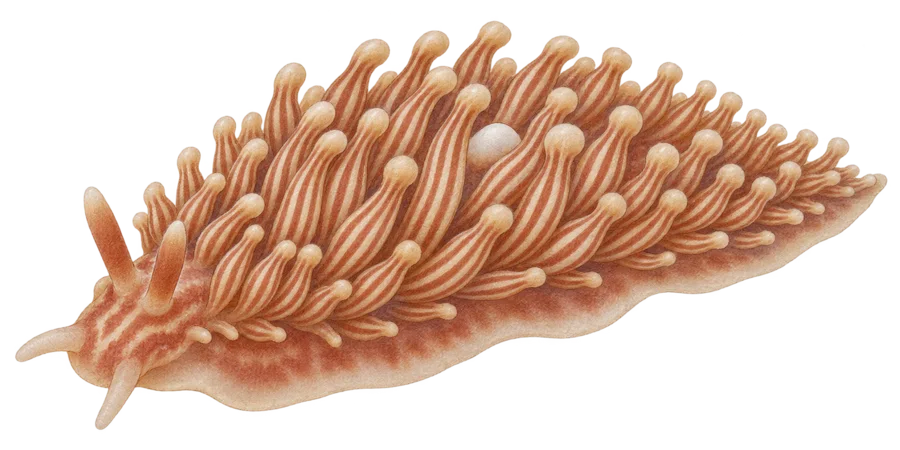
What looks like a cluster of tiny coral tentacles might turn out to be a very well-disguised sea slug. This nudibranch eats flowerpot corals and looks enough like their soft, waving tentacles to hide in plain sight.
How to spot the difference
Look for the outline of a body and two smooth sensory stalks at the front, then check for a small white hump about halfway down its back. Its long, fingerlike projections are called cerata. They grow in rows and are longest near the middle. On a living coral, a good macro photo may show where the slug’s rows end and the coral’s own tentacles begin.
Six things worth noticing
- The name goniophaga means “eats Goniopora,” the scientific name of flowerpot corals.
- The orange egg ribbon coils like a tiny roll of tape. It’s much easier to pick out than the camouflaged adult.
- The researchers who described it counted up to 16 rows of cerata on the specimen they examined.
- Juveniles have fewer rows and fewer projections than adults.
- The mature specimens in the species description were about 1.6 to 3 cm long, roughly an inch long at the upper end. That size comes from the described Hong Kong specimens, not a Palau survey.
- Under a microscope, researchers found intact cells of the host coral’s symbiotic algae in the slug’s fingerlike projections.
Palau field note
Researchers collected this species on a flowerpot coral at Lighthouse Reef in Palau. This is a documented record, not a claim it occurs on every reef or a guaranteed sighting. Leave coral and sea slugs undisturbed. If you find one, take a whole-animal macro photo first, then a wider frame that shows its host.
Explore more Palau diving or practice macro photography in our Underwater Photographer course.




