


← Back to South Florida Fish ID
Florida Prickly Cockle
Trachycardium egmontianum · Cardiidae
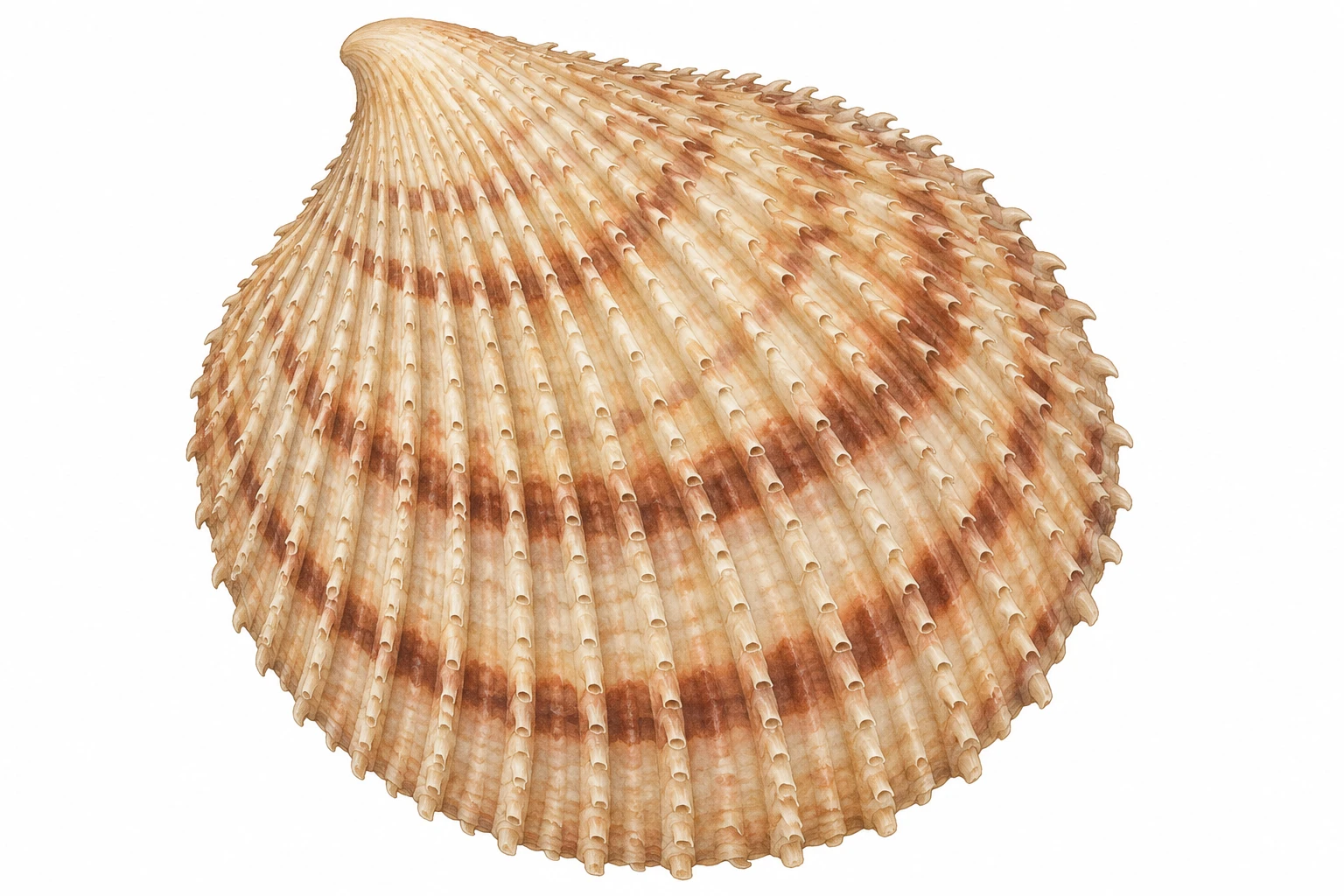
A rounded, inflated shell with rows of little scales gives this cockle a rough texture. The silhouette and rib shape matter more than any single color.
One fun thing to know
The ribs may retain their spiky scales even on shells with very little pigment. An all-white individual has been recorded at Blind Pass.
I saw this and want to share
To share this guide with a dive buddy, copy the page link.
How to identify it
- Rounded, inflated shell with a near-central hinge peak
- About 27–32 raised ribs carry pointed scales
- Cream to gray outside with variable warm or purple patches; empty valves can be salmon-red inside
Where to look
Florida records include the southwest coast and Atlantic sites such as Coral Cove and South Hutchinson Island.
Size
Shell to about 2.6 in (67 mm).
What it eats
Filter feeder: the gills trap suspended microscopic food such as plankton and organic particles.
Behavior
Cockles live shallowly in sand and use a muscular foot to dig. Avoid digging up an animal to examine its underside.
Reproduction
Marine bivalves commonly develop through free-swimming larvae before settling; Florida spawning dates for this species were not verified.
Look-alikes
Yellow prickly cockles are typically more oval; a large Atlantic giant cockle has broad rounded ribs rather than these sharp scales. Shell wear can erase the scale tips.
Can you collect or eat it?
Observe and leave in place. Check the Florida Fish and Wildlife Conservation Commission’s shell-collecting rules and local protected-area restrictions before removing a live shell.
Check current species and site rules before collecting. This guide does not establish permission to collect.
Make your next dive happen
Dive with Stuart Scuba · Train with us · Travel with us · Shop with us



