


← Back to South Florida Fish ID
Florida Cone
Conus anabathrum · Conidae
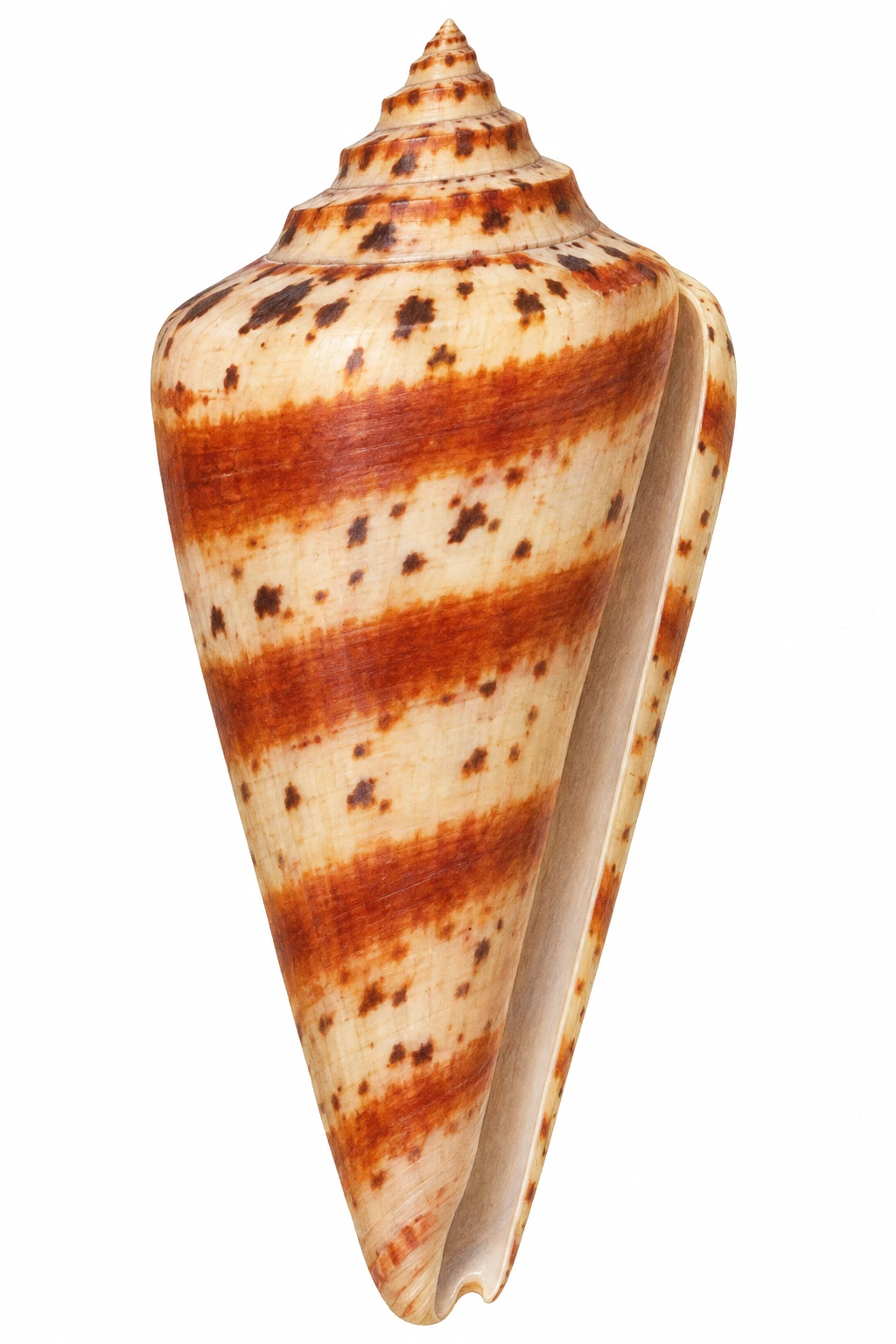
The Florida cone has a relatively tall spire and a narrow opening. Its background can be cream to tan, with darker bands or spots. Observe without touching.
One fun thing to know
Florida cones can lay spoon-shaped egg capsules inside an empty pen shell.
I saw this and want to share
To share this guide with a dive buddy, copy the page link.
How to identify it
- Taller stepped spire compared with the alphabet cone
- Often broad chestnut or orange-brown zones on a pale background
- Long, narrow opening and tapered base
Where to look
It occurs in Florida coastal waters. A record from one coast is not evidence of a sighting at a particular dive site on the other coast.
Size
The shell can reach about 5.4 cm (2.1 in).
What it eats
Predatory; it uses venom to capture prey. A dependable local prey list is not established here.
Behavior
Moves on sandy and vegetated shallows and can shelter beneath the surface. Do not probe the substrate for it.
Reproduction
Produces elongated, spoonlike egg capsules, sometimes attached inside empty shells.
Look-alikes
Alphabet cone more often has rows of isolated marks and a low spire. A beach-worn specimen may need close expert examination.
Can you collect or eat it?
Venomous cone snail. Do not handle a live animal or put a shell of uncertain occupancy in a pocket. Photograph it in place; this is not a harvest recommendation.
Check current species and site rules before collecting. This guide does not establish permission to collect.
Make your next dive happen
Dive with Stuart Scuba · Train with us · Travel with us · Shop with us



