


Fish identification archive / Raja Ampat
Five-Lined Snapper
Lutjanus quinquelineatus
Raja Ampat field guide
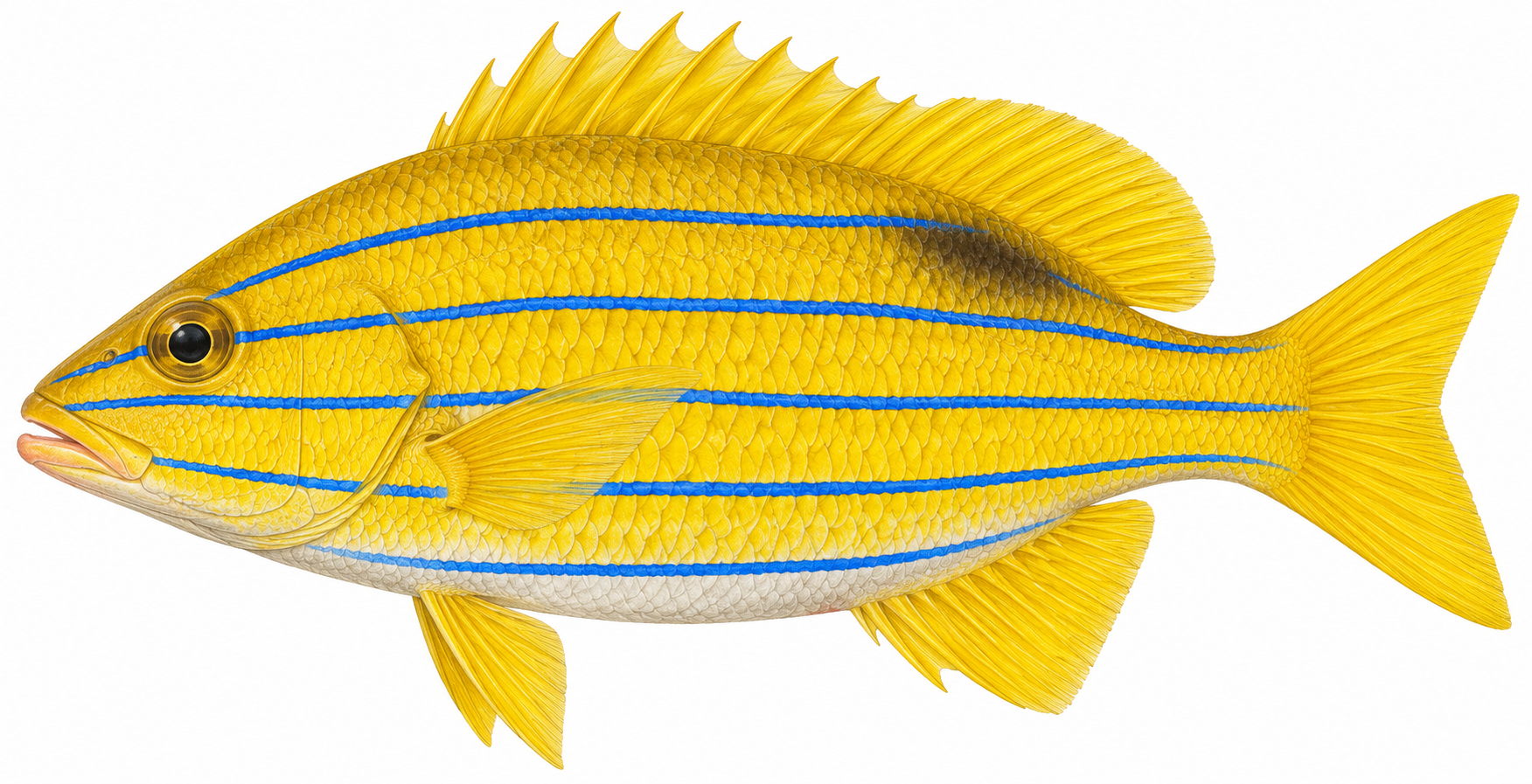
Two things to tell your dive buddy
- The fifth line is an important separator from similarly coloured snappers.
- Its posterior dark mark can appear diffuse; stripe count and spot position are best used together.
How to identify it
Yellow snapper with five narrow blue side stripes and usually a diffuse dark mark high on the rear flank.
Habitat and where to look
Sheltered reef lagoons and exposed outer slopes.
Daily habits and behavior
Can gather in large aggregations.
What is on the menu?
Fishes and invertebrates.
Mating and the next generation
Spawning over much of the year, with a summer peak, is reported from New Caledonia; this is not a Raja Ampat calendar.
Look-alikes and identification traps
Bluestripe snapper has four blue side stripes rather than five.
Try this observation
From a steady position, choose one fish and follow all five lines rather than trying to count across a moving school.
Raja Ampat occurrence
Recorded in Raja Ampat; regional occurrence does not promise a sighting on a particular dive. This guide does not imply that every site, itinerary or season offers the same chance of an encounter.
Observe, do not disturb
Keep a respectful distance, leave the animal an unobstructed route and follow your dive guide. Do not touch, feed, chase or collect wildlife. Identification does not establish permission to harvest or food safety; Florida harvest labels do not apply to this Indonesian guide.
Sources and review
Reviewed November 18, 2026.
- Allen & Erdmann: Bird’s Head reef-fish checklist, Raja Ampat records
- Scientific reference 1 (fishesofaustralia.net.au)
- Scientific reference 2 (australian.museum)
- Scientific reference 3 (www.fao.org)
- Scientific reference 4 (efl.lk)
- Scientific reference 5 (fishesofaustralia.net.au)
- Scientific reference 6 (reefresilience.org)
Check the stripe count and rear blotch
Look for five narrow blue lines on a vivid yellow side. A dark smudge high on the rear flank is a useful second clue when another fish blocks part of the stripe pattern, but the smudge is not equally clear on every fish.
Use SDI Reef Fish Identification to practice comparing similar schooling fish one individual at a time.
Make your next dive happen
Dive With UsTrain With UsExplore the Raja Ampat tripShop With Us
Questions? (772) 600-8288 or info@stuartscuba.com.




