


Indo-Pacific Cushion Sea Star
Culcita novaeguineae · Oreasteridae · Sea star · Palau Fish ID
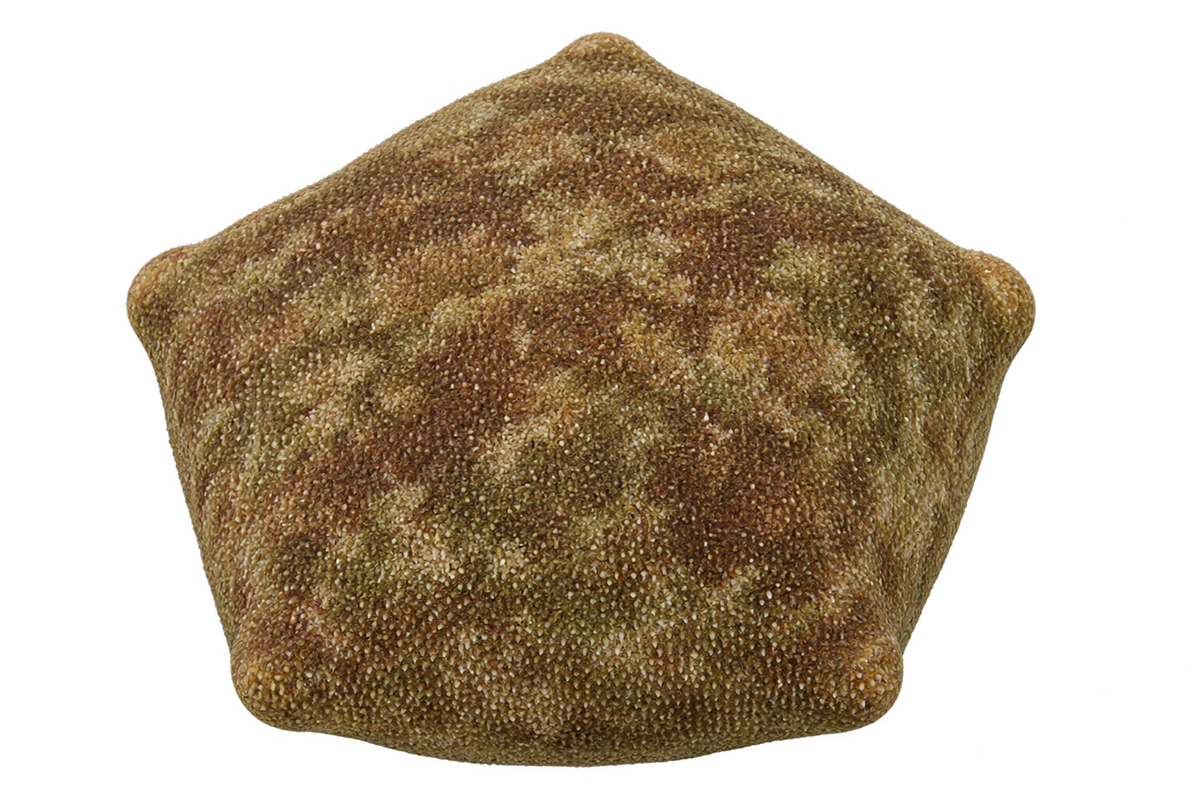
If you spot what looks like a small, five-cornered cushion lying near a coral patch, take another look. A grown Indo-Pacific cushion star is so plump that its arms are easy to miss. The rounded shape is the clue, not an odd sea cucumber growing five corners.
How to recognize it
Look for a raised, rounded body with five subdued corners. The back of the adult has a fine, textured surface. Palau specimens described by the collector had little cone-shaped projections. They were nothing like the prominent dark pegs that make a chocolate-chip sea star so easy to recognize.
Where to look in Palau
Palau field records place adults on sand near coral patches at Ngerameayus and south of Aulup tagel. The Ngerameayus specimens were collected at about a meter deep. Watch the open space between coral patches as well as the coral itself. That is where a low, rounded animal can blend into the terrain.
Size and life stages
One Palau specimen measured about 4 inches (10 cm) from the center to an arm corner. That is a specimen measurement, not its full width or a species maximum. Looking from the side is useful because the height changes the impression of size.
What it does all day
Field observations and feeding experiments identify this sea star as a coral eater. In a Hawaiian study, researchers compared coral traits to understand why the stars favored some prey over others. A study in Mo’orea observed most feeding activity at night. Neither observation predicts what a Palau individual will be doing on any particular dive.
The next generation
Young cushion stars can be flatter than adults. An adult drawing captures the inflated shape, not everything a small star will look like. If a low, flat animal doesn’t match other clues, keep the ID provisional rather than forcing it into this profile.
Look-alikes
The cushion-shaped Atlantic sea star in our guide is a separate species. The local reef and the small, dense texture help sort photographs afterward. In Palau, a sea star with longer arms and large individual knobs is a better fit for a chocolate-chip sea star.
Try this on your next dive
Photograph it in profile as well as from above. One shows the padded shape, the other shows the corners. If it is on coral, no need to lift it to see whether it is feeding. A steady hover keeps the view clear and the sand undisturbed. For practice, consider the SDI Advanced Buoyancy Control.
Six things to notice
- The five corners are easy to miss on a well-rounded adult.
- Palau specimens had small pointed projections, not broad dark knobs.
- The adults were seen on sand near coral patches in the Rock Island survey area.
- Part of its diet can be living coral tissue.
- In one Mo’orea study, the stars did most of their feeding at night.
- Experiments in Hawai‘i compared how different corals affected feeding choices.
Keep looking through the Palau Fish ID guide, or explore our international group dive trips.




