


Fish identification archive / Raja Ampat
Copperband Butterflyfish
Chelmon rostratus
Raja Ampat field guide
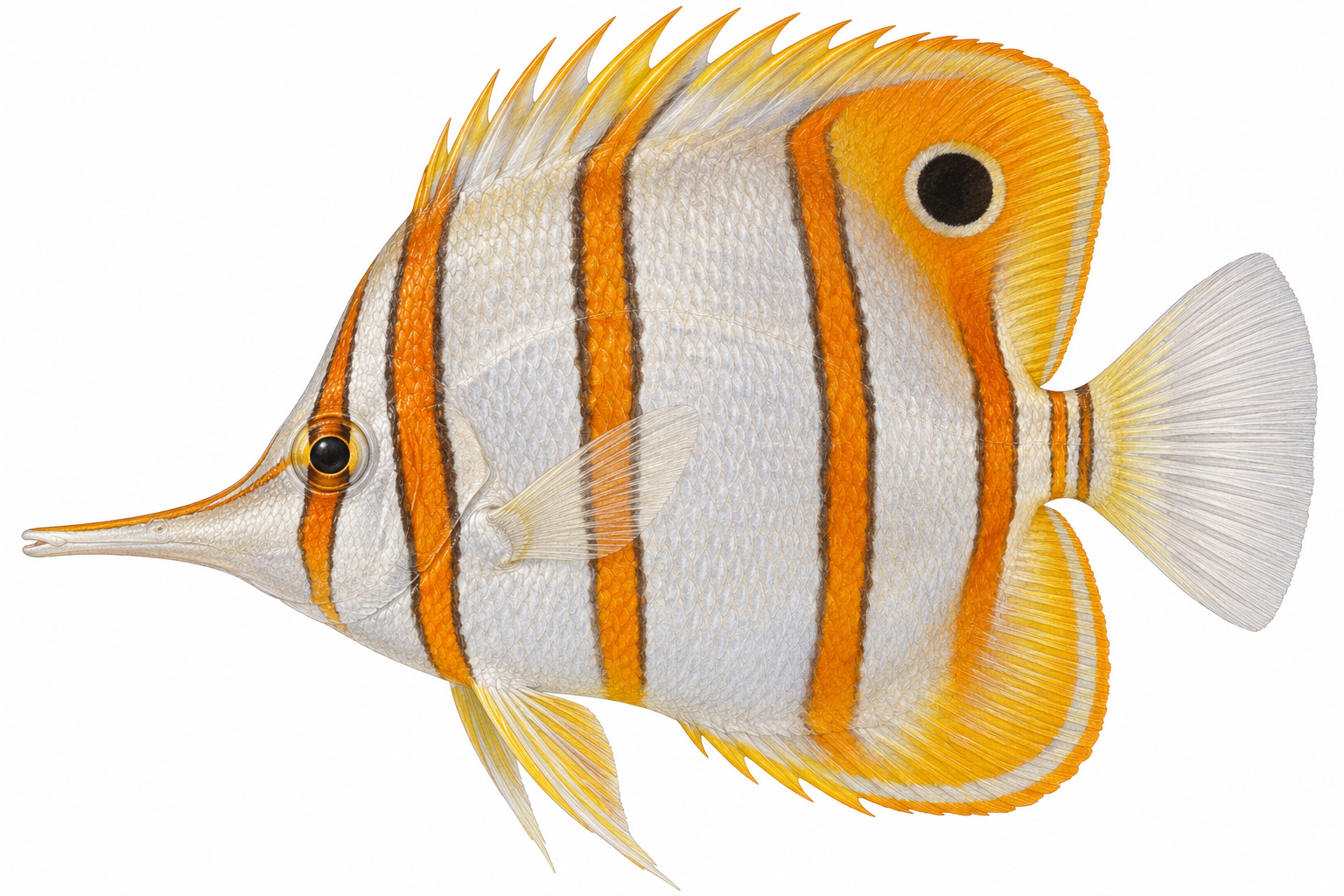
Two things to tell your dive buddy
- The long adult beak develops after the larval fish settles on a reef; the distinctive tool is not present throughout its early life.
- It eats small invertebrates. The eye bar and the separate dorsal eyespot are different markings, so locate the real eye before deciding which end you are watching.
How to identify it
Very long narrow snout, orange vertical bars on a pale body, and a dark eyespot high on the rear dorsal fin.
Habitat and where to look
Shallow coastal reefs, bays and estuarine reef habitats.
Daily habits and behavior
A close observer can follow the snout as it investigates the reef. Let it choose its own route rather than pushing it from a crevice.
What is on the menu?
Small invertebrate prey. Its narrow mouth and long adult snout make the feeding apparatus especially distinctive.
Mating and the next generation
Butterflyfish family context: eggs are released into open water, and the larvae spend an early drifting stage away from the adult reef habitat. This is not a Raja Ampat spawning-calendar prediction.
Look-alikes and identification traps
Long-snouted butterflyfishes need more than a beak for identification. Confirm the orange vertical bands, dorsal eyespot and pale body together.
Try this observation
Watch the angle of the snout during feeding and record where it probes without disturbing the substrate.
Raja Ampat occurrence
Recorded in Raja Ampat; regional occurrence does not guarantee an encounter on a particular dive. This guide does not imply that every site, itinerary or season offers the same chance of an encounter.
Observe, do not disturb
Keep a respectful distance, leave the animal an unobstructed route and follow your dive guide. Do not touch, feed, chase or collect wildlife. Identification does not establish permission to harvest or food safety; Florida harvest labels do not apply to this Indonesian guide.
The spot on the back is not the eye
The real eye sits near the long, narrow snout. The round black mark sits much farther back on the dorsal fin, above the tail area. In a side view, that separation and the orange bars are more useful than the eyespot alone.
SDI Underwater Photographer course: Practice composing a side view that shows both the snout and the rear fin.
Sources and review
Reviewed November 18, 2026.
Make your next dive happen
Dive With UsTrain With UsExplore the Raja Ampat tripShop With Us
Questions? (772) 600-8288 or info@stuartscuba.com.




