


← Back to South Florida Fish ID
Common Remora
Remora remora · Echeneidae
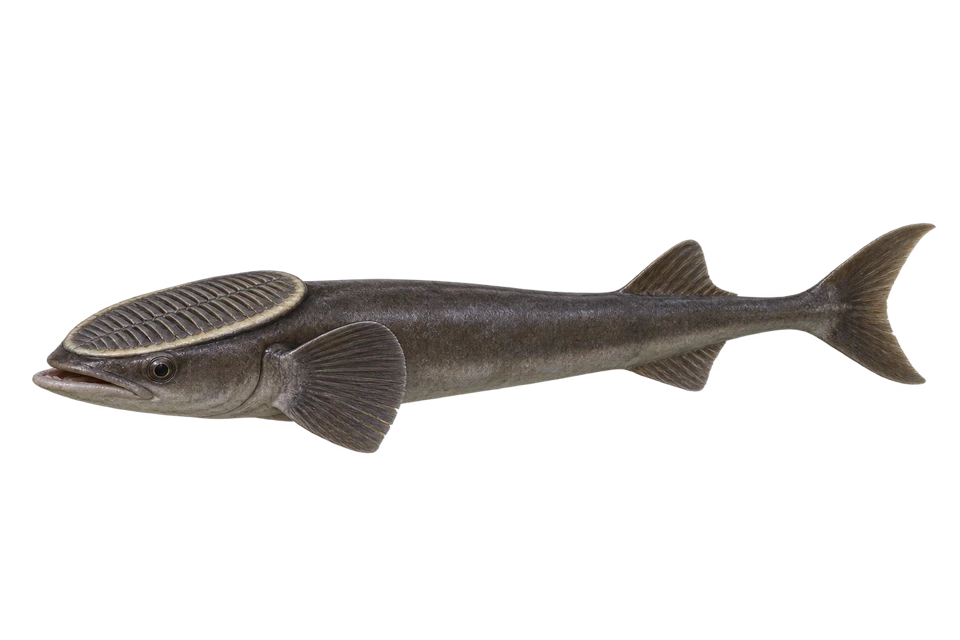
Check for the oval suction disc on top of a flattened head and a body without a strong lengthwise stripe.
One fun thing to know
The adhesive disc is a modified dorsal fin moved forward to the top of the head.
How to identify it
- The broad ridged head disc reaches roughly to the end of the rounded pectoral fin.
- A projecting lower jaw sits under a flattened head. The body is usually fairly uniform gray or brown.
- The rear fins oppose one another and the tail has a clear concave edge.
Where to look
Open water, often attached to sharks and sometimes to other large fish, rays or turtles. A Smithsonian collection record documents the species at Matecumbe in the Florida Keys.
Size
33.9 in (86 cm). reported length; measurement convention not stated in the cited field account.
What it eats
Eats prey that can include zooplankton, small fish and external parasites.
Behavior
Look for it riding a passing host; allow both animals to move freely. Do not try to peel off an attached fish.
Reproduction
Eggs and larvae drift in open water. This guide does not establish a local spawning season.
Look-alikes
The slender Sharksucker often shows a conspicuous dark side stripe. A pilotfish may follow similar hosts but has bold vertical bars and no head disc.
Can you collect or eat it?
Enjoy watching it and leave it in the water. This guide does not verify species-specific harvest or food-safety rules. Check the current rules for the exact location, species and method before taking anything, and never collect where prohibited.
Check Florida’s current saltwater rules
Field references
- REEF field survey reference 1
- Smithsonian Shorefishes reference 2
- Smithsonian Shorefishes reference 3
- fws.gov reference 4
- collections.si.edu reference 5
I saw this and want to share
Make your next dive happen
Dive with Stuart Scuba · Train with us · Travel with us · Shop with us



