


Camouflage Grouper
Epinephelus polyphekadion
Two details worth remembering
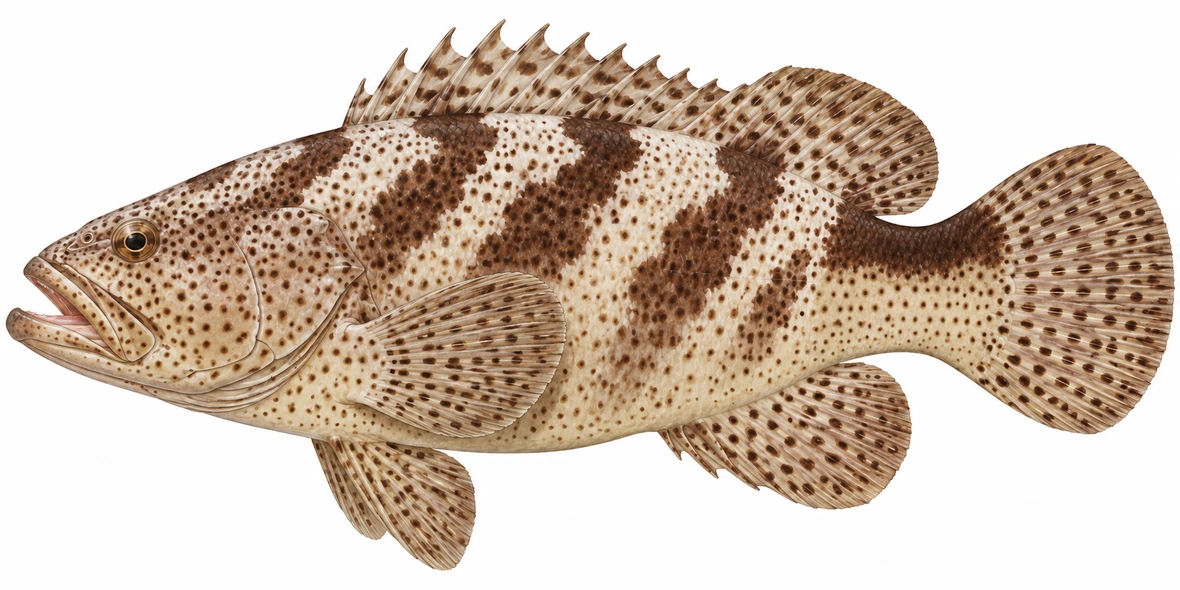
- The look-alike problem is real: camouflage and brown-marbled groupers are regularly confused, but the former has stronger oblique bands and a larger tail-base saddle.
- Reproductive gatherings are a temporary concentration of fish, not proof that a reef supports those numbers all year.
How to identify it
A pale-brown, finely spotted grouper with larger dark blotches forming oblique bands and a conspicuous dark saddle on the upper tail base.
Where to look
Coral-rich lagoons and outer reefs, particularly island and atoll settings. Scan the whole outline rather than only the spot pattern, which visually breaks up the body against reef structure.
Natural history
An aggregation-spawning species studied in eastern Indonesia. Reproductive behaviour and sexual pattern should be stated from species-specific work, not assumed from the general reputation of groupers as sex-changers.
Look-alikes
Brown-marbled grouper has a smaller tail-base saddle and less clearly oblique bands. Fin-ray counts can help specialists but are rarely practical for divers.
What to watch for underwater
Photograph the entire fish, including the tail base, and compare it with brown-marbled grouper before entering the sighting.
Recorded in Raja Ampat
This species has a published Raja Ampat record. A regional record does not guarantee a sighting on a particular dive.
Sources: fishesofaustralia.net.au species reference · Regional survey record · pmc.ncbi.nlm.nih.gov species reference
I saw this and want to share
Back to Raja Ampat Fish ID · Dive Raja Ampat with Stuart Scuba




