


Burro Grunt
Rhonciscus crocro · Haemulidae
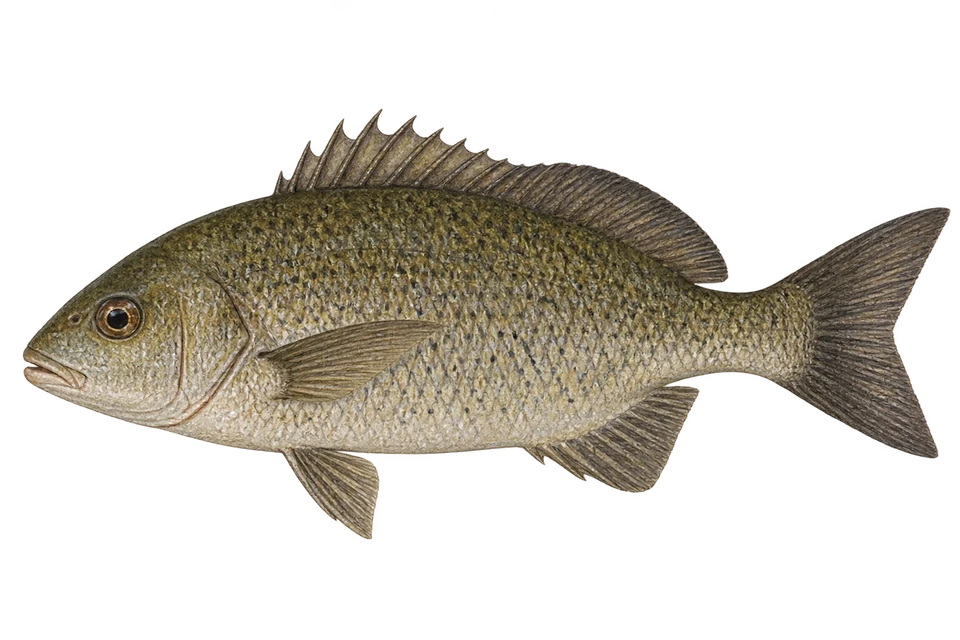
Check an olive-silver fish for scattered dark flecks and a dark edge on the soft rear part of the back fin.
One fun thing to know
This grunt makes use of turbid inshore water and can also occur in rivers.
How to identify it
- Elongate and sturdy with olive above and silver below.
- Dark specks and dusky fins, with a dark margin on the soft dorsal.
- Young fish can show subtle wavy stripes rather than adult speckling.
Where to look
Often shallow, murky water over soft bottom or vegetation, including estuarine and river-influenced areas.
Local record: This fish has been recorded in REEF surveys at Blue Heron Bridge (Phil Foster Park), Riviera Beach. A local record is not a guarantee of a sighting.
Size: Up to about 13.0 in (33 cm) in the cited account. This is a published upper size, not what to expect on every dive.
What it eats
Small fish and bottom-dwelling crustaceans are among reported prey.
How it behaves
Silty water can hide the speckles; wait for the fish to turn side-on.
Reproduction
Eggs and larvae are pelagic; the survey does not locate a spawning ground.
Look-alikes
Unlike showier striped grunts, adults are a subdued olive or silver. A poor view of a juvenile may not be enough for an ID.
Can you collect or eat it?
Enjoy watching it and leave it in the water. This guide does not verify species-specific harvest or food-safety rules. Check the current rules for the exact place, species and method before taking any fish.
Check Florida’s current saltwater rules
Field references
I saw this and want to share
Make your next dive happen
Dive with Stuart Scuba · Train with us · Travel with us · Shop with us



