


Brown-marbled Grouper
Epinephelus fuscoguttatus
Two details worth remembering
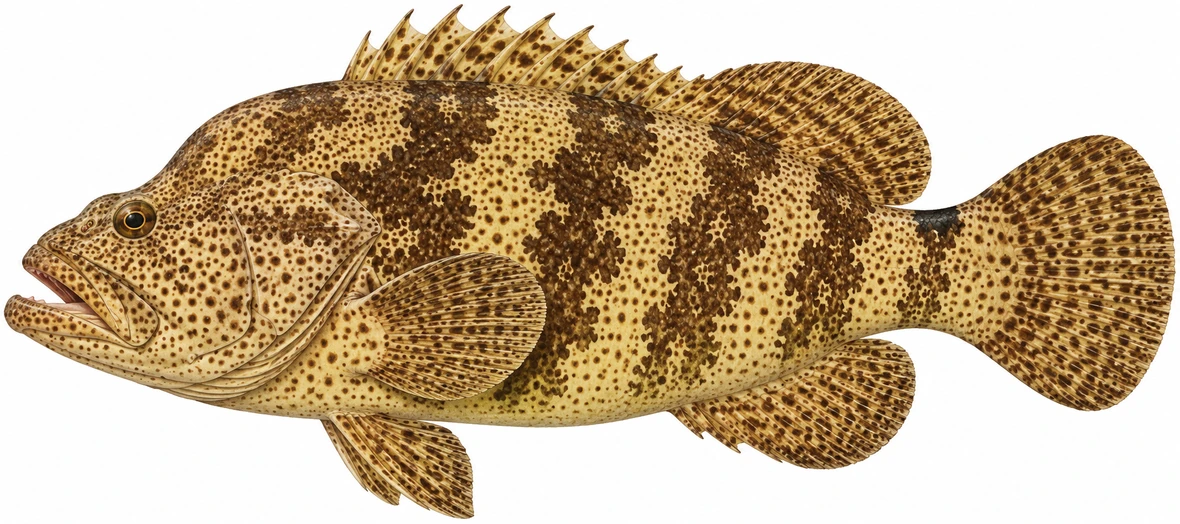
- The small dark saddle above the tail is easy to overlook but helps distinguish this fish from the similar camouflage grouper.
- A large gathering is not automatically a permanent resident school. Reproductive aggregations can concentrate fish that normally occupy a much wider area.
How to identify it
A large, heavy grouper with many fine brown spots, irregular dark blotches arranged in roughly five vertical series, and a small dark saddle on top of the tail base. Adults have a distinct indentation near the eyes followed by a convex forehead.
Where to look
Coral-rich lagoon pinnacles, channels and outer slopes. Juveniles can use seagrass habitat. The same species therefore connects sheltered nursery grounds with larger reef structures.
Natural history
Forms spawning aggregations. A five-year Komodo study found variable seasonal and lunar aggregation patterns; those dates should not be advertised as a Raja schedule.
Look-alikes
Camouflage grouper has clearer oblique bands and a larger dark patch on the tail base. A close view of the whole pattern is better than matching a single spot.
What to watch for underwater
Compare the head profile, tail-base saddle and overall blotch arrangement in one photograph.
Recorded in Raja Ampat
This species has a published Raja Ampat record. A regional record does not guarantee a sighting on a particular dive.
Sources: fishesofaustralia.net.au species reference · Regional survey record · hub.hku.hk species reference
I saw this and want to share
Back to Raja Ampat Fish ID · Dive Raja Ampat with Stuart Scuba




