


Bluestreak Goby
Valenciennea strigata · Gobiidae
Six things worth noticing
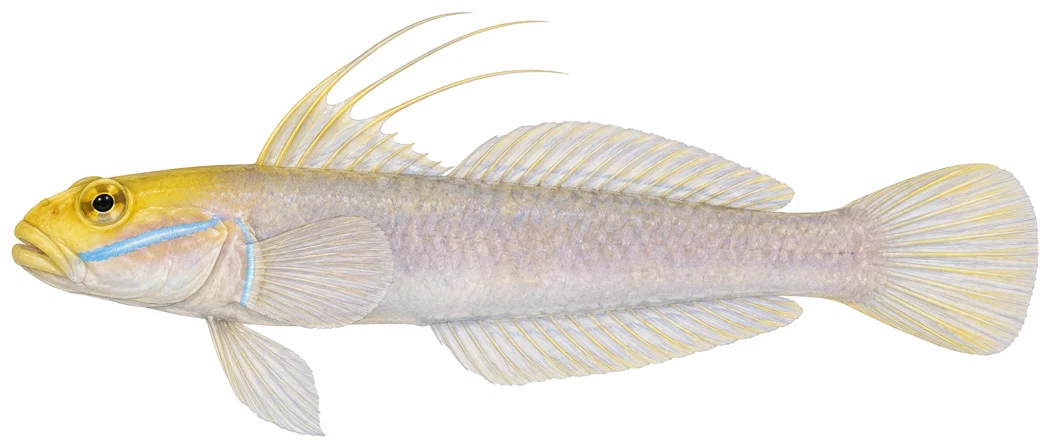
- Look for a yellow head and a blue cheek line against an otherwise pale body. The combination matters more than any one color.
- A feeding goby takes in a mouthful of sand and sorts out tiny animals, then lets the sand spill back out.
- Pairs in one field study often stayed together through several broods, close to their shared burrow.
- In that study, males spent more time maintaining the burrow while females spent more time feeding.
- The male also guarded eggs inside the burrow for two to three days in that study. An empty-looking entrance doesn’t mean the burrow is unused.
- Both partners tended to stay around the same patch. If you see one fish feeding, wait and watch the same area for its partner.
How to identify it
The head is yellow with a bright blue streak across the cheek. A second, fainter mark can cross the pectoral-fin base. The body is much paler than the head.
What to watch for underwater
Pairs hover near a burrow and take mouthfuls of sand to sift out food. Eggs are laid in the burrow, where the male guards them. Wait for a natural feeding pass to see the cheek mark clearly. Watch the sand next to the opening and let the fish come into view on its own. This is a good use of the quiet hover you practice in Advanced Buoyancy Control: a fin kick can obscure the cheek stripe and the very behavior you’re waiting to see.
Where it has been recorded in Raja Ampat
REEF divers have reported this species at Kalig Kecil near Misool in Raja Ampat. The site record establishes local occurrence.
Field notes
- Family
- Gobiidae
- Field-guide group
- Goby
- Reported maximum length
- 18 cm total length
- Also listed as
- Blueband Glidergoby, Blueband Glider Goby, Blueband Goby, Golden-head Sleeper Goby, Golden-head Sleeper-goby, Golden-headed Sleeper
On our dives: Observe and photograph. Give wildlife room to move and leave it where you found it.
Compare field guides
I saw this and want to share
Back to all Raja Ampat species · Dive Raja Ampat with Stuart Scuba




