


Blue Trevally
Ferdauia ferdau
Two details worth remembering
- Young fish can shelter among large jellyfish tentacles. A jellyfish can therefore be temporary cover as well as a drifting animal in its own right.
- The upper jaw is strongly protrusible, an important feeding feature in a fish that takes much of its prey near the bottom.
How to identify it
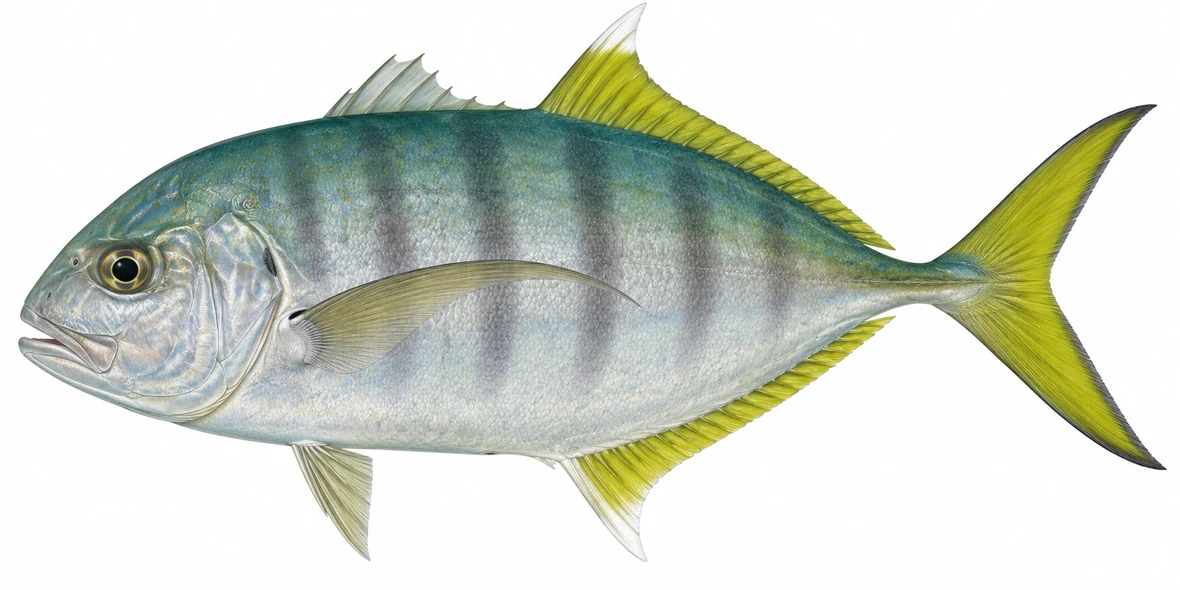
A blue-green to yellow-green trevally with a silver underside and five to seven broad dusky side bars. Gold speckles may be faint. The snout is blunt and the pectoral fins long and curved.
Where to look
Sandy coastal areas beside reefs, lagoons and estuaries. It can travel in large, wide-ranging schools. Do not confuse this habitat description with a local abundance estimate.
Natural history
Mostly bottom crustaceans and molluscs, with some small fishes.
Look-alikes
Bluefin trevally Caranx melampygus is a separate species. Avoid the ambiguous shortcut “blue jack”; record the broad bars and head shape.
What to watch for underwater
Watch a passing school for broad bars and the blunt head profile; compare these with the small blue spots of bluefin trevally.
Recorded in Raja Ampat
This species has a published Raja Ampat record. A regional record does not guarantee a sighting on a particular dive.
- Also listed as
- Carangoides ferdau
Sources: fishesofaustralia.net.au species reference · Regional survey record · australian.museum species reference · doi.org species reference
I saw this and want to share
Back to Raja Ampat Fish ID · Dive Raja Ampat with Stuart Scuba




