


The Unglamorous Side of Owning a Dive Shop
Benjamin Hadfield Oct 29, 2026
The Unglamorous Side of Owning a Dive Shop
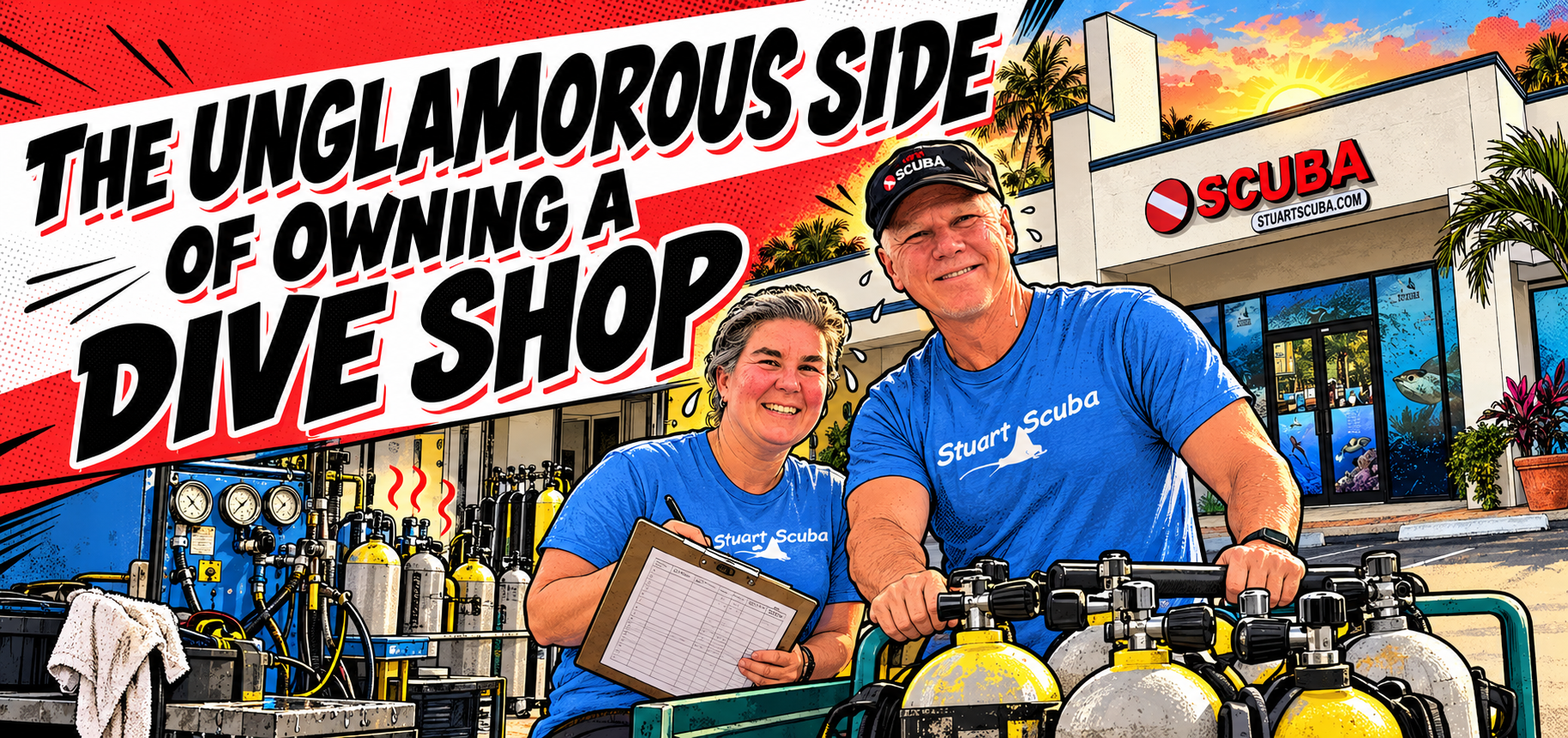
People sometimes think owning a dive shop means endless summer, drinks on the beach, and diving whenever the mood strikes.
The beach part is real. So are the tanks, invoices, inventory, wet gear, and all the things that have to happen before anyone gets to see a reef, wreck, or lobster.
Stay with me. The challenges grow in intensity—not because they’re more dramatic, but because I’m saving the glamorous part for last.
The tank-filling sweat factory
Many summer mornings, I’m at the shop around 5 a.m. Mondays tend to arrive earliest. I put on workout clothes, head in, and get a jump on the week.
The tanks from the weekend are waiting. Customer tanks, boat tanks—every one of them needs to be checked and filled. We’re fortunate to have a roll-up door, big fans, and a cold dunk tank. We’re also fortunate to have two compressors that can fill at nearly 60 CFM together.
Those compressors are excellent at making breathing gas. They’re also excellent at making heat.
The fill room tells me a little about the week ahead: what came back, what needs attention, and what the boat will need. Sometimes a tank fill comes with a question or a request. I try to listen carefully, because that small conversation can tell us how to serve someone better next time.
That’s why I like to get started before the Florida sun joins the operation. By midmorning, the fill room can feel less like a workplace and more like an extremely specialized sauna with a lot of valves.
A day on the boat is still a workday
There was a time when I could show up about 30 minutes before a trip, find my gear and tanks on the boat, and go diving.
That time has passed.
Now there’s loading, carts, tanks, gear, and the working end of the whole operation. It’s a little like being a hotel porter, except the bags are heavier and nobody has ever tipped me in tiny soaps.
Every once in a while, I’ll show up quietly and tell the crew I’m here for a day of “aqua therapy.” That may be true. It also comes with the crew’s reports, the day’s questions, and the occasional risk report. I listen to what the crew saw and what the divers experienced. If something was unclear or didn’t go as smoothly as it should, I want to know while the details are still fresh.
Relaxing in the water is lovely. Running the boat still has a job description.
Retail: where the fun meets the spreadsheet
A dive shop can feel like five businesses under one roof. Retail is one of the hats I wear, and it comes with a steady stream of small questions.
What should we stock? How much? Do we have it in the right size? Is the inventory system accurate? Did a manufacturer start a sale today and lower the advertised price without changing what it costs us? Is someone online selling the same gear for less?
Most manufacturers set a MAP price—the minimum advertised price. It helps keep prices fair and consistent, though it doesn’t make the internet behave. We work hard to price gear fairly and use MAP when it applies rather than MSRP. About 99% of the time, customers will see the same price online that they see from us.
Every so often, someone visits the shop, checks out a product, gets the dimensions, and buys it online to save five dollars.
I try not to take that personally. I really do.
The funny part is that I probably would have matched the price. The less funny part is that I’m standing there holding the tape measure, thinking, “Well, at least we got to spend some quality time together.”
We also keep a broad selection of equipment, because people come in with different needs and different bodies. The conversations at the counter help us understand what people are looking for, what fits, and what questions keep coming up. That matters when we decide what to stock. It also means tying up money in inventory before it ever leaves the shelf.
When winter slows down, the bills don’t get the memo. Replacing dive computers can still make a six-thousand-dollar order feel like a very personal conversation with the bank account.
Winter is also when manufacturers start talking about spring and fall orders. They want us to plan ahead, place orders, and stock up for next season. In other words, when the shop is quieter, that’s when we’re asked to become a warehouse for the busy months ahead.
That’s retail. I promised we’d get to diving.
Take a break from my spreadsheets
Test your dive knowledge with Stuart Scuba’s Daily Scuba Trivia →
Procedures, people, and Florida heat
We review our procedures regularly and look for ways to do things better. That doesn’t mean making every simple task complicated. It means making sure the right people are on the right dives, the safety pieces are in place, and all the moving parts move the way they should.
Easy? No. Worth doing carefully? Every time.
We have shop staff and boat staff, and they aren’t always in the same place—or thinking about the same part of the day. Add Florida heat, a busy schedule, and a lot of people trying to help, and communication can occasionally take the scenic route.
Both groups care about the customers and want them to have a safe, enjoyable day. They’re usually working toward the same thing, even if they start from different ends of the problem. I need to listen to both sides, understand what each group is seeing, and make sure useful information gets where it needs to go. Sometimes the fix is a clearer explanation. Sometimes it’s a change to the way we do something.
The puzzle master and the heavy loads
My job as a dive shop owner isn’t in the water. It’s being the puzzle master—and, apparently, the carrier of heavy things.
I spend a lot of time listening to customers, crew, and staff, then gathering the details and trying to make something useful out of them. What happened? What did the customer understand? What did the crew see? Is this a one-time problem, or have we heard the same thing three times this week?
Not all useful information arrives in a spreadsheet. Some of it comes from a question at the counter, a comment on the boat, or a staff member saying, “There’s a better way to handle that.” I try to pay attention to those conversations, because they can point to a better process, a safer decision, or a clearer explanation.
The people are the best and hardest part of the business. When a customer has a great day, earns a certification, or finds the gear that fits, it’s a privilege to be part of that. When expectations don’t match—about the boat, a course price, or what’s included—we have to slow down, listen, and work through it. If we haven’t explained something clearly, we need to own that and make it right.
We try to make safety, training standards, and basic decency the starting point, not the finish line. If an agency allows six students, we keep our class to four. If a customer wants a full tank, we use the cold dunk tank to help make sure it leaves at the pressure they’re expecting. It’s a small detail, but a tank that’s ready to go is a good way to start a dive.
A good dive shop is a bit like a duck. The customer sees us gliding along on the surface. Underneath, there’s a lot of paddling—and occasionally somebody is trying to remember where the clipboard went.
Why we keep doing it
Nikki and I believe in the people here, the work we do, and the customers who trust us with their training, their equipment, and their time. We show up, listen, and do what we said we would do.
I’m especially grateful for Nikki. She’s my humble and fearless wife, my partner in the shop, and the person who will patiently listen to one of my harebrained ideas—or let me try to explain the data in one of my 500 spreadsheets.
Some of those explanations take longer than the spreadsheet deserves.
Our partnership is what keeps me going. Why she puts up with me remains a mystery, and I’m grateful nonetheless. I’m not sure I want to investigate too closely in case we uncover a reason.
Lucy, our little white dive shop dog, has a simpler job. She watches the front door, keeping an eye out for treats and belly rubs. She has no interest in my spreadsheets, inventory, or business plans. Lucy knows what matters.
My dad used to say, “We don’t quit when we’re tired. We quit when it’s done.”
I tell the staff that they may be younger, smarter, stronger, and better-looking than me—but, damn it, they’ll never outwork me. Nikki and I lead from the front, and we work hard to serve the people who make this shop what it is.
My dad also said to work smarter, not just harder. When I teach, I tell students to question everything. If I can’t explain why we do something—or explain it so my 11-year-old grandson would understand it—we need to review it. And if we find a better way, we should test it.
That applies to the business, too. A process isn’t sacred just because we’ve always done it that way. We’ll listen, discuss it, try to improve it, and keep what works.
So what’s the unglamorous side of diving?
Mostly, it’s the stuff that happens before the bubbles start: early mornings, late nights, heavy tanks, hot rooms, inventory, planning, and time spent solving problems instead of diving.
But once the bubbles start, it’s game on. Three-foot seas or the Atlantic laid out like a lake, it doesn’t matter much to me. Get me in the water, and I’m happy.
My favorite dive is still the next one I get to do.
Check the dive report
Before your next dive day, check the Stuart Scuba Weather Center → for the current seven-day marine and dive forecast.
Plan Your Next Dive with Stuart Scuba
Dive With Us
Explore upcoming local charters and choose a dive that fits your experience.
Before you book
Check the individual listing for departure time, requirements and availability.
Travel With Us
Find upcoming dive adventures and start planning your next trip.
Plan your trip
Review dates, inclusions and trip details on the travel calendar.
Stay Connected with Stuart Scuba
 Follow pageShare
YouTube
SubscribeWatch & shareFollow on InstagramView & share post
Follow company news, training updates, and dive stories.
Follow on LinkedInGoogle Reviews
See Stuart Scuba’s current Google rating and review count below. Open the listing in Google Maps to browse customer reviews.



