


Ear Pain After Scuba Diving? Why the First Few Feet Matter
Benjamin Hadfield Nov 07, 2026
Ear Pain After Scuba Diving? Why the First Few Feet Matter
By Benjamin Hadfield, Technical Instructor Trainer at Stuart Scuba in Stuart, Florida
Surveys cited by Divers Alert Network (DAN) suggest that more than half of divers have had ear squeeze at least once. An ear that won’t clear can end a dive. Keep descending, and you can turn pressure into an injury.
An equalization guide developed by DAN Southern Africa, DAN Europe, and DIVEIN reported these survey results.
- The guide described 89% of respondents as equalizing incorrectly. The published summary leaves how it assessed technique unclear.
- 29% said trouble clearing their ears kept them out of the water for weeks or months.
- 6.3% reported permanent ear damage tied to equalization problems.
The first warning can come within a few feet of the surface. You jump off the boat and start down with your buddy. Both ears start to feel tight. You try to clear them, but the pressure builds into a deep ache. One ear might hurt worse, with a sharp, stabbing pain that feels like it’s coming from the side of your head. That’s what ear squeeze can feel like. A sharp pain between your eyes or across your forehead can be sinus squeeze.
If you’re having trouble clearing, stop your descent. Signal your buddy and rise a few feet together under control, breathing normally. Once the pressure eases, try a gentle clear. If it still hurts or you can’t clear comfortably, end the dive together.
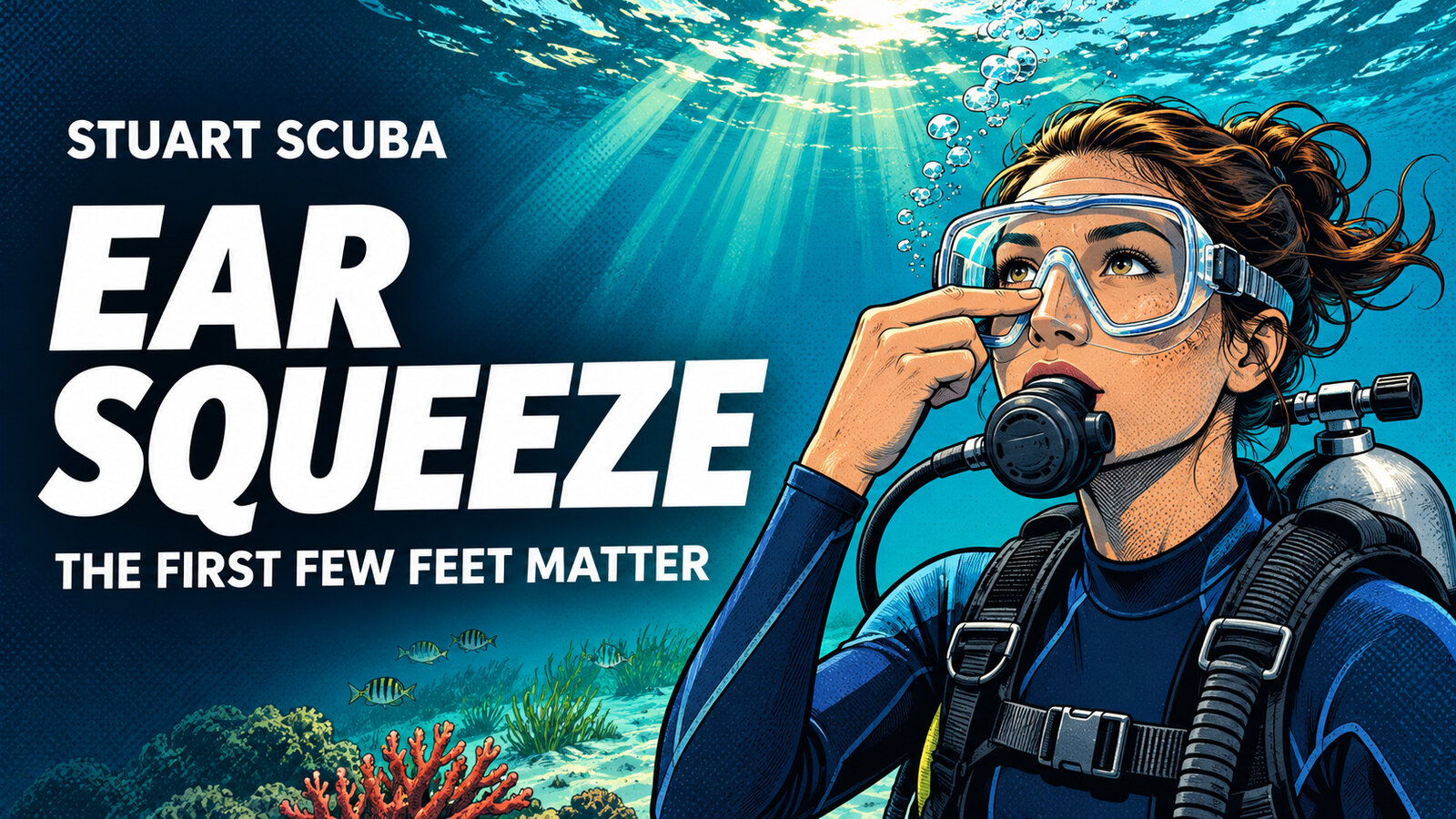
What causes ear squeeze in scuba diving?
Middle-ear barotrauma is a pressure injury. As you descend, water pressure rises. Your Eustachian tubes let air travel from the back of your nose and throat into the space behind each eardrum. If that air can’t get through, the pressure pushes the eardrum inward. That can cause pain, fluid buildup, bleeding, or a torn eardrum.
If a clinician recommends mineral oil to soften earwax, the oil works in the outer ear canal. The eardrum separates that canal from the middle ear, where you equalize pressure. If an ear feels plugged on land, have it checked before you dive.
How to practice clearing your ears before a dive
At Stuart Scuba, we encourage students to start practicing on land the week before a dive. When you’re feeling well, do a few short, gentle practice sessions a day. Try a swallow, a yawn, or the equalization technique you learned in class. Get familiar with the small click or release you feel when each ear opens. Stop if there’s pain.
The idea is to learn what works while you’re sitting in a chair with nothing else to do. Once you’re in fins with a mask full of water, you already have a few things to sort out.
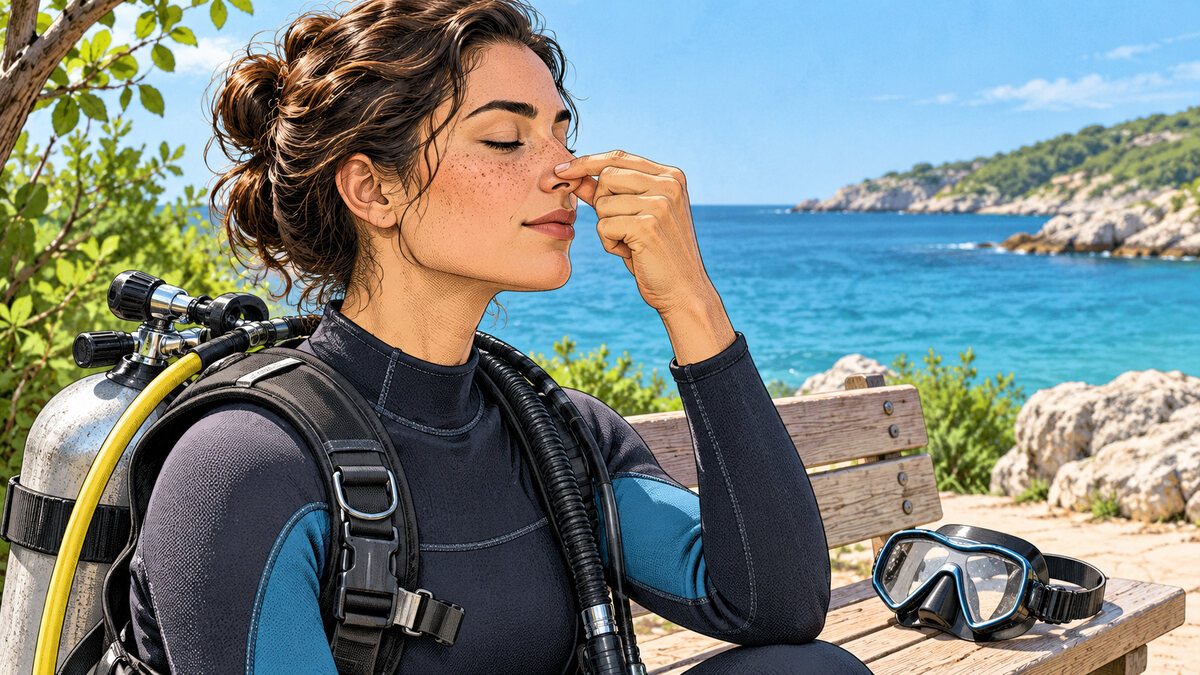
How long should you blow during a Valsalva?
Pinch your nose, tip your chin slightly up if that helps, and gently breathe out against the pinch. Release as soon as your ears clear or if it hurts. Five seconds is the most you should hold even gentle pressure.
We see students with clearing trouble try the Valsalva for a second or two. A second or two is plenty if your ears open. If they stay blocked, release the pinch and reset. Underwater, that means stopping the descent and easing the pressure before you try again. Blowing harder or holding pressure can injure the inner ear.
Other ways to equalize
- Swallow or start a yawn. Let your jaw move forward and down a little.
- Toynbee. Pinch your nose and swallow.
- Frenzel. Pinch your nose, close the back of your throat, and use your tongue to make a gentle “K” sound. An instructor can help you learn the motion.
A lot of divers get more consistent when they slow down, relax their jaw, and find a method that works for them. If either ear keeps giving you trouble despite gentle attempts, talk to an ear, nose, and throat clinician familiar with diving before your next dive.
When to equalize on descent and what to do if an ear won’t clear
- Start as soon as you go down. After a gentle clear at the surface, clear again as you begin descending. Keep doing it every few feet, especially over the first 10 to 15 feet, where the proportional pressure change is greatest. A shallow dive at Blue Heron Bridge counts. Descend slowly, feet first if practical.
- Stop and signal your buddy if an ear won’t clear. Breathe normally and rise a few feet under control to a depth where the pressure eases and you feel comfortable. For this first reset, stay with your buddy in the water column if you can safely hold that depth.
- Give yourself a moment. Drop your shoulders, unclench your jaw, and take a couple of normal breaths. Once the pressure eases, try a swallow or a gentle equalization.
- Continue only if both ears clear comfortably. If an ear still won’t clear, keeps blocking when you try to descend again, or starts to hurt, end the dive and surface under control with your buddy.
On our boat dives, you and your buddy descend together in open water. Stay close enough to see each other’s signals. Before you jump in, agree that if one of you stops on descent, both of you stop. Have that conversation on the boat, where you can talk without a mouthful of regulator. If you know you need a slow descent, tell the crew before you gear up so you can make a plan that fits the dive.
Can I take a decongestant before scuba diving?
If you get a little stuffy from recurring allergies, talk with a clinician familiar with dive medicine before the trip. A decongestant can reduce swelling, and it can also have side effects. If your clinician recommends one, try it on land first so you know how you respond.
Congestion can come back if a medicine wears off. Overusing some nasal sprays can also cause rebound congestion. On ascent, air behind the eardrum expands and needs a way out. When congestion traps that air, you can get a painful reverse block.
Sit out the dive if you have a cold or sinus infection, feel congested, have ear pain, or can’t clear both ears gently at the surface. If you need a decongestant just to get your ears to clear, call it for the day. If you’ve taken a decongestant for the first time, stay topside. The boat is a lousy place to find out how you react to a new medication.
When to get ear pain checked after diving
A sharp pain that suddenly goes away on descent can mean the eardrum has torn. Signal your buddy and end the dive safely.
Get your ear checked promptly if blood or fluid drains from it, or if the pain is severe or worsening. Get a medical evaluation if pain or fullness lasts more than a few hours. Keep ear drops out of an ear you may have injured.
Get urgent medical care for sudden hearing loss, new ringing, or vertigo, the feeling that you or your surroundings are spinning. If these happen underwater, signal for help and end the dive safely. Tell the clinician you were scuba diving and when the symptoms started. Inner-ear barotrauma and inner-ear decompression sickness can cause similar symptoms.
Severe, ongoing vertigo after a dive is an emergency. Call local emergency services first (911 in the U.S.), then call the DAN emergency hotline at +1 (919) 684-9111.
If a clinician diagnoses an ear injury, wait until they confirm it has healed and you can equalize normally before diving again.
If you’d like some time in the pool to practice slow descents and holding depth, come see us in Stuart. We can work on those skills with you in our Stuart Scuba Refresher Course.
Plan Your Next Dive with Stuart Scuba
Dive With Us
Explore upcoming local charters and choose a dive that fits your experience.
Before you book
Check the individual listing for departure time, requirements and availability.
Travel With Us
Find upcoming dive adventures and start planning your next trip.
Plan your trip
Review dates, inclusions and trip details on the travel calendar.
Stay Connected with Stuart Scuba
 Follow pageShare
YouTube
SubscribeWatch & shareFollow on InstagramView & share post
Follow company news, training updates, and dive stories.
Follow on LinkedInGoogle Reviews
See Stuart Scuba’s current Google rating and review count below. Open the listing in Google Maps to browse customer reviews.



