


← Back to South Florida Fish ID
Blackspotted Snake Eel
Quassiremus ascensionis · Ophichthidae
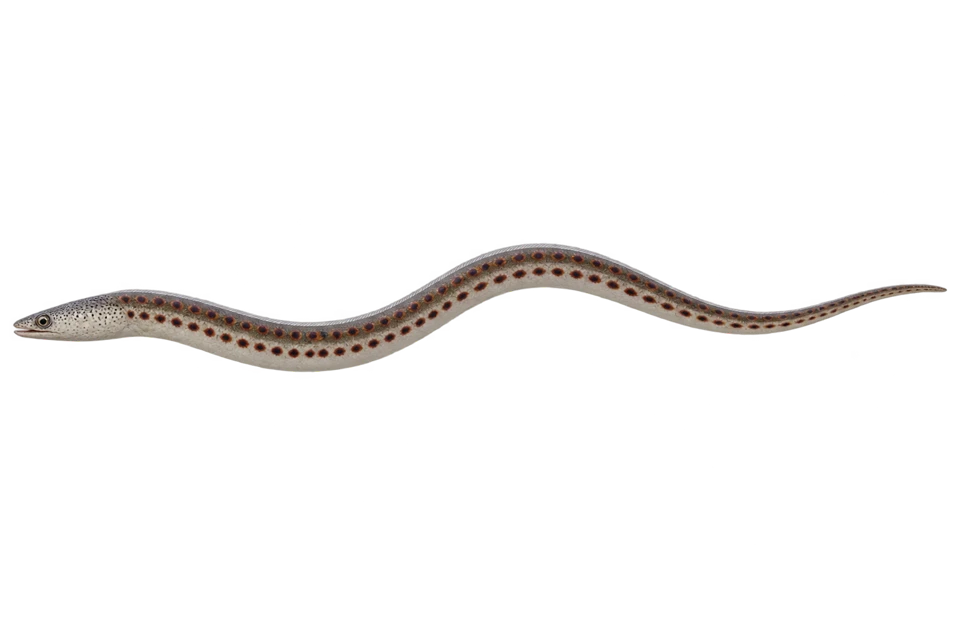
Two rows of dark-centered rings along a gray eel and a finely speckled head are the clues to watch for.
Fun facts for your next surface interval
- Look at the face in profile: the snout hangs forward over the mouth, with a short groove underneath.
- One nostril is a small tube near the snout. The rear nostril opens into the mouth instead of making another obvious hole on the face.
- The gill opening is a narrow crescent low on the side, just below the tiny pectoral fin.
- The long dorsal fin starts behind the gill opening, not over the top of the head.
- The tail accounts for a little less than half the eel’s length. A head peeking out of the sand shows very little of the whole animal.
- The eel was first described from a specimen collected east of Ascension Island. It’s also documented on the western side of the Atlantic.
Use Stuart Scuba’s SDI Reef Fish Identification course to practice separating similar eels from a few easy-to-see clues.
How to identify it
- Gray above, pale below, with two orderly rows of dark-centered, rust-ringed spots along the back and mid-flank.
- Pale head covered by a fine darker network of spots.
- Tail ends in a blunt finless point; the pectoral fin is tiny.
Where to look
Shallow seagrass, sand and rubble.
Size
28.0 in (71 cm). Published upper size; measurement type not specified.
What it eats
Eats bottom invertebrates, including worms, mollusks and crustaceans.
Behavior
Scan the sand beside grass or rubble. If only the head shows, take a careful side view rather than touching or disturbing the bottom.
Reproduction
The Smithsonian lists eggs and early larvae as pelagic.
Look-alikes
Goldspotted Eel also has rings, but the darker centers, neat two-row pattern and fine head speckling here are useful checks.
Can you collect or eat it?
Enjoy watching it and leave it in the water. This guide does not verify species-specific harvest or food-safety rules. Check the current rules for the exact location, species and method before taking anything, and never collect where prohibited.
Check Florida’s current saltwater rules
Field references
I saw this and want to share
Make your next dive happen
Dive with Stuart Scuba · Train with us · Travel with us · Shop with us



