


Black Jack
Caranx lugubris · Carangidae
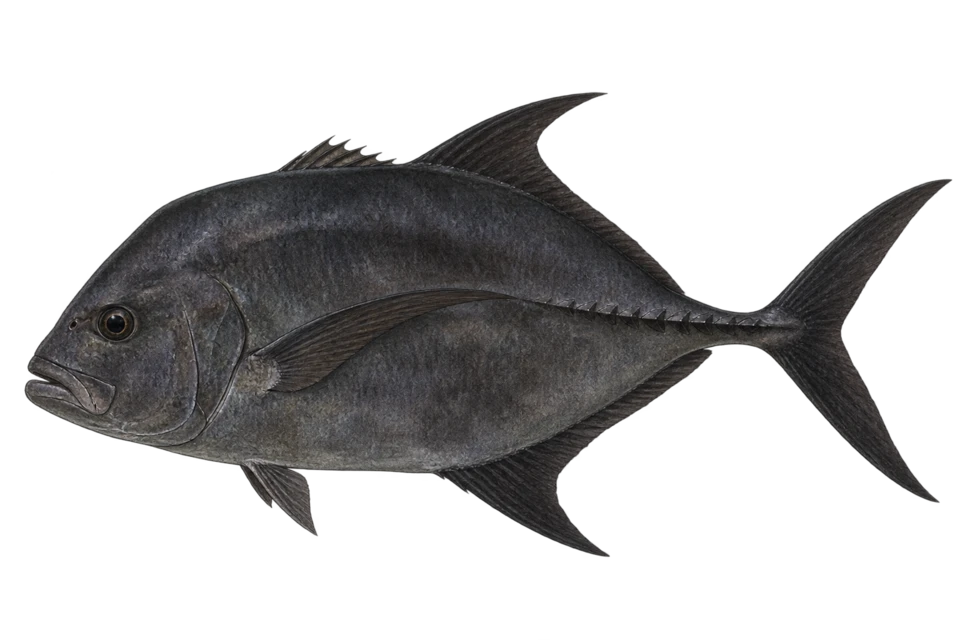
Dark fins and a row of armored scales near the tail distinguish this jack from a usual silver school.
One fun thing to know
The tough scales along the tail base are called scutes.
How to identify it
- Deep dark-gray to black body, steep forehead and a deeply forked tail.
- Long pectoral fin and pointed dorsal and anal lobes.
- Hard scales along the straight part of the lateral line before the tail.
Where to look
Clear water near offshore banks, island slopes and drop-offs. It is not typical at the Bridge.
Local record: This fish has been recorded in REEF surveys at Blue Heron Bridge (Phil Foster Park), Riviera Beach. A local record is not a guarantee of a sighting.
Size: Up to about 39.4 in (100 cm) in the cited account. This is a published upper size, not what to expect on every dive.
What it eats
Fish and, in some reports, zooplankton.
How it behaves
Look off reef edges or drop-offs; it can occur in schools.
Reproduction
Pelagic eggs and larvae. A survey sighting does not establish local spawning.
Look-alikes
Horse-eye Jack is generally more silvery with a conspicuously large eye. Check the angular forehead, dark fins and dark tail-base scales.
Can you collect or eat it?
Enjoy watching it and leave it in the water. This guide does not verify species-specific harvest or food-safety rules. Check the current rules for the exact place, species and method before taking any fish.
Check Florida’s current saltwater rules
Field references
I saw this and want to share
Make your next dive happen
Dive with Stuart Scuba · Train with us · Travel with us · Shop with us



