


Fish identification archive / Raja Ampat
Bird Wrasse
Gomphosus varius
Raja Ampat field guide
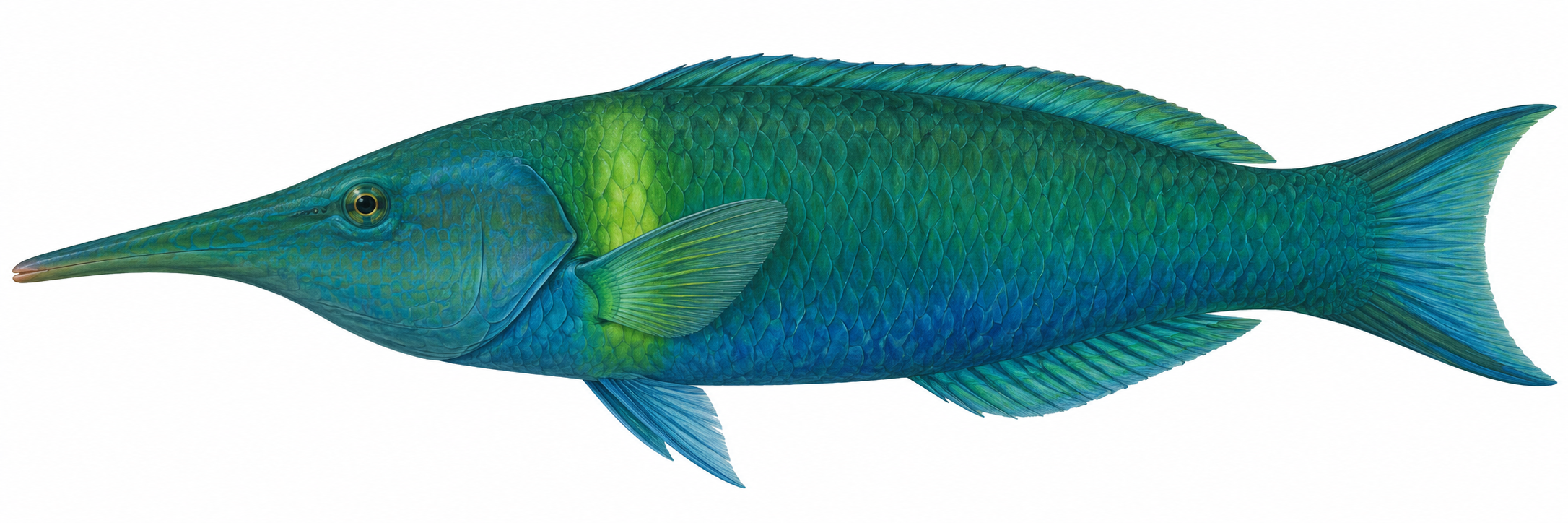
Two things to tell your dive buddy
- The extraordinary adult snout is a feeding tool: long jaws reach into reef crevices for small crustaceans and other prey.
- Young bird wrasses have much shorter jaws. An identification based only on the spectacular adult beak can miss the juveniles.
How to identify it
Adults have conspicuously elongated, birdlike snouts; males are green-blue, while females have much paler forebodies.
Habitat and where to look
Coral-rich lagoons and seaward reefs; juveniles may use seagrass.
Daily habits and behavior
May travel alone or in small groups, using its long jaws to probe crevices.
What is on the menu?
Small crustaceans, brittle stars, molluscs and small fishes.
Mating and the next generation
A hermaphroditic wrasse whose colors differ with sexual development.
Look-alikes and identification traps
The adult beak is distinctive, but juveniles have shorter jaws. Confirm the body pattern as well as snout shape.
Try this observation
Follow the direction of the snout and see which crevices attract its attention.
Raja Ampat occurrence
Recorded in Raja Ampat; regional occurrence is not an itinerary-specific sighting promise. This guide does not imply that every site, itinerary or season offers the same chance of an encounter.
Observe, do not disturb
Keep a respectful distance, leave the animal an unobstructed route and follow your dive guide. Do not touch, feed, chase or collect wildlife. Identification does not establish permission to harvest or food safety; Florida harvest labels do not apply to this Indonesian guide.
The beak is clearer on larger bird wrasses
A larger bird wrasse has a slender snout that projects well beyond the mouth of most wrasses. Green males and darker-backed females can look quite different. Young fish have shorter jaws, so the adult profile is not a reliable test for a small one.
SDI Underwater Videographer course: Practice keeping a moving fish in profile without following it into the reef.
Sources and review
Reviewed November 18, 2026.
Make your next dive happen
Dive With UsTrain With UsExplore the Raja Ampat tripShop With Us
Questions? (772) 600-8288 or info@stuartscuba.com.




