


Bicolor Angelfish
Centropyge bicolor · Pomacanthidae
How to identify it
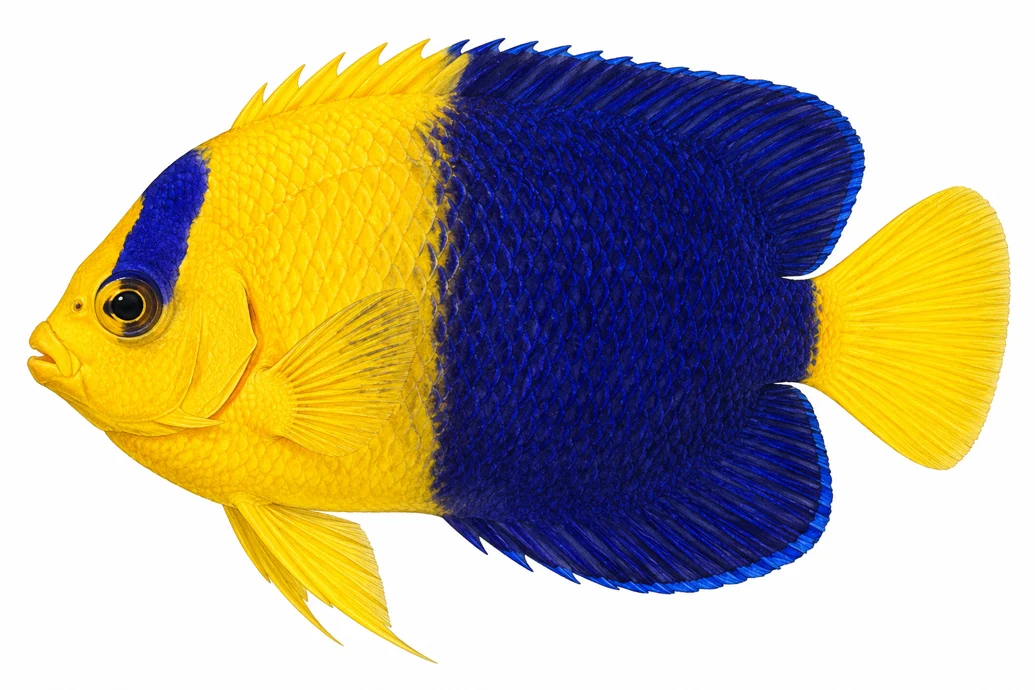
The yellow front half and navy-blue back half make a clean vertical split. Check the tail: it goes back to yellow. A blue band crosses the forehead above the eye.
What to watch for underwater
This little angelfish stays within a short dash of a crevice. Watch the mouth as it works over the reef for algae and small invertebrates. In its social group, a female can become the male.
Where it has been recorded in Raja Ampat
At Kalig Kecil near Misool, REEF divers reported this species on 21 of the 23 survey dives in the site report reviewed November 18, 2026. That count describes those dives at that site. It is not an estimate for the entire archipelago. View the regional record.
Field notes
- Family
- Pomacanthidae
- Field-guide group
- Angelfish
- Reported maximum length
- 15 cm standard length (to the tail base)
- Also listed as
- Bicoloured Angelfish, Black And Gold Angel-fish, Blue & Gold Angelfish, Blue And Gold Angelfish
On our dives: Observe and photograph. Give wildlife room to move and leave it where you found it.
Compare field guides
Pearl-scaled Angelfish · Keyhole Angelfish
Fishes of Australia species account and reference photographs · REEF survey records for Kalig Kecil, Misool
I saw this and want to share
Back to all Raja Ampat species · Dive Raja Ampat with Stuart Scuba
Look for yellow at both ends
The front half and tail are yellow, with a deep blue patch across the back half of the body. Look for the blue band above the eye too. If the tail is hidden, wait for a side view before ruling out a similar small angelfish.
SDI Reef Fish Identification course: Use the course to practice combining separate color marks into one identification.




