


← Back to South Florida Fish ID
Banded Rudderfish
Seriola zonata · Carangidae
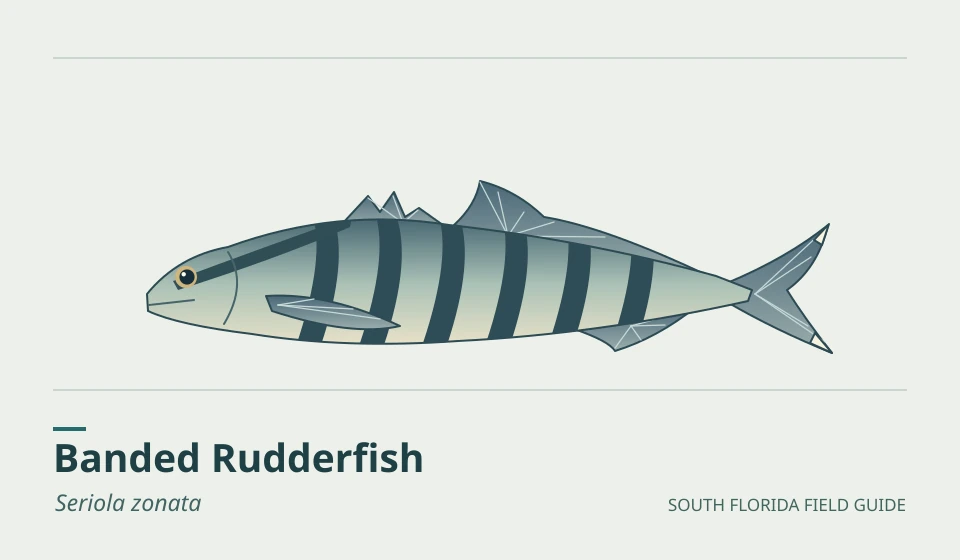
Young banded rudderfish have six dark body bars; adults become more uniformly gray-blue.
One fun thing to know
The young sometimes follow much larger fish.
I saw this and want to share
How to identify it
- Young banded rudderfish have six dark body bars; adults become more uniformly gray-blue.
- Look for an eye-to-dorsal band in juveniles and pale forked-tail tips.
- The anal fin is shorter than the second dorsal fin.
Where to look
Documented in Lake Worth Lagoon; also around nearshore and offshore hard bottom.
Size
Usually under 24 in (61 cm).
What it eats
Adults eat small fishes and shrimp.
Behavior
Moves above structure; juveniles may hold near floating weeds.
Reproduction
FWC reports spawning offshore through much of the year.
Look-alikes
Lesser Amberjack has a longer anal-fin base. Check fin proportions rather than color alone.
Can you collect or eat it?
Florida regulates this fish along with lesser amberjack. Check state or federal rules for the exact waters.
Check current Florida saltwater rules and posted rules at your site.
Field references
Make your next dive happen
Dive with Stuart Scuba · Train with us · Travel with us · Shop with us



