


Banded Pipefish
Halicampus crinitus · Syngnathidae
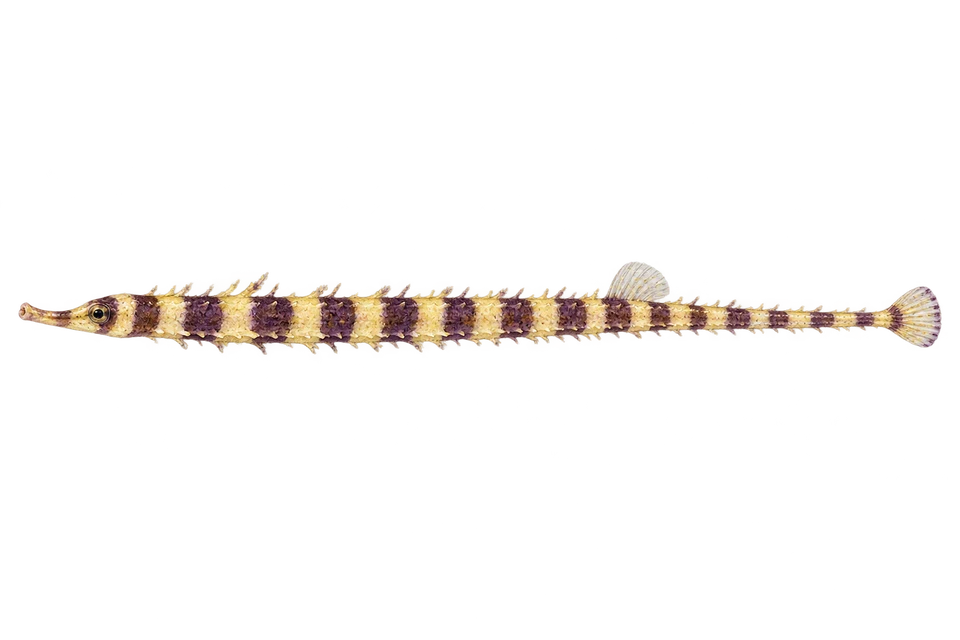
The bands can be bold or nearly absent. Check for a short snout and little ridges along the pencil-thin body.
One fun thing to know
REEF lists this as Harlequin or Banded Pipefish under Micrognathus crinitus. Smithsonian STRI uses Halicampus crinitus and notes unresolved regional taxonomy.
How to identify it
- A short tubular snout with a smooth-topped central ridge.
- Toothed body ridges and small skin flaps.
- Color ranges from mottled or dark to bold pale and purplish-brown bands.
Where to look
Rock, coral, coarse sand and seagrass. Scan edges between textures for a thin silhouette.
Local record: This fish has been recorded in REEF surveys at Blue Heron Bridge (Phil Foster Park), Riviera Beach. A local record is not a guarantee of a sighting.
Size: Up to about 5.9 in (15 cm) in the cited account. This is a published upper size, not what to expect on every dive.
What it eats
Takes tiny prey through its tubular mouth like other small pipefishes; the local diet was not confirmed.
How it behaves
Difficult to separate from textured bottom; the outline and head are more reliable than color.
Reproduction
Male pipefishes brood eggs. The local breeding season is not established.
Look-alikes
Smooth Pipefish lacks the same prominently toothed ridges. Get a clear side view of the head and trunk.
Can you collect or eat it?
Enjoy watching it and leave it in the water. This guide does not verify species-specific harvest or food-safety rules. Check the current rules for the exact place, species and method before taking any fish.
Check Florida’s current saltwater rules
Field references
I saw this and want to share
Make your next dive happen
Dive with Stuart Scuba · Train with us · Travel with us · Shop with us



