


Bacalao Grouper
Mycteroperca olfax · Epinephelidae · Grouper · Galápagos Islands Fish ID
How to identify it
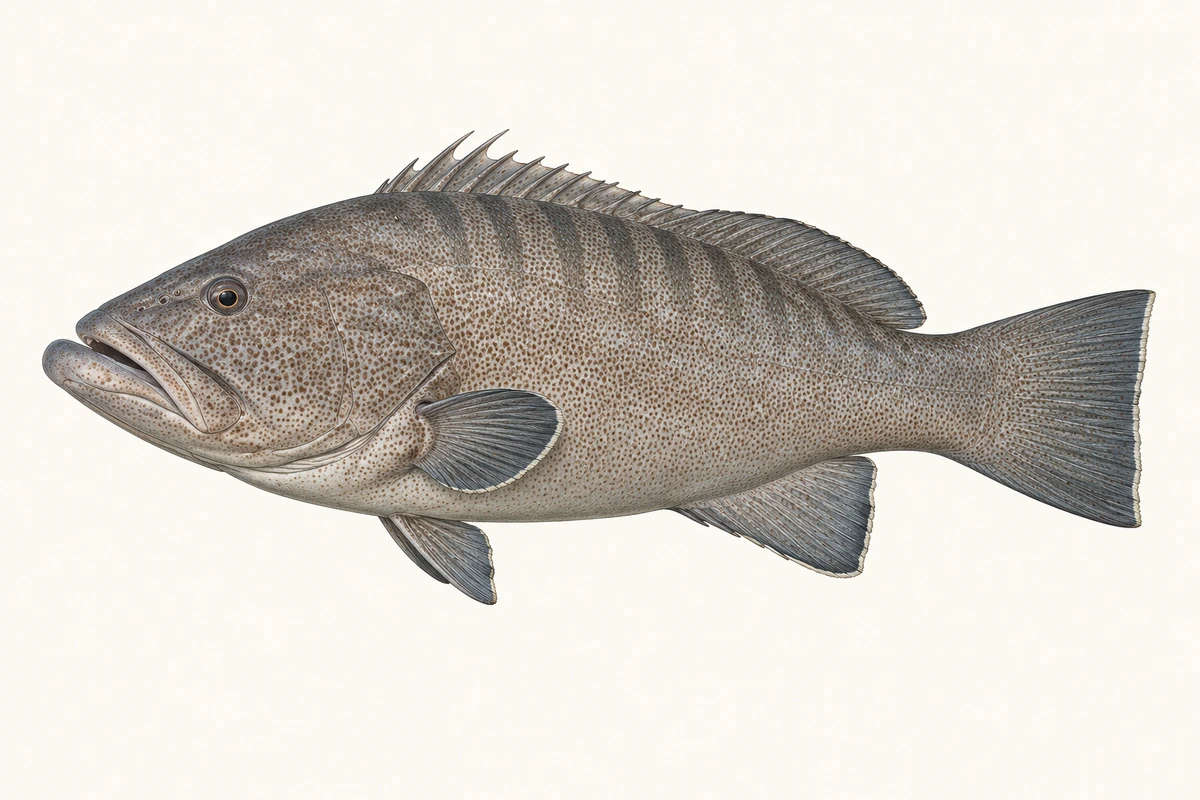
Look along the rocky reef for a big, long-bodied grouper. The tall front lobe of its dorsal fin and the nearly straight tail are better clues than color alone.
Separate it from the slender, deeply forked-tail Pacific Creolefish and the smaller, white-spotted Flag Cabrilla. A bright yellow Bacalao is possible; don’t assume it’s another species from color alone.
Galápagos Islands records
Divers recorded it at Enderby off Floreana in the Galápagos. That is a documented sighting, not a promise of an encounter.
Fun facts
- The second and third dorsal spines are longer than their neighbors, giving the front of the fin its raised lobe.
- Most are gray-brown, with closely spaced brown spots and sometimes thin bars on the upper body.
- Occasional individuals are bright yellow all over.
- The lower jaw projects, while the tail ends close to a straight edge rather than in long trailing lobes.
- Large fish can reach about 1.2 meters, although a diver won’t see that size every time.
- It lives around rocky reefs and feeds on fish and mobile crustaceans.
Explore and learn
If the fish is holding by a wall, watch its outline rather than trying to move it away from shelter. Catch the dorsal fin when it rises and the tail when it turns.
Practice identifying groupers by body and fin shape · Explore Stuart Scuba’s worldwide group dive trips




