


← Back to South Florida Fish ID
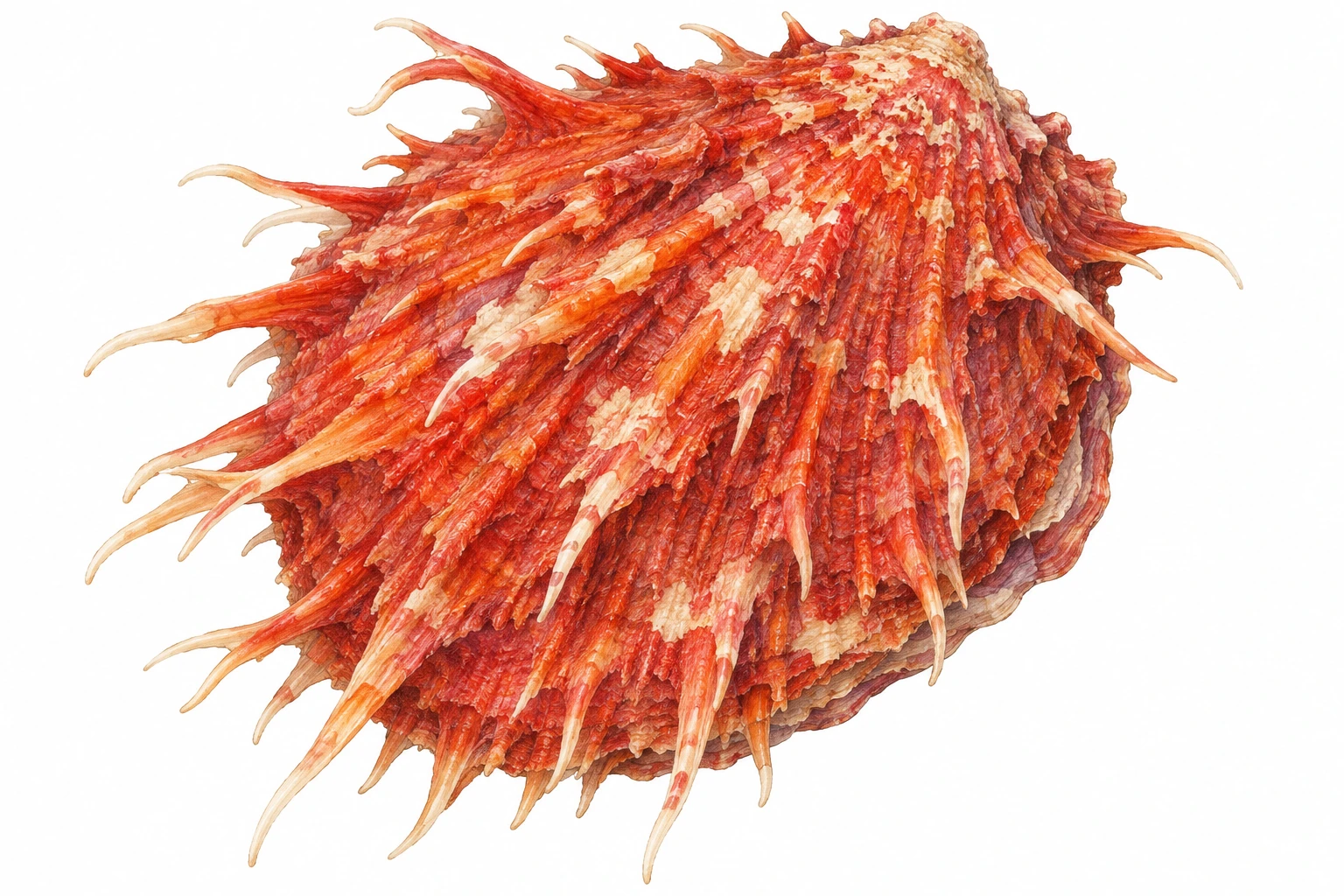
Atlantic Thorny Oyster
Spondylus americanus · Spondylidae
This reef bivalve has a heavy shell decorated with projecting spines. It often blends into the organisms growing over it; look for the shell seam and spines together.
One fun thing to know
It is named an oyster for its attached habit, but the FAO guide distinguishes it from true oysters and compares its hinge with that of scallops.
I saw this and want to share
To share this guide with a dive buddy, copy the page link.
How to identify it
- Thick shell with radiating rows of long spines
- White, peach, reddish or orange on exposed shell; growth may obscure the color
- Lower valve fixed to a hard surface; look for two valves rather than loose branches
Where to look
Documented on the Thunderbolt wreck in the middle Florida Keys; also reported from reef recesses and ledges. Do not assume it occurs at every reef.
Size
Large individuals can be several inches across; spines make estimates tricky.
What it eats
Filter feeder: the gills trap suspended microscopic food such as plankton and organic particles.
Behavior
Remains attached to hard surfaces. Sponges and other growth can mask the shell and make the animal look like part of the reef.
Reproduction
Marine bivalves commonly develop through free-swimming larvae before settling; Florida spawning dates for this species were not verified.
Look-alikes
Oysters such as the frond oyster can have layered projections but not the same heavy radial spines. Other Spondylus species need close shell comparison; spines alone do not determine species.
Can you collect or eat it?
Observe and leave in place. Check the Florida Fish and Wildlife Conservation Commission’s shell-collecting rules and local protected-area restrictions before removing a live shell.
Check current species and site rules before collecting. This guide does not establish permission to collect.
Make your next dive happen
Dive with Stuart Scuba · Train with us · Travel with us · Shop with us



