


← Back to South Florida Fish ID
Atlantic Pearl Oyster
Pinctada imbricata · Margaritidae
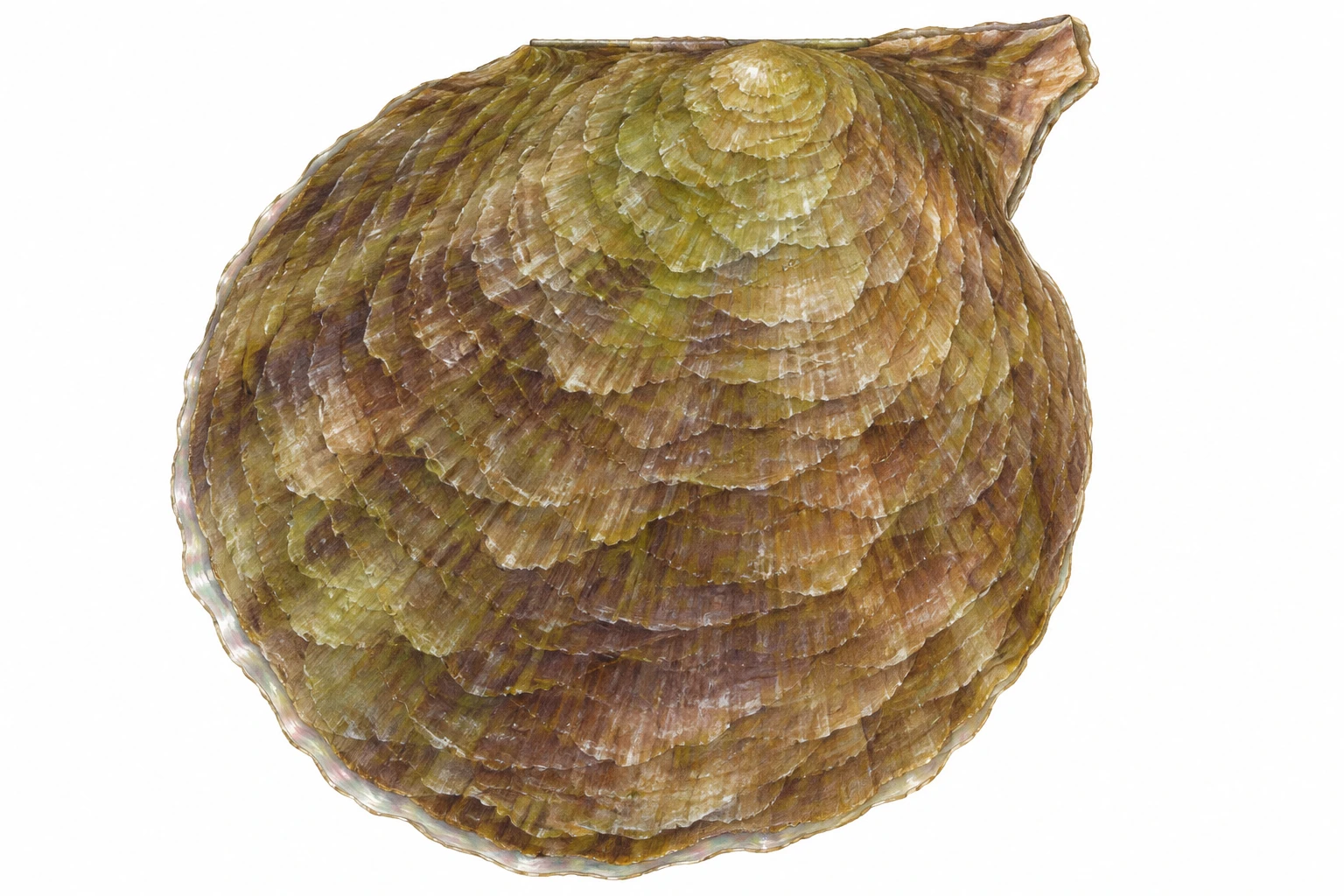
Look for a thin, rounded shell with a straight, winged hinge. On a piling or other hard surface, the small scales around the shell are a better clue than its variable brownish color.
One fun thing to know
The shiny inside is nacre, also called mother-of-pearl. You do not need to open a live shell to identify it.
I saw this and want to share
To share this guide with a dive buddy, copy the page link.
How to identify it
- Unequal, relatively flat valves with rounded outline
- Two hinge projections, with a comparatively short rear wing
- Flat scales in curved rows; tan, brown or purplish shell, sometimes green-tinged
Where to look
Live animals have been recorded at Blue Heron Bridge in Riviera Beach. The species is also known from the Dry Tortugas.
Size
Shell to about 3 in (76 mm).
What it eats
Filter feeder: the gills trap suspended microscopic food such as plankton and organic particles.
Behavior
Attaches to a solid surface with byssal threads. The gill folds are sometimes visible between the mantle edges of a slightly open live shell.
Reproduction
Marine bivalves commonly develop through free-swimming larvae before settling; Florida spawning dates for this species were not verified.
Look-alikes
The winged pearl oyster (Pteria colymbus) has a more exaggerated rear hinge wing. A flat tree oyster is more angular and has a long, straight edge.
Can you collect or eat it?
Observe and leave in place. Check the Florida Fish and Wildlife Conservation Commission’s shell-collecting rules and local protected-area restrictions before removing a live shell.
Check current species and site rules before collecting. This guide does not establish permission to collect.
Make your next dive happen
Dive with Stuart Scuba · Train with us · Travel with us · Shop with us



