


← Back to South Florida Fish ID
Atlantic Partridge Tun
Tonna pennata · Tonnidae
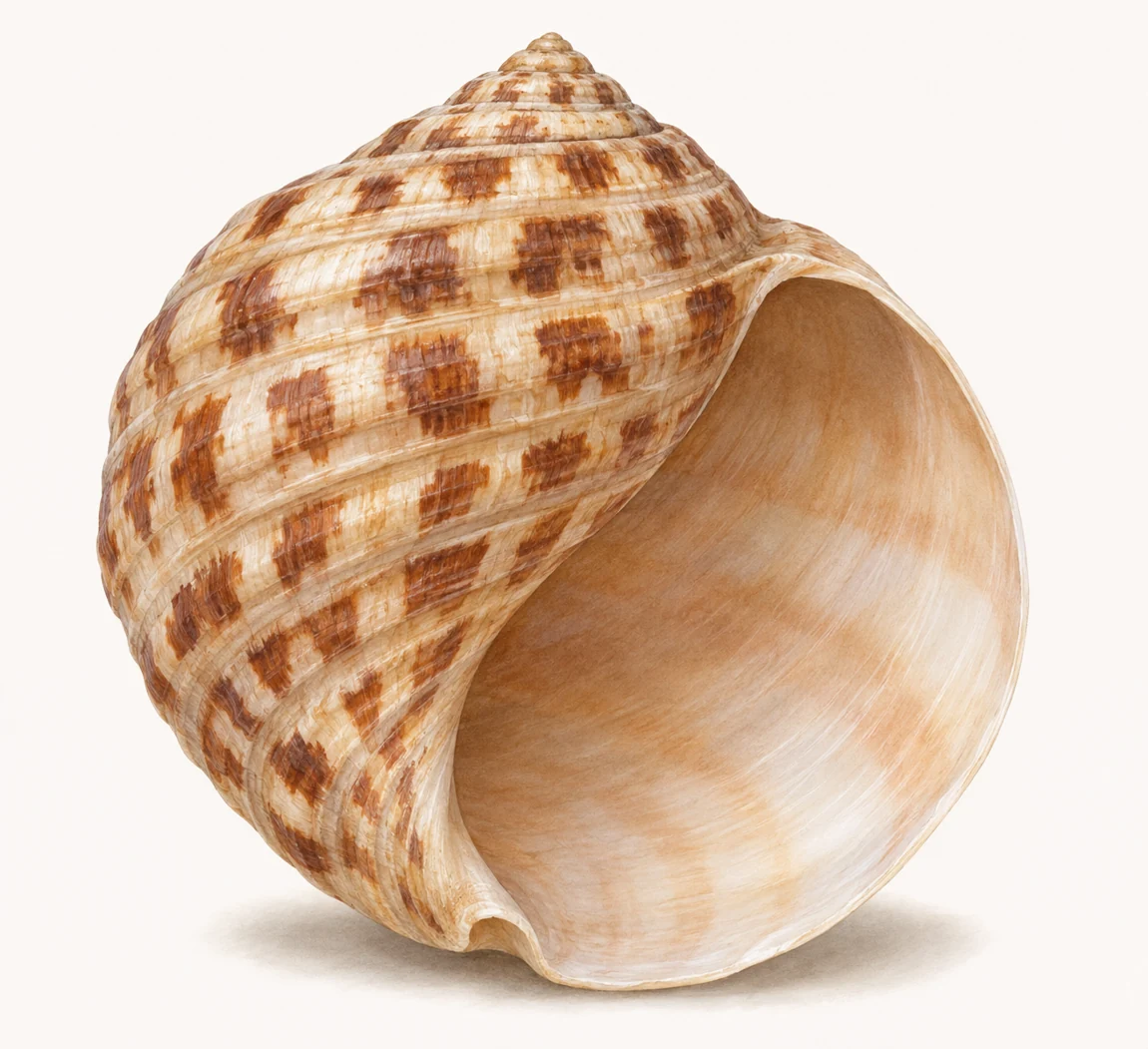
Broad ribs and pale rectangular spots give the Atlantic partridge tun a patterned shell. It is more elongated than the giant tun.
One fun thing to know
The Atlantic partridge tun can extend its mouth to reach prey such as sea cucumbers.
I saw this and want to share
To share this guide with a dive buddy, copy the page link.
How to identify it
- Inflated egg-shaped shell with a somewhat pointed spire
- Wide, flattened spiral ribs separated by grooves
- Alternating light marks give fresh tan shells a spotted or checkered look
Where to look
The species has been recorded in the Florida Keys and the Dry Tortugas. Empty shells have also been found in Hobe Sound. Shell finds do not establish live local populations.
Size
A hand-sized shell when mature; size alone does not separate tuns.
What it eats
Predates sea cucumbers; a feeding observation identifies Isostichopus badionotus as prey.
Behavior
Crawls on soft bottom and uses an extendable feeding organ to approach prey. Empty shells may house hermit crabs.
Reproduction
Tuns lay egg masses and have swimming larvae; a local spawning schedule for this species is not established.
Look-alikes
Giant tun is rounder, has a lower spire, and lacks the same contrasting pale pattern on fresh shells. The Indo-Pacific partridge tun is a different species.
Can you collect or eat it?
Observation profile, not a harvest or edibility recommendation. Leave living animals and occupied shells in place; follow site rules.
Check current species and site rules before collecting. This guide doesn’t establish permission to collect.
Make your next dive happen
Dive with Stuart Scuba · Train with us · Travel with us · Shop with us



