


← Back to South Florida Fish ID
Atlantic Manta Ray
Mobula yarae · Mobulidae
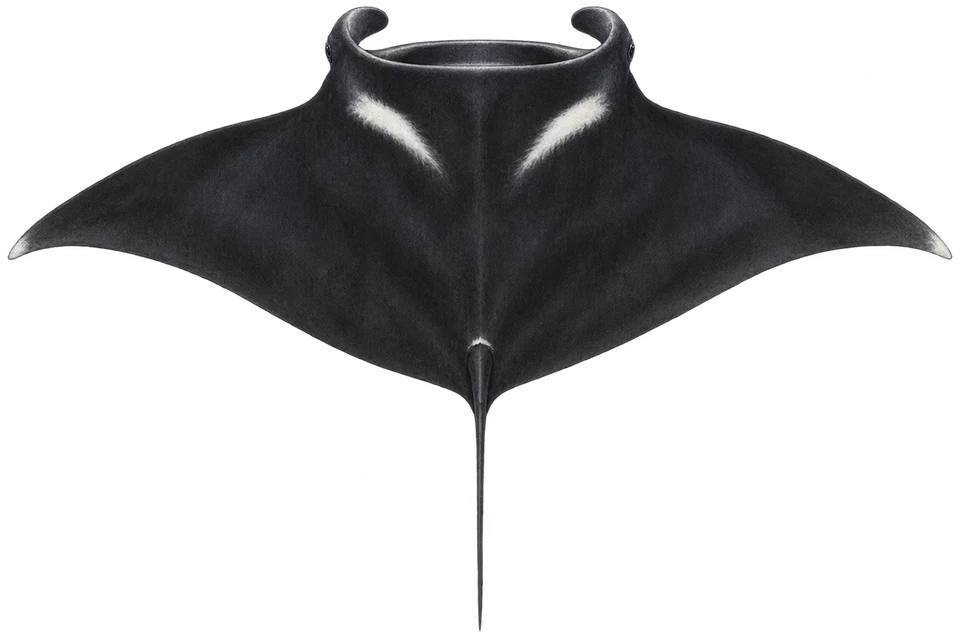
If a dark, broad-winged ray glides past with two curled lobes beside its mouth, you may be watching an Atlantic manta. South Florida’s shallow coast is a nursery for this recently described species.
One fun thing to know
The specimen used to formally describe the species in 2025 was found at Pompano Beach in 2017. Its species name honors Yara, meaning “mother of water” in Tupi mythology.
How to identify it
- A broad mouth at the front edge of the head, flanked by two flexible feeding lobes. The pectoral fins form a wide, pointed disc, and a thin tail trails behind.
- The upper side is usually dark with two pale shoulder patches angled diagonally. The underside varies; when dark spots are visible, they often cluster on the abdomen or pectoral fins, rather than between the gills.
- Use the shoulder pattern, underside and overall shape together. One distant glimpse, a dark back or a photograph of only the upper side may not settle the species.
Where to look
Found in the western Atlantic and Caribbean. Researchers have documented juvenile Atlantic mantas using shallow coastal waters off Southeast Florida as nursery habitat. They are also recorded in open water and near river mouths. A regional record does not guarantee a sighting on any particular dive.
Size
236.2 in (600 cm). Published upper estimate of adult disc width (wingspan), not body length.
What it eats
Filters zooplankton from the water. The paired head lobes unfold to guide water into the broad mouth, where specialized structures associated with the gills separate food from the flow.
Behavior
Stay where you are, leave a clear path, and never chase or touch the ray. An underside photo from a respectful distance can help researchers recognize an individual by its markings.
Reproduction
Atlantic mantas give birth to live young. The shallow Southeast Florida nursery supports juveniles; a consistent local birth season is not established here.
Look-alikes
The giant oceanic manta (Mobula birostris) shares the large forward-facing mouth and paired head lobes, but typically has a different, more T-like shoulder pattern. Patterns vary, and neither pattern is conclusive alone. Devil rays generally have the mouth set farther back underneath the head.
Can you collect or eat it?
Do not harvest. Florida prohibits recreational harvest of manta rays in state waters. Observe only: do not touch, chase or block the animal’s path.
Check Florida’s current saltwater rules
Field references
- doi.org reference 1
- zenodo.org reference 2
- marinemegafauna.org reference 3
- marinemegafauna.org reference 4
- ocean.si.edu reference 5
- flrules.org reference 6
I saw this and want to share
Make your next dive happen
Dive with Stuart Scuba · Train with us · Travel with us · Shop with us



