


Fish identification archive / Atlantic Longarm Octopus
Atlantic Longarm Octopus
Macrotritopus sp.
Fun facts for your next surface interval
- This is a local natural-history story, not merely an animal with Florida somewhere on its range map: scientists have studied its daily life at Blue Heron Bridge.
- Neighbouring octopuses can share a lagoon without using it in the same way. Local research found this longarm form searching sand by day, while the larger common-octopus form mainly hunted over harder bottom at night.
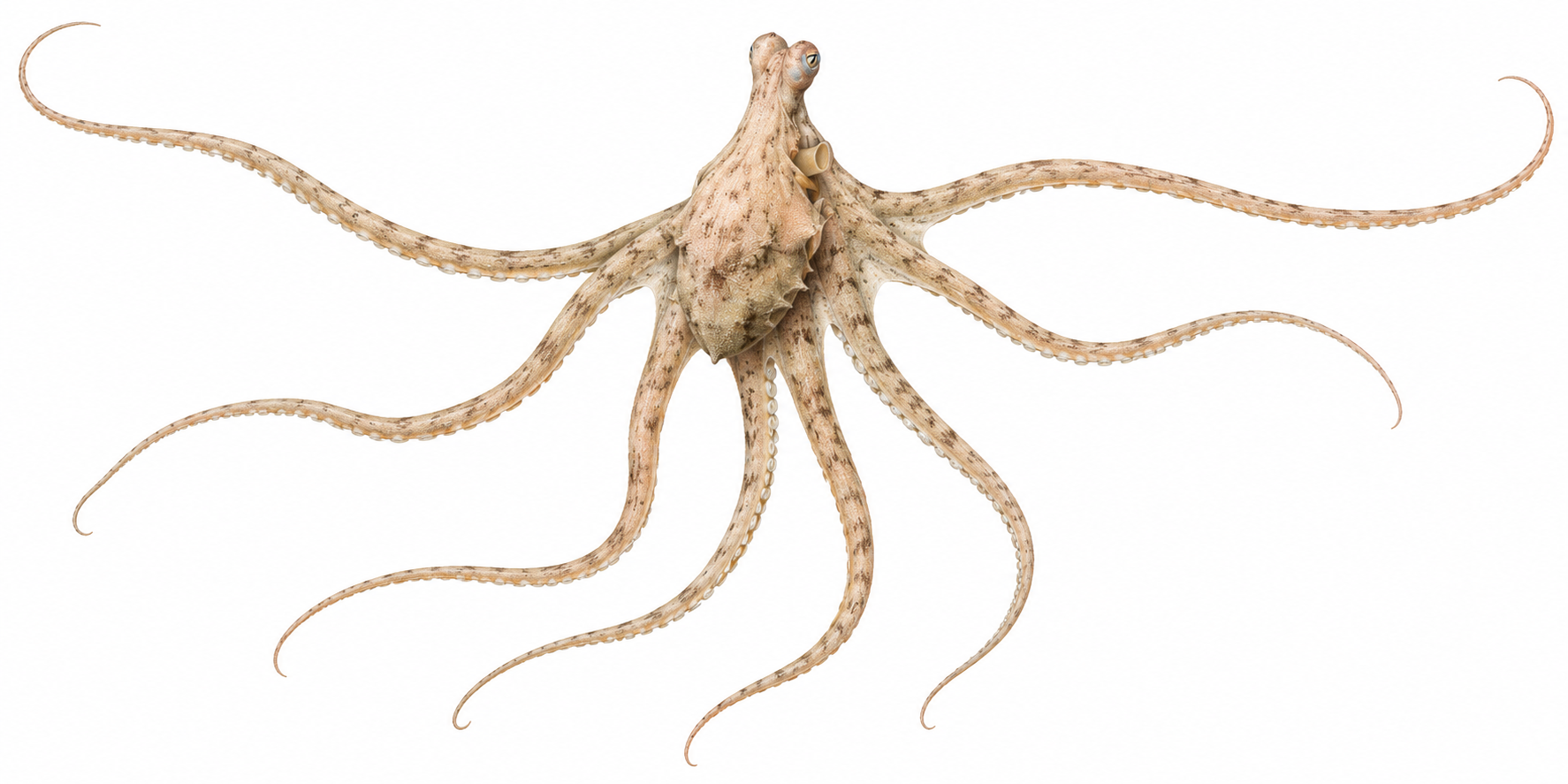
- An octopus can resemble a fish without becoming one. Its flattened swimming posture and trailing arms create a flounder-like outline; apparent mimicry is a description of the resemblance, not proof of exactly what a predator thinks.
- A familiar animal can still hold a taxonomic mystery. The local longarm octopus has often been published as Macrotritopus defilippi, but researchers are still testing the precise identity of South Florida populations.
How to recognize it
A small sand-dwelling octopus with a slender mantle, very long thin arms and relatively little webbing between them. Its sand-matching colours can change, so body proportions and behaviour are more useful than a single colour. Look for the eight sucker-bearing arms, not just an impression of a flatfish moving over sand.
West Palm Beach and local habitat
Documented directly at Blue Heron Bridge, Phil Foster Park, in Lake Worth Lagoon near Palm Beach Inlet. It uses soft sandy bottom; a 2024 field study sampled the local population, identifying it under the traditional name Macrotritopus defilippi.
Behavior: watch what it does
Local research found daytime foraging, with pauses to scan followed by arm-and-sucker exploration of the bottom. Individuals may raise the body into a tripod-like stance or flatten themselves while swimming in a manner resembling a flounder.
What it eats
Crustaceans were the prey recorded for this octopus in the local foraging study. That observation describes the study, not a claim that every individual eats only one kind of prey throughout its life.
Similar animals and identification limits
Do not substitute a robust reef octopus or a white-spotted, long-armed Callistoctopus. The Indo-Pacific mimic octopus is a different animal. Even within Macrotritopus, photographs alone do not establish whether the South Florida population belongs to M. defilippi, M. beatrixi or another lineage.
A better underwater observation
Hover clear of the sand and watch without chasing or blocking its route. Does it pause, probe the bottom, stand high or flatten to swim? Record the behaviour and location rather than trying to provoke a display.
Why the scientific name stays cautious
South Florida studies traditionally call this animal Macrotritopus defilippi. We use Macrotritopus sp. because the precise identity of the local population remains unresolved. This is not an identification as M. beatrixi. Also searched as Atlantic longfinger octopus and Atlantic long-arm octopus.
Observe responsibly
Documented local presence is not a promise of a sighting or a statement of abundance. Do not chase, handle, feed or disturb wildlife. This identification guide is not permission to collect or harvest, and it does not establish food safety. Check current rules and protected-area boundaries for your exact location.
Harvest, protection and eating safety
Restricted marine life: live collection only. Blue Heron Bridge is closed to collection.
Can it be hunted or harvested?
Florida treats the Atlantic Longarm Octopus (Macrotritopus sp.) as ornamental marine life. The common octopus exception applies to a different animal. Where collection is open, the recreational limit is five longarm octopuses per person per day within the 20-organism daily limit. The two-day possession limit is ten of one species within 40 organisms total. Land and keep each animal alive using an adequately sized circulating livewell, aeration or oxygenation system. A recreational saltwater fishing license is required unless exempt. Recreational catch cannot be sold.
Florida seasons and areas
Blue Heron Bridge and Phil Foster Park: Divers may not collect or possess this octopus inside the mapped Special Marine Life Area at any time of year. The rule has narrow vessel transit and landing exceptions for animals lawfully taken elsewhere. FWC lists no statewide seasonal closure for this category. Other parks, refuges and sanctuary zones have their own boundaries. Lee County prohibits harvest. In Manatee County the limit is two of one species per day, with a two-per-species possession limit in the specified waters.
Can it be speared?
No. Florida's marine-life rules allow specified live-collection methods. A spear is not one of them.
Is it safe to eat?
This species has no recreational food harvest under Florida's marine-life rules. A legal live collection must stay alive. If you see one on a West Palm dive, give it room and photograph it in place.
Official rules and health guidance
- FWC marine-life rules, octopod limits and Blue Heron Bridge boundary map
- Florida rule 68B-42.0036, closed areas and vessel exceptions
- FWC recreational saltwater fishing licenses
- Florida rule 68B-26.004, Lee and Manatee county restrictions
Rules reviewed November 18, 2026. Check the current FWC rules and the boundary for your dive site.
I saw this
Share the guide with your dive buddies. Review your caption before posting.
Nothing posts automatically. Sharing does not record a verified sighting.
References and further reading
Make your next dive happen
Dive with Stuart ScubaExplore more marine lifeTravel with usWatch the sand, not just the arms
The long arms on this little octopus can blend into open sand. Scientists studying Atlantic longarm octopuses have also filmed them swimming with the low, flat silhouette and rippling motion of a flounder. That behavior is a clue, not enough to name the species from a brief sighting.
Develop the sequence in our Underwater Video course. Try recording a short, steady sequence rather than chasing the animal for a close-up.




