


Arrow Stargazer
Gillellus greyae · Dactyloscopidae
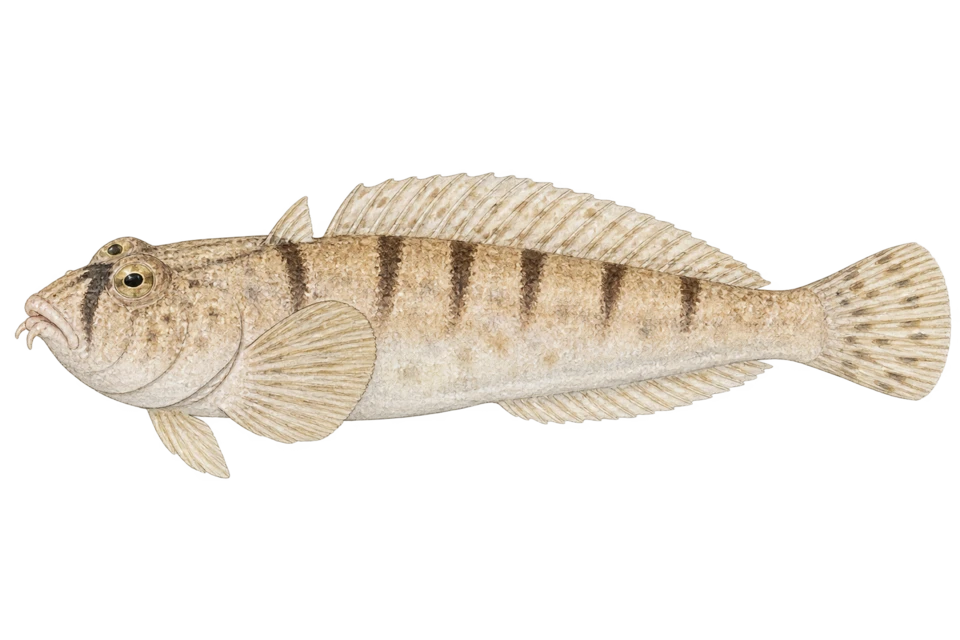
On the sand, look for two upward-facing eyes and a small upturned mouth with a fringed lower lip.
One fun thing to know
A tiny spiny fin just behind the head is separated from the main dorsal fin.
How to identify it
- Eyes on top of the head, not on stalks.
- Small skin flaps on the lower lip, unlike the upper lip.
- About six dark narrow bars across the upper side and a dark mark between the eyes.
Where to look
Sand in seagrass beds or between coral and rocks, about 3–89 ft (1–27 m).
Local record: This fish has been recorded in REEF surveys at Blue Heron Bridge (Phil Foster Park), Riviera Beach. A local record is not a guarantee of a sighting.
Size: Up to about 3.9 in (9.8 cm) in the cited account. This is a published upper size, not what to expect on every dive.
What it eats
Small fish and crustaceans such as small shrimp and crabs.
How it behaves
Buried fish can show little more than the eyes and mouth. Look without stirring the sand.
Reproduction
Smithsonian records brooded eggs and drifting larvae; no local breeding calendar was found.
Look-alikes
Other sand stargazers also peek out of sand. Check the lower lip and dorsal bars if you can see both.
Can you collect or eat it?
Enjoy watching it and leave it in the water. This guide does not verify species-specific harvest or food-safety rules. Check the current rules for the exact place, species and method before taking any fish.
Check Florida’s current saltwater rules
Field references
I saw this and want to share
Make your next dive happen
Dive with Stuart Scuba · Train with us · Travel with us · Shop with us



