


← Back to South Florida Fish ID
Amber Pen Shell
Pinna carnea · Pinnidae
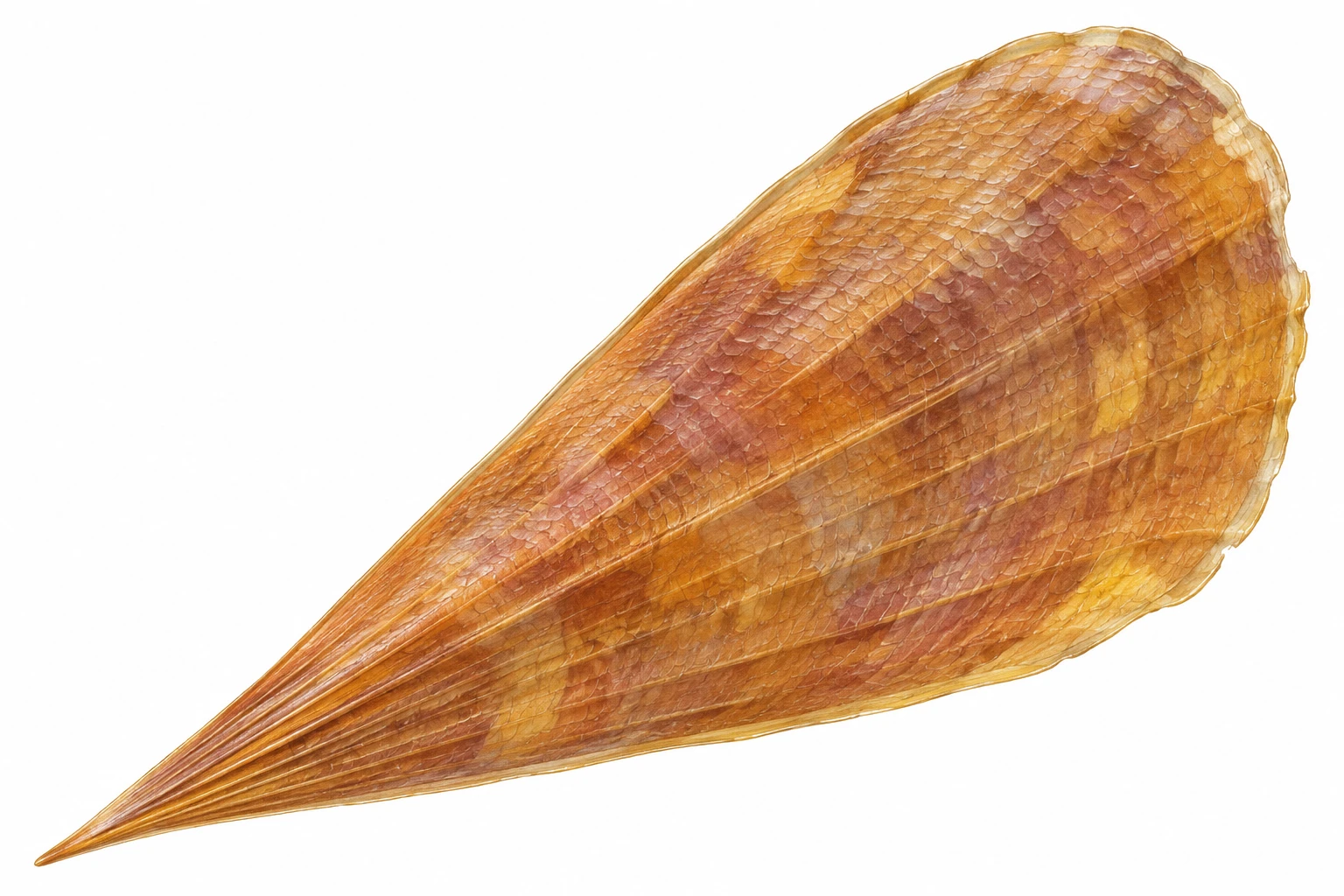
Look for a thin, upright fan growing narrower toward the sand. The pointed hinge end anchors below the surface, so the part you see above the bottom is usually the wide end.
One fun thing to know
The animal anchors point-first in the seabed using a bundle of tough threads called a byssus.
I saw this and want to share
To share this guide with a dive buddy, copy the page link.
How to identify it
- Long wedge or fan, narrow at the hinge and broad at the opening
- Thin, often amber to light brown shell, with a lengthwise groove
- Live individuals can stand upright with only the broad edge showing
Where to look
Harvard’s collections hold marine specimens from Key Biscayne and Lake Worth South Inlet.
Size
May exceed 6 in (15 cm); the visible part can be much shorter.
What it eats
Filter feeder: the gills trap suspended microscopic food such as plankton and organic particles.
Behavior
Usually stays anchored in soft bottom near seagrass; gaping valves admit and release water without the shell moving from its spot.
Reproduction
Marine bivalves commonly develop through free-swimming larvae before settling; Florida spawning dates for this species were not verified.
Look-alikes
The stiff pen shell (Atrina rigida) has conspicuous fluted spines on spaced ribs. An amber color does not by itself rule out an Atrina species.
Can you collect or eat it?
Observe and leave in place. Check the Florida Fish and Wildlife Conservation Commission’s shell-collecting rules and local protected-area restrictions before removing a live shell.
Check current species and site rules before collecting. This guide does not establish permission to collect.
Make your next dive happen
Dive with Stuart Scuba · Train with us · Travel with us · Shop with us



