


Fish identification archive / Alpheus thomasi Snapping Shrimp
Alpheus thomasi Snapping Shrimp
Alpheus thomasi
I saw this
Spotted this marine animal? Share the guide with your dive buddies. Review your caption before posting.
For Instagram, copy the caption and link into your own post or message. Nothing is posted automatically and this does not record a verified sighting.
A tiny neighbor with a loud introduction
- This shrimp appears dressed for a very small striped-pajama party.
- A big claw does not come with permission to skip the dive briefing.
- For the best portrait, bring patience. The shrimp has not agreed to a modeling contract.
A documented Jupiter Inlet shrimp
Hendrix and Gore's 1973 original description includes two juveniles collected at Jupiter Inlet, Palm Beach County, on March 8, 1973. Other specimens came from Walton Rocks in St Lucie County and the Miami/Key Biscayne area. Historical collection records do not promise present-day sightings or establish a Blue Heron Bridge record.
Recognition and look-alikes
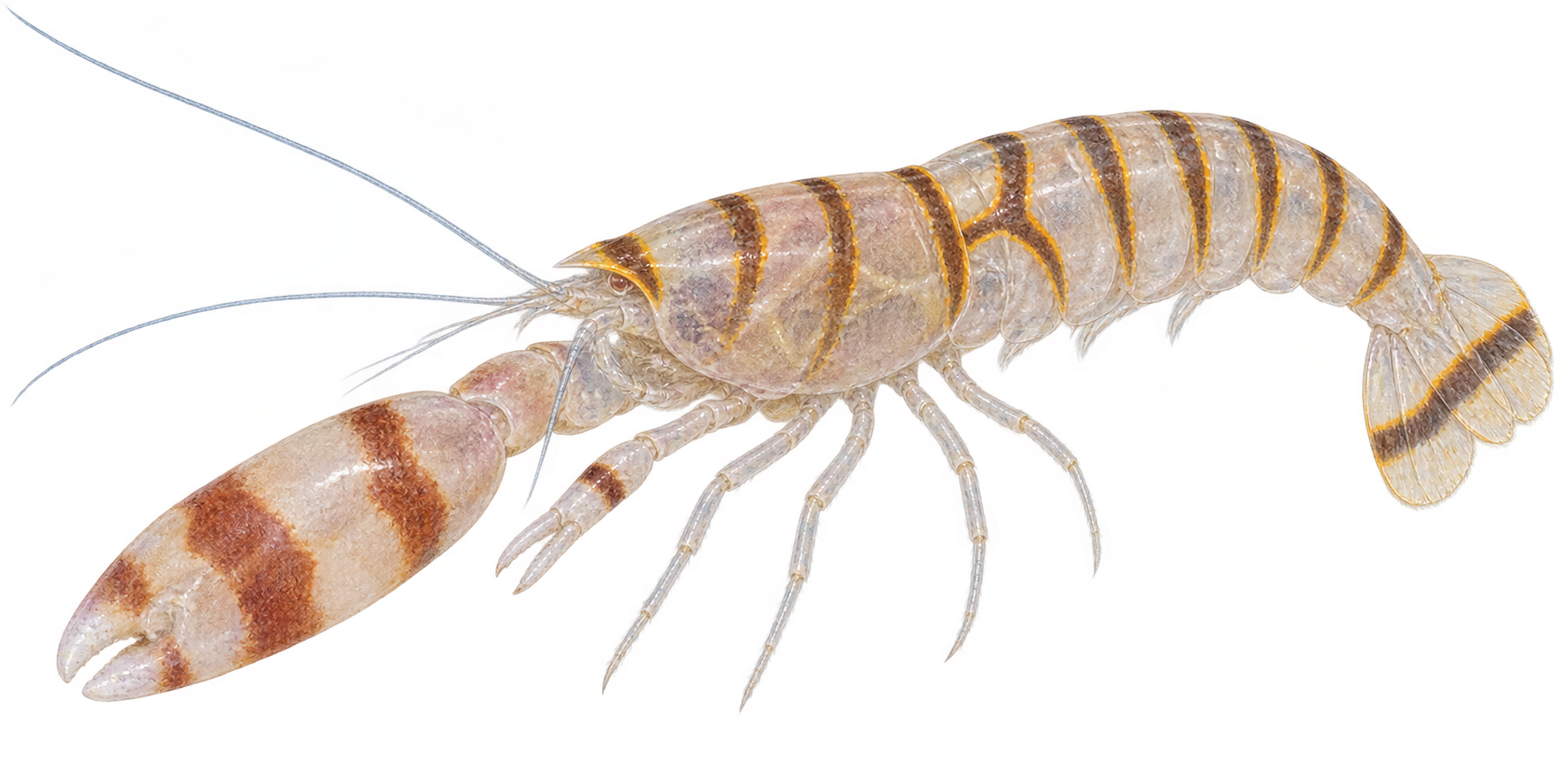
The description records nine transverse brown, blue-gray or orange bands on a clear-to-white background, often with yellow or orange borders. Compare the body and claw pattern together; color alone is not a definitive identification.
Compare another local snapping shrimp
Striped snapping shrimp, Alpheus formosus, has a different pattern. Use the individual guides and source descriptions rather than treating every pistol shrimp as one species.
Habitat and careful observation
Published specimens occupied shallow worm-reef crevices and limestone spaces. The Jupiter juveniles were found near the inlet's south-side jetties. This is historical habitat evidence, not advice to enter an inlet or dive an unassessed surf zone.
Ask Stuart Scuba about an appropriate dive for current conditions and your experience. Keep away from fragile habitat, watch from a stable position and never break rock or worm tubes to expose a shrimp.
Size: read the measurement carefully
The Jupiter juveniles measured 2.2 and 3.4 mm carapace length; the egg-bearing holotype measured 9.3 mm carapace length. These are head-shell measurements, not total body lengths or a species-wide maximum.
Feeding, mating and life history
The original description records egg-bearing females, but does not establish a complete species-specific diet, mating account or Florida breeding season. We leave those questions open rather than borrow another shrimp's biology.
Keep encounters natural
Do not offer food, handle an animal to inspect eggs or coax it out for a photograph. Record its habitat and behavior without interruption. A careful observation is more valuable than an invented certainty.
Why the snap?
Research on snapping shrimp explains a specialized claw producing a fast water jet and a cavitation bubble whose collapse makes the snap. That general mechanism is not a species-specific study of Alpheus thomasi. Sound alone cannot identify which shrimp you heard.
Photograph the clues, leave the habitat
Try to record the whole animal, its bands and both claws from a respectful distance. Include the date and location in your dive notes. Keep the housing clear of the bottom and allow room for surge. Do not touch, chase, feed or collect wildlife for an identification image.
Harvest, protection and eating safety
Can it be hunted or collected?
RED CC: Do not harvest. Stuart Scuba's Conservation and Common Sense recommendation is observation only. This recommendation is not a declaration of blanket legal protection.
Florida seasons
Our leave-in-place recommendation applies all year. It does not establish a legal closed season. Confirm current species and location rules with FWC rather than interpreting a directory tag as collection permission.
Is it safe to eat?
We do not recommend this animal as a food target and make no species-specific safe-to-eat claim.
Sources and review
Reviewed November 13, 2026. Locality and identification details are based on the original description; historic records are not a current abundance survey.
Make your next dive happen
Dive With Us
Explore local charters and plan a dive suited to your experience.
View dive calendarTrain With Us
Build your fish identification, buoyancy and diving skills.
Explore trainingTravel With Us
Discover upcoming dive adventures and trip details.
Explore dive travelShop With Us
Browse equipment for your diving and ask our team for help choosing.
Explore dive gearReview current dates, availability, prices, inclusions and requirements on each listing before booking or buying.
Call us now
Ask about marine life identification
Marine Life Identification
Ask about dates, prerequisites or your next step. An inquiry does not reserve a place. Please provide your own contact details; do not include medical, payment or a child's personal information.
We use these details to respond to your inquiry. This form does not sign you up for marketing.
Explore more with Stuart Scuba
Open Water course options · Advanced Adventure training · Technical training · Professional training · All courses · Local dives · Dive trips · Facebook · Instagram · YouTube
Your surface-interval essentials
Questions for Stuart Scuba? info@stuartscuba.com
Check the Stuart Scuba Weather Center · Play scuba trivia
Weather and wildlife vary. Confirm current conditions, trip requirements and departure details with the operator.
Plan Your Next Dive with Stuart Scuba
Dive With Us
Explore upcoming local charters and choose a dive that fits your experience.
Before you book
Check the individual listing for departure time, requirements and availability.
Travel With Us
Find upcoming dive adventures and start planning your next trip.
Plan your trip
Review dates, inclusions and trip details on the travel calendar.
Stay Connected with Stuart Scuba
 Follow pageShare
YouTube
SubscribeWatch & shareFollow on InstagramView & share post
Follow company news, training updates, and dive stories.
Follow on LinkedInGoogle Reviews
See Stuart Scuba’s current Google rating and review count below. Open the listing in Google Maps to browse customer reviews.



