

Fish identification archive / Yellowtail (Redfin) Parrotfish
Yellowtail (Redfin) Parrotfish
Sparisoma rubripinne
Fun facts for your next surface interval
- Yellowtail and redfin are two common names for one species, highlighting different parts of its initial-phase pattern. [source]
- A resting fish can change into a mottled pattern quickly enough to confuse a photo comparison. [source]
- Eggs and larvae occupy the water column; the adults do not keep them in a visible reef nest. [source]
Florida and local context
REEF's cumulative diver-survey report lists Sparisoma rubripinne at Blue Heron Bridge (WPB), Phil Foster Park. This is a species-level citizen-science report, not an independently reidentified specimen or a prediction of present-day abundance.
A documented past record does not establish present abundance or guarantee an encounter.
Sources: REEF: Blue Heron Bridge cumulative diver-survey species report
How to recognize this animal
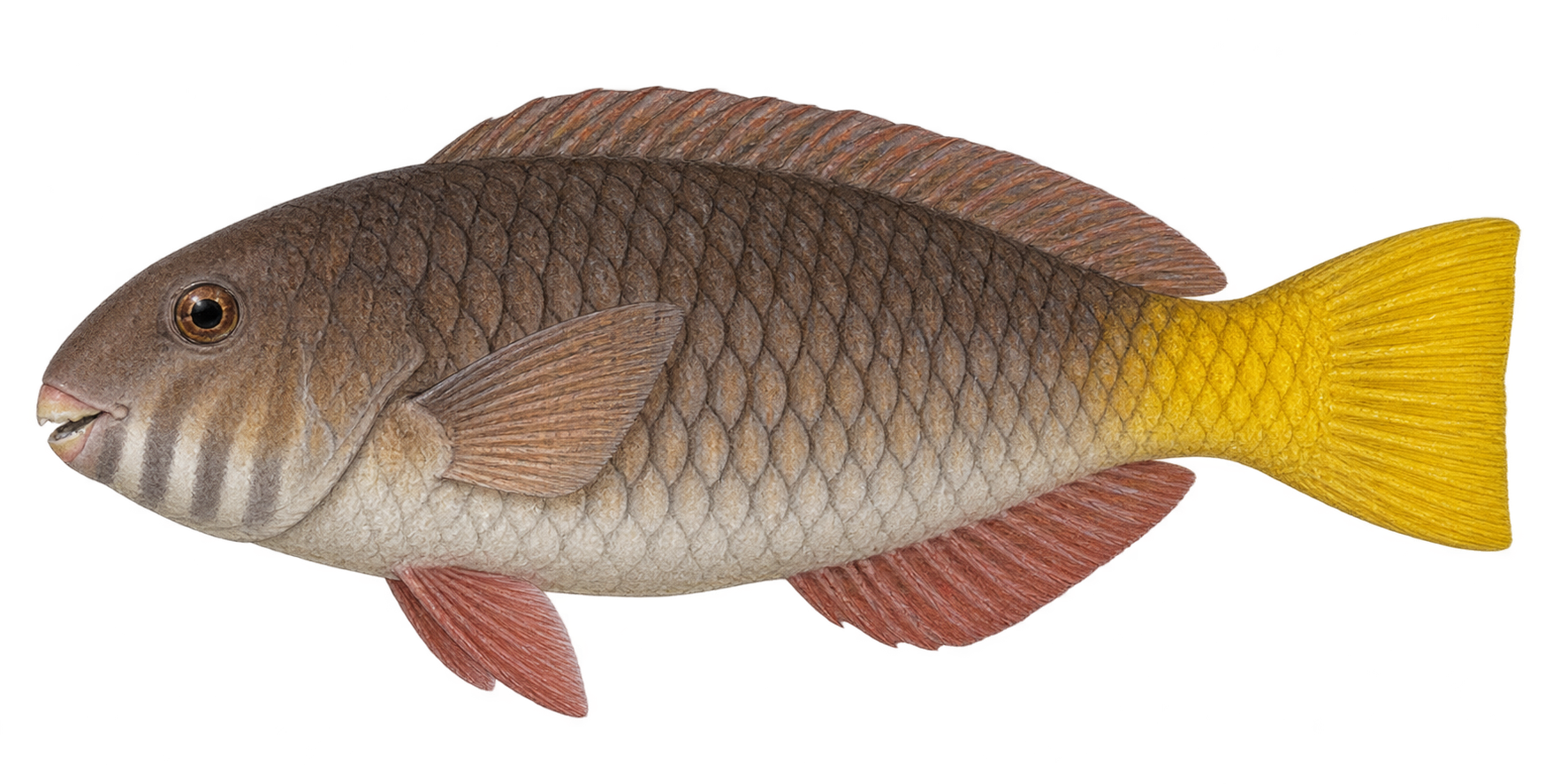
Initial-phase fish are gray-brown with dark scale edges, a yellow tail base and tail, and reddish pelvic and anal fins. Terminal-phase fish are greener, with a red iris, a dark pectoral-fin-base blotch and a pale or yellowish rear tail crescent. The two appearances belong to the same species; a yellow tail alone is not a complete identification.
Sources: Smithsonian Tropical Research Institute: yellowtail parrotfish
Size and life stages
Smithsonian reports a maximum of 48 cm (19 inches) and an age of at least six years. Juveniles resemble the initial phase. Color phase is not a simple age ruler or a reliable way to assign sex to every individual. Photograph the fish’s proportions and fin pattern instead of labeling a gray fish an immature female by default.
Sources: Smithsonian Tropical Research Institute: yellowtail parrotfish
Habitat and where to look
Reef habitat connects with adjacent seagrass and algal beds in the reviewed accounts. Watch the transition from hard bottom to vegetation, where a grazing fish may move between surfaces. Avoid hovering so low that fins or camera equipment scrape the very habitat you are trying to document.
Sources: Smithsonian Tropical Research Institute: yellowtail parrotfish; Fishes of Texas Project: yellowtail parrotfish biology and reproductive uncertainty
Range and local context
The Smithsonian regional account extends from Bermuda through the southern Caribbean. Older broad accounts include distant Atlantic populations now separated or questioned in later treatments, so this guide does not transfer every historical record into the modern species. The local basis is the species-specific Blue Heron Bridge REEF entry.
Sources: Smithsonian Tropical Research Institute: yellowtail parrotfish
What is on the menu?
This is a vegetation-feeding parrotfish. Sources list benthic algae and seagrasses rather than a diet consisting only of coral. The mouth and throat have different processing structures, including crushing teeth in the throat. A bite at a reef surface should not automatically be described as eating live coral tissue.
Sources: Smithsonian Tropical Research Institute: yellowtail parrotfish; Fishes of Texas Project: yellowtail parrotfish biology and reproductive uncertainty
Daily habits and behavior
Juveniles and initial-phase fish can rapidly become mottled while settling on the bottom, as summarized by the Fishes of Texas account. Treat changing color as part of the observation. A useful sequence can show the same fish before and after it rests without disturbing it to force the change.
Sources: Fishes of Texas Project: yellowtail parrotfish biology and reproductive uncertainty
Mating and the next generation
Group spawning is documented, and eggs and larvae enter the water column. Published summaries disagree about whether the species should be described as routinely changing from female to male; the Fishes of Texas account preserves evidence that challenges that simple interpretation. We therefore do not assign sex or promise sex change from color phase alone.
Sources: Smithsonian Tropical Research Institute: yellowtail parrotfish; Fishes of Texas Project: yellowtail parrotfish biology and reproductive uncertainty
Look-alikes and identification traps
Other gray or green Sparisoma parrotfishes can overlap in appearance. Compare the tail base, iris, pectoral-base mark and complete lower-fin color together. Initial-phase redband parrotfish may show a small pale upper tail-base spot rather than the yellowtail’s yellow tail region. Poor light can hide red fins and exaggerate how similar two fish appear.
Sources: Smithsonian Tropical Research Institute: yellowtail parrotfish; https://biogeodb.stri.si.edu/caribbean/en/thefishes/species/3921
Observe without disturbing
Let the animal graze undisturbed. Avoid blocking its route or separating fish from a group, and never touch a resting individual to reveal its colors. Keep photographs of the same fish together so rapid pattern changes are not mistaken for two species. Collection rules require a separate check and are not implied by identification.
Sources: Smithsonian Tropical Research Institute: yellowtail parrotfish; Fishes of Texas Project: yellowtail parrotfish biology and reproductive uncertainty
Harvest, protection and eating safety
Live-only ornamental collection; no collection at Blue Heron Bridge
Yellow means legal or safety conditions require attention. It is not an edible badge or permission to take an animal.
This color is a qualified summary, not permission to collect or a guarantee that a particular animal is safe to eat.
Can it be hunted or harvested?
Yellowtail (Redfin) Parrotfish falls under Florida’s parrotfish category, called family Scaridae in the regulations. A recreational saltwater fishing license is required unless exempt. Where collection is lawful, the animal must be landed alive and maintained alive in a suitably sized circulating, aerated or oxygenated system. The recreational limit is five of this species within 20 marine-life organisms per person per day; the two-day possession limit is ten of this species within 40 total. Recreational sale is prohibited. Maximum 12 inches total length.
Florida seasons and areas
The designated Blue Heron Bridge Special Marine Life Area, including Phil Foster Park and its mapped surrounding waters, is closed to collection of listed tropical ornamental marine life. Narrow motorized-vessel transit and landing exceptions concern animals lawfully taken elsewhere, not collection here. The Florida marine-life requirements also apply in adjacent federal waters. No species-specific annual closed months are stated in the reviewed marine-life table. Biscayne National Park, state parks, wildlife refuges and Florida Keys sanctuary zones can impose additional closures; check the actual location before collecting.
Can it be speared?
No recreational spearing under these live-only marine-life requirements. Collection uses authorized nonlethal hand/net/slurp-gun methods, subject to species and site restrictions. Quinaldine is prohibited.
Is it safe to eat?
This is live-only ornamental collection, not food harvest. Do not kill a collected animal for a meal. No recipe or safe-to-eat claim is provided.
This is Sparisoma rubripinne, not yellowtail snapper. Modern taxonomic placement within Labridae does not remove the rule’s explicit parrotfish category.
Palm Beach is Atlantic Florida. Do not transfer Atlantic guidance to the Gulf, Monroe County, or federal waters without checking the applicable rules.
Before you act: Confirm the species, date, exact management area, state or federal waters, gear, licenses and current local closures. A local occurrence record never grants permission to take an animal.
Official rules and health guidance
- FWC recreational marine-life requirements and species list
- Florida Rule 68B-42.001: listed marine-life species
- Florida Rule 68B-42.0036: mapped marine-life collection closures
- Palm Beach County: Phil Foster Park fishing and collection notice
- FWC spearing restrictions
- NOAA: Florida Keys sanctuary zones
- Florida Rule 68B-42.005: final-adopted recreational bag rule register
Reviewed 2026-11-11. Rules and advisories can change; check the linked authorities before acting.
Identification and source cautions
- Reproductive-system summaries conflict; routine protogyny is not asserted.
- Older Brazil/eastern Atlantic range claims can include other Sparisoma taxa.
Sources and review
Biology and taxonomy reviewed 2026-11-11. Photographs on cited sites are reference material and are not reproduced here.
Make your next dive happen
Dive With Us
Explore local charters and plan a dive suited to your experience.
View dive calendarTrain With Us
Build your fish identification, buoyancy and diving skills.
Explore trainingTravel With Us
Discover upcoming dive adventures and trip details.
Explore dive travelShop With Us
Browse equipment for your diving and ask our team for help choosing.
Explore dive gearReview current dates, availability, prices, inclusions and requirements on each listing before booking or buying.
Call us now
Ask about marine life identification
Marine Life Identification
Ask about dates, prerequisites or your next step. An inquiry does not reserve a place. Please provide your own contact details; do not include medical, payment or a child's personal information.
We use these details to respond to your inquiry. This form does not sign you up for marketing.
Explore more with Stuart Scuba
Open Water course options · Advanced Adventure training · Technical training · Professional training · All courses · Local dives · Dive trips · Facebook · Instagram · YouTube
Your surface-interval essentials
Questions for Stuart Scuba? info@stuartscuba.com
Check the Stuart Scuba Weather Center · Play scuba trivia
Weather and wildlife vary. Confirm current conditions, trip requirements and departure details with the operator.
Plan Your Next Dive with Stuart Scuba
Dive With Us
Explore upcoming local charters and choose a dive that fits your experience.
Before you book
Check the individual listing for departure time, requirements and availability.
Travel With Us
Find upcoming dive adventures and start planning your next trip.
Plan your trip
Review dates, inclusions and trip details on the travel calendar.
Stay Connected with Stuart Scuba
 Follow pageShare
YouTube
SubscribeWatch & shareFollow on InstagramView & share post
Follow company news, training updates, and dive stories.
Follow on LinkedInGoogle Reviews
See Stuart Scuba’s current Google rating and review count below. Open the listing in Google Maps to browse customer reviews.



