

Fish identification archive / Yellowtail Damselfish
Yellowtail Damselfish
Microspathodon chrysurus
I saw this
Spotted this marine animal? Share the guide with your dive buddies. Review your caption before posting.
For Instagram, copy the caption and link into your own post or message. Nothing is posted automatically and this does not record a verified sighting.
Fun facts for your next surface interval
- Growing up changes the dress code: electric-blue-spotted youngsters become browner adults.
- A tiny fish with a real-estate opinion: the species is strongly territorial.
- A brush already built in: its flexible upper teeth form a brush-like row.
Florida and local context
Florida-wide documented range; Palm Beach frequency not established: The cited distribution explicitly includes Florida. No Palm Beach abundance or guaranteed sighting is inferred.
Documented regional presence is not a guarantee of an encounter or a measure of how common this animal is at your dive site.
How to recognize this animal
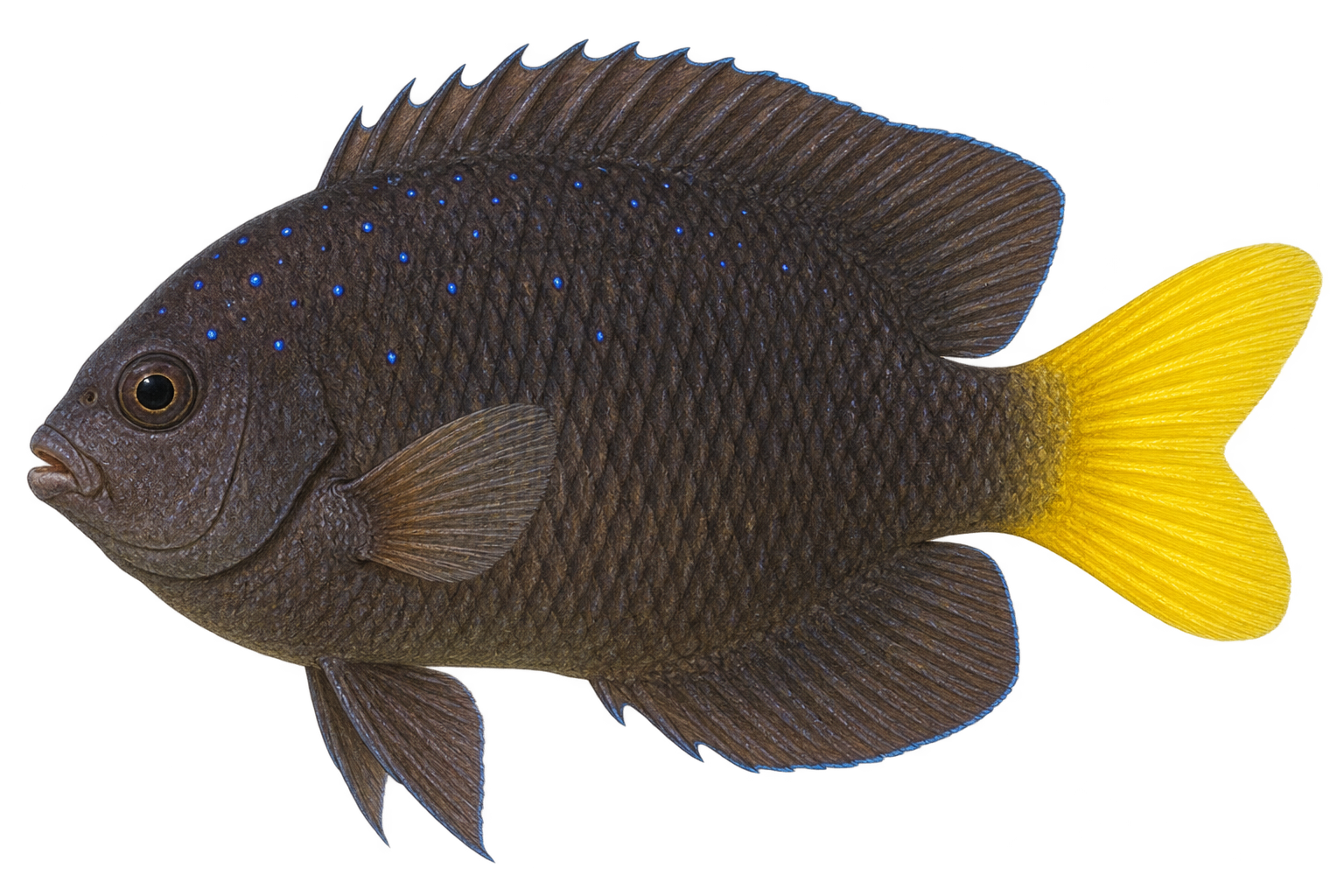
The adult Yellowtail Damselfish is a deep, thick-bodied reef fish, usually gray-brown with scattered bright blue spots on its upper body. The tail is paler and often yellow. Juveniles wear a much darker blue outfit covered with brilliant spots. The adult illustration deliberately avoids that juvenile costume. Look for the chunky body and short face as well as the tail.
Size and life stages
FishBase gives a common length around 15 cm and a maximum of 21 cm, making this a substantial damselfish rather than a tiny chromis. These are reference sizes, not a prediction for every Florida fish. A side view helps distinguish a broad adult from a smaller, more elongated fish when distance and water clarity make length estimates unreliable.
Habitat and where to look
It lives on coral and rocky reefs, often in shallow water. Juveniles are associated with branching fire coral in published accounts. That association is a reason to look carefully, not to touch: stay clear of both the fish and its living shelter. Search from outside the branches, and leave an obscured youngster partly hidden rather than trying to improve the view.
Range and local context
Verified distribution accounts include southern Florida and Bermuda through the Caribbean to Brazil. The Lake Worth Lagoon working checklist contains a row for this species but no verification mark, so that row is not used here as proof of a local sighting. This profile establishes Florida occurrence while leaving Palm Beach frequency and any particular dive-site encounter unclaimed.
What is on the menu?
Food includes algae and small reef-associated animal material. Juveniles can also act as cleaners, removing items from other fishes. A fish nibbling close to a larger animal is therefore not necessarily attacking it. Watch whether the larger fish holds position and permits the contact, but avoid assigning a cleaning interaction when the behavior is too brief or obscured to interpret.
Daily habits and behavior
Yellowtail Damselfish is territorial and can be assertive toward other reef residents. Its comparatively sturdy build gives a different impression from the loose groups of plankton-feeding chromis overhead. Observe repeated returns to a feeding area and the directions of any short chases. Do not test the fish's persistence by moving a finger or object toward it.
Mating and the next generation
Like other documented damselfishes, it lays adhesive eggs on the bottom and the male tends them. The larvae subsequently enter open water. Nest care connects the apparently busy movements of an adult with a vulnerable early life stage that a casual observer might never see. Keep a comfortable distance from repeated nest-directed activity and avoid shining lights into the same spot for extended periods.
Look-alikes and identification traps
Young Beaugregory and Cocoa Damselfish may also be blue-spotted and yellowish. Compare the overall depth of the body and any dorsal eyespot, rather than relying on bright dots alone. Adult yellowtail damselfish is robust and often noticeably larger. Yellowtail Reeffish has a different, deeply forked chromis-like tail and should not be identified from a shared common-name fragment.
Observe without disturbing
Photograph the natural adult or juvenile phase you actually see and label it accordingly. Do not push a young fish out of branching coral or provoke an adult to demonstrate its territorial behavior. Keep fins and dangling gauges away from the reef. If a clean diagnostic view never appears, record the encounter as tentative and enjoy the fish without forcing the identification.
Harvest, protection and eating safety
Restricted marine life: live collection only; no spearing
Can it be hunted or harvested?
Yellowtail Damselfish is regulated live ornamental marine life, not an ordinary food-fishing target. FWC lists no species-specific size limit for this damselfish. A saltwater fishing license is required unless exempt. Fish must be landed and kept alive with adequate aeration or circulating water. Daily limit: five of this species within 20 marine-life organisms; possession: ten within 40. Recreational sale is prohibited.
Florida seasons and areas
No recreational closed months are listed for this species in the reviewed marine-life rules. Collection is prohibited within the designated Blue Heron Bridge dive site. Florida marine-life rules also apply in adjacent federal waters. Sanctuary no-take zones and other park or refuge restrictions can close otherwise eligible areas; check the exact site before collecting.
Can it be speared?
Prohibited. FWC expressly includes damselfishes among ornamental reef-fish families that cannot be taken by spearing. Chromis and reeffishes are damselfishes too.
Is it safe to eat?
This live-collection classification is not an eating-safety approval. No species-specific Florida consumption clearance was verified. Do not assume a fish is safe because it is small, colorful or absent from an advisory chart. Marine toxins can cause illness despite cooking; consult current local health guidance rather than using this identification page as permission to eat it.
Before you act: This recreational overview is not permission to collect or spear at your dive site. Confirm the species, date, management area, state or federal waters, gear, licenses and current local closures. Identification artwork cannot establish an identification or guarantee seafood safety.
Official rules and health guidance
- FWC: Recreational Marine Life
- Florida Administrative Code: current Marine Life chapter 68B-42
- FWC: Saltwater Recreational Licenses
- NOAA: Florida Keys Sanctuary Regulations
- FWC: Spearing
- Florida Department of Health: Eating Healthy Seafood
- Florida Department of Health: Seafood Poisoning
- FDA/EPA: Advice about Eating Fish
Reviewed 2026-11-10. Rules and advisories can change; check the linked authorities before harvesting or eating.
Sources and review
Reviewed 2026-11-10.
Make your next dive happen
Dive With Us
Explore local charters and plan a dive suited to your experience.
View dive calendarTrain With Us
Build your fish identification, buoyancy and diving skills.
Explore trainingTravel With Us
Discover upcoming dive adventures and trip details.
Explore dive travelShop With Us
Browse equipment for your diving and ask our team for help choosing.
Explore dive gearReview current dates, availability, prices, inclusions and requirements on each listing before booking or buying.
Call us now
Ask about marine life identification
Marine Life Identification
Ask about dates, prerequisites or your next step. An inquiry does not reserve a place. Please provide your own contact details; do not include medical, payment or a child's personal information.
We use these details to respond to your inquiry. This form does not sign you up for marketing.
Explore more with Stuart Scuba
Open Water course options · Advanced Adventure training · Technical training · Professional training · All courses · Local dives · Dive trips · Facebook · Instagram · YouTube
Your surface-interval essentials
Questions for Stuart Scuba? info@stuartscuba.com
Check the Stuart Scuba Weather Center · Play scuba trivia
Weather and wildlife vary. Confirm current conditions, trip requirements and departure details with the operator.
Plan Your Next Dive with Stuart Scuba
Dive With Us
Explore upcoming local charters and choose a dive that fits your experience.
Before you book
Check the individual listing for departure time, requirements and availability.
Travel With Us
Find upcoming dive adventures and start planning your next trip.
Plan your trip
Review dates, inclusions and trip details on the travel calendar.
Stay Connected with Stuart Scuba
 Follow pageShare
YouTube
SubscribeWatch & shareFollow on InstagramView & share post
Follow company news, training updates, and dive stories.
Follow on LinkedInGoogle Reviews
See Stuart Scuba’s current Google rating and review count below. Open the listing in Google Maps to browse customer reviews.



