

Fish identification archive / Yellowhead Wrasse
Yellowhead Wrasse
Halichoeres garnoti
I saw this
Spotted this marine animal? Share the guide with your dive buddies. Review your caption before posting.
For Instagram, copy the caption and link into your own post or message. Nothing is posted automatically and this does not record a verified sighting.
Fun facts for your next surface interval
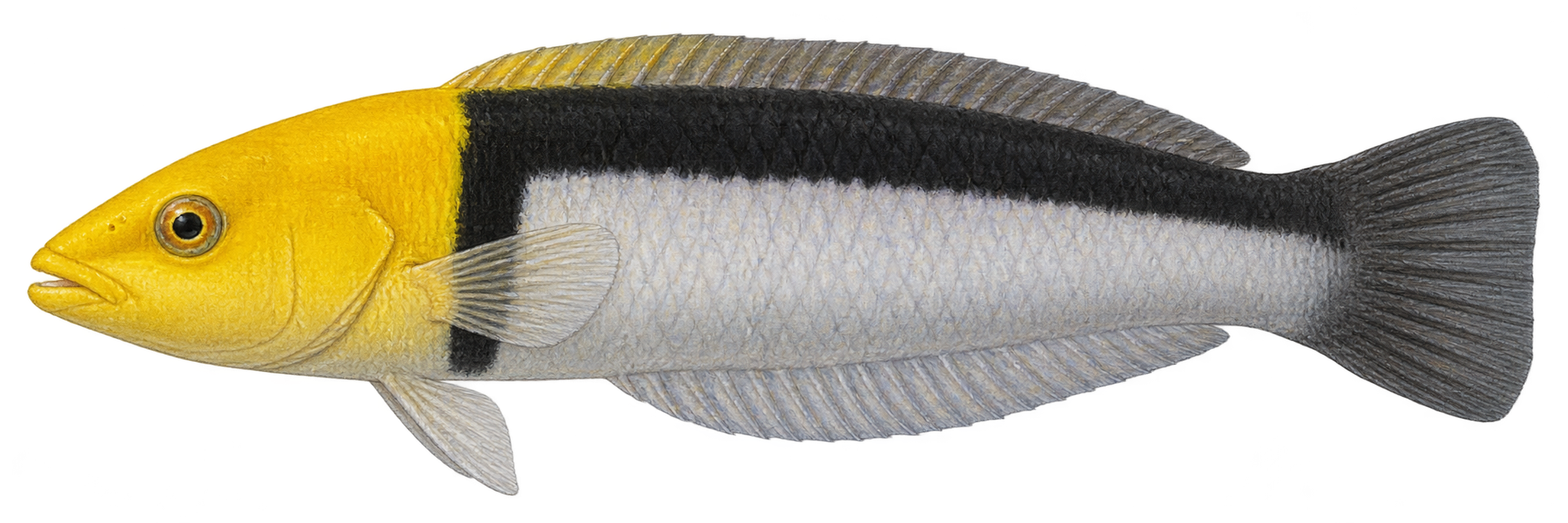
- The terminal adult wears a black T, a handy underwater identification letter.
- Its juvenile outfit is yellow with a blue racing stripe.
- It can benefit when another bottom-feeding fish uncovers lunch.
Florida and local context
Lake Worth Lagoon / Blue Heron Bridge, Palm Beach County: Florida Museum checklist explicitly marks this species verified. This documents occurrence, not local abundance.
Documented regional presence is not a guarantee of an encounter or a measure of how common this animal is at your dive site.
How to recognize this animal
A terminal-phase yellowhead wrasse is among the easier wrasses to recognize: a bright yellow head meets a thick black vertical bar, which joins a black stripe along the upper back. Together they form a bold T-shaped mark above a pale lower body. Juveniles are yellow with a blue stripe; initial-phase fish have more brown across the upper front.
Size and life stages
The species reaches about 12 inches, or 30 centimeters, in total length. A small yellow fish may represent an earlier stage, not a miniature version of the illustrated adult pattern. Include the snout and tail in size estimates and photographs. The most helpful record pairs an approximate length with a description of the stripe or black bar actually seen.
Habitat and where to look
Rubble and sand around reef margins are characteristic habitat. These edges offer places to search for food and suitable sand for shelter. During a dive, scan the low spaces between reef outcrops rather than only the open water overhead. Avoid resting a knee or fin in a sandy patch simply because it appears empty at first glance.
Range and local context
Yellowhead wrasse occurs in Florida and the tropical western Atlantic. Its Lake Worth Lagoon checklist entry is explicitly verified, supplying documented Palm Beach County occurrence. Regional ranges in older references extend farther south than some modern treatments, so this profile keeps the geographic claim to the well-supported Florida and Caribbean area instead of promising a worldwide distribution.
What is on the menu?
It eats small invertebrates, including worms, crustaceans, mollusks and echinoderms. Published observations also describe wrasses taking advantage of prey disturbed by other bottom-feeding fishes. If several species travel together, watch who is disturbing the bottom and who is collecting exposed food. That can reveal a feeding relationship without requiring you to intervene or provide bait.
Daily habits and behavior
The bright yellow head is only one chapter of the identification story. A juvenile's blue stripe, an initial fish's brown upper front and a terminal fish's black T all matter. These changes make photographs from different years look surprisingly unlike one another. Recording the phase helps other divers compare their sighting with the appropriate reference image.
Mating and the next generation
Eggs and larvae occur in the water column rather than developing as a guarded cluster on the reef. This early drifting stage contrasts with the adult's close association with the bottom. Treat spawning timing as a separate biological question from fishing seasons. A fish being colorful, paired or active does not by itself establish that reproduction is taking place.
Look-alikes and identification traps
The slippery dick often shows two dark stripes in its initial phase and a different green-and-pink terminal pattern. A puddingwife adult has blue scale spotting and pale saddles instead of the yellowhead's bold black T. When viewing a small yellow juvenile, check stripe color and placement carefully; an adult identification shortcut will not cover every young wrasse.
Observe without disturbing
Give a feeding wrasse space to move between reef and sand. Do not kick the bottom, remove rubble or pursue it into cover. A side view that includes the full back is especially valuable for showing the T-shaped marking. Keep the dive plan and your buddy in view while enjoying a fish that rewards a patient, detailed look.
Harvest, protection and eating safety
Restricted marine life: live collection only; no spearing
Can it be hunted or harvested?
Yellowhead Wrasse (Halichoeres garnoti) is restricted tropical ornamental marine life, not an ordinary food-fishing species or a blanket no-take species. Where collection is lawful, a saltwater fishing license is required unless exempt. Land and keep the fish alive with adequate circulation or aeration. No species-specific size limit is listed. Daily limit: five of this species within 20 marine-life organisms total per person. Two-day possession maximum: ten of this species within 40 organisms total. Recreational sale is prohibited.
Florida seasons and areas
No annual recreational closed months are listed for this marine-life species. Collection is prohibited within the designated Blue Heron Bridge dive-site boundary and throughout Biscayne National Park. Florida marine-life rules also apply in adjacent federal waters on both coasts. Check the exact sanctuary, park and refuge zone before collecting. Western Dry Rocks’ designated one-square-mile area is closed to all fishing April 1–July 31 annually.
Can it be speared?
No. Spears are not authorized recreational gear for this regulated tropical marine-life fish. Use only lawful live-collection methods, such as permitted hand-held, barrier or drop nets or a slurp gun, and comply with the live-landing requirement.
Is it safe to eat?
Not recommended as a food target. This species is regulated for live collection, and this guide does not certify it as safe to eat. Check Florida DOH guidance before eating any locally caught fish. Cooking does not remove all marine toxins, and legal collection is not evidence of food safety.
Before you act: This recreational overview is not permission to collect or spear at your dive site. Confirm the species, date, management area, state or federal waters, gear, licenses and current local closures. Identification artwork cannot establish an identification or guarantee seafood safety.
Official rules and health guidance
- FWC recreational marine-life rules
- FWC recreational saltwater licenses and exemptions
- FWC Biscayne National Park limits and closed areas
- NOAA Florida Keys sanctuary zones
- Florida Administrative Code 68B-42.007: marine-life gear
- Florida DOH seafood-consumption guidance
- Florida DOH ciguatera and other seafood poisoning
- FWC Western Dry Rocks seasonal closure
Reviewed 2026-11-10. Rules and advisories can change; check the linked authorities before harvesting or eating.
Sources and review
Reviewed 2026-11-10.
Make your next dive happen
Dive With Us
Explore local charters and plan a dive suited to your experience.
View dive calendarTrain With Us
Build your fish identification, buoyancy and diving skills.
Explore trainingTravel With Us
Discover upcoming dive adventures and trip details.
Explore dive travelShop With Us
Browse equipment for your diving and ask our team for help choosing.
Explore dive gearReview current dates, availability, prices, inclusions and requirements on each listing before booking or buying.
Call us now
Ask about marine life identification
Marine Life Identification
Ask about dates, prerequisites or your next step. An inquiry does not reserve a place. Please provide your own contact details; do not include medical, payment or a child's personal information.
We use these details to respond to your inquiry. This form does not sign you up for marketing.
Explore more with Stuart Scuba
Open Water course options · Advanced Adventure training · Technical training · Professional training · All courses · Local dives · Dive trips · Facebook · Instagram · YouTube
Your surface-interval essentials
Questions for Stuart Scuba? info@stuartscuba.com
Check the Stuart Scuba Weather Center · Play scuba trivia
Weather and wildlife vary. Confirm current conditions, trip requirements and departure details with the operator.
Plan Your Next Dive with Stuart Scuba
Dive With Us
Explore upcoming local charters and choose a dive that fits your experience.
Before you book
Check the individual listing for departure time, requirements and availability.
Travel With Us
Find upcoming dive adventures and start planning your next trip.
Plan your trip
Review dates, inclusions and trip details on the travel calendar.
Stay Connected with Stuart Scuba
 Follow pageShare
YouTube
SubscribeWatch & shareFollow on InstagramView & share post
Follow company news, training updates, and dive stories.
Follow on LinkedInGoogle Reviews
See Stuart Scuba’s current Google rating and review count below. Open the listing in Google Maps to browse customer reviews.



