

Fish identification archive / Yellowhead Jawfish
Yellowhead Jawfish
Opistognathus aurifrons
I saw this
Spotted this fish? Share the guide with your dive buddies. Review your caption before posting.
For Instagram, copy the caption and link into your own post or message. Nothing is posted automatically and this does not record a verified sighting.
Fun facts for your next surface interval
- Its mouth is both a lunch catcher and a tiny construction shovel.
- Dad carries the nursery in his mouth: no spare room required.
- A four-inch fish can have a very large presence when only its yellow face is peeking out.
Palm Beach connection
Lake Worth Lagoon / Blue Heron Bridge, Palm Beach County: Verified species row (x).
Documented regional presence is not a guarantee of an encounter or a measure of how common this fish is at your dive site.
How to recognize this fish
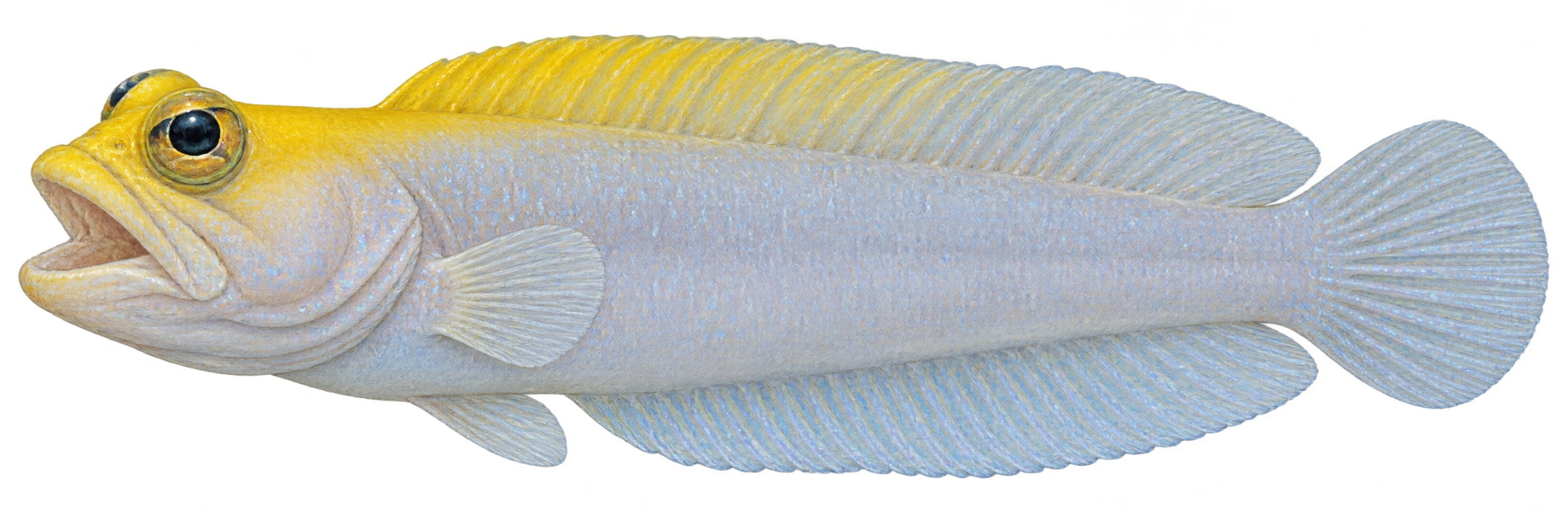
The yellow face is the first clue, but the rest of the fish matters too: a pale blue-gray body, large projecting eyes and a remarkably broad mouth. Fine blue spotting can show in good light. Often only the head is visible at the burrow entrance, so an incomplete view should be recorded as just that.
Size and life stages
This is a small fish, reaching about 10 centimeters, or four inches. Its impressive mouth can make a close-up portrait seem much larger than the animal really is. Photographing a surrounding patch of undisturbed substrate as well as the fish gives a useful sense of scale without placing an object beside its home.
Habitat and where to look
Yellowhead jawfish occupy burrows in sand and broken-coral substrate near reefs. The empty-looking space between reef structures is therefore worth watching. Settle your buoyancy before approaching, then scan for small yellow heads or a hovering fish. Do not kneel beside a hole: you may be standing on another animal’s burrow or blocking its escape route.
Range and local context
The species occurs in the western tropical Atlantic, from southern Florida and the Bahamas through the Caribbean toward northern South America. A verified Lake Worth Lagoon entry provides local support for this archive. That historical documentation is not a count of current residents, and a familiar sandy patch may look very different on another dive.
What is on the menu?
Zooplankton drifting through the water supplies the menu. The jawfish can hover near its entrance to intercept small food items rather than ranging widely across the reef. Watch for short feeding movements followed by a return toward the opening. There is no need to add food or stir sediment to make the behavior visible.
Daily habits and behavior
The broad mouth doubles as construction equipment, moving sand and shell fragments while the fish maintains its shelter. Hovering close to home is another useful behavioral clue. A patient, motionless observer may see more than a diver repeatedly approaching the entrance. If the fish withdraws, give it time and space rather than waiting directly over it.
Mating and the next generation
The male incubates a sticky ball of eggs in his mouth. This mouthbrooding protects the developing young and is one of the species’ most memorable behaviors. Courtship may include an arched swimming display with extended fins. Do not try to make a male open his mouth for a photograph; an unobstructed shelter matters more than seeing the eggs.
Look-alikes and identification traps
Other local jawfishes can also appear as a face peering out of sand. The combination of a yellow head and pale blue body is more useful than the burrow alone. Gobies and blennies also use holes, but have different proportions and head details. A full side view helps; never coax a fish out to obtain one.
Observe without disturbing
Leave a wide buffer around the burrow and avoid directing fins, exhaust bubbles or lights into the opening. Do not rearrange shells, remove rubble or uncover a hiding fish. Keep observation periods brief, particularly around a mouthbrooding male. For your dive log, note the habitat and observed behavior separately from anything you could not confirm.
Harvest, protection and eating safety
Restricted marine life: live collection only; no spearing
Can it be hunted or harvested?
Yellowhead Jawfish is regulated as tropical ornamental marine life, rather than an ordinary food-fishing target. Where collection is lawful, a recreational saltwater fishing license is required unless exempt; fish must be landed and kept alive with suitable aeration or circulation. Maximum live-collection size: 4 inches total length. The daily limit is five of this species within 20 marine-life organisms total. A two-day possession limit also applies.
Florida seasons and areas
No recreational closed months are listed in the FWC marine-life rules reviewed. This does not make every location open: collection is prohibited within the designated Blue Heron Bridge dive-site boundary. Florida marine-life rules also apply in adjacent federal waters, on both coasts. Check park, refuge and Florida Keys sanctuary restrictions before collecting.
Can it be speared?
Not allowed for recreational marine-life collection. The permitted collection methods are nonlethal live-capture methods; spears are not authorized by the marine-life gear rules.
Is it safe to eat?
Not assessed here as food and not recommended as a food target. Legal live collection is not a finding that a fish is safe to eat. Florida DOH advisories depend on catch location and consumer group; cooking cannot remove all marine toxins.
Before you act: This recreational overview is not permission to collect or spear at your dive site. Confirm the species, date, management area, state or federal waters, gear, licenses and current local closures. A fish illustration cannot establish an identification or guarantee seafood safety.
Official rules and health guidance
- FWC: Recreational Marine Life
- Florida Administrative Code: Marine Life, Chapter 68B-42
- FWC: Saltwater Recreational Licenses and Permits
- NOAA: Florida Keys National Marine Sanctuary Zones
- Florida Administrative Code: Marine-life Gear, 68B-42.007
- Florida Department of Health: Eating Healthy Seafood and Local Advisories
- Florida Department of Health: Seafood Poisoning
Reviewed 2026-11-10. Rules and advisories can change; check the linked authorities before harvesting or eating.
Sources and review
Reviewed 2026-11-10.
Make your next dive happen
Dive With Us
Explore local charters and plan a dive suited to your experience.
View dive calendarTrain With Us
Build your fish identification, buoyancy and diving skills.
Explore trainingTravel With Us
Discover upcoming dive adventures and trip details.
Explore dive travelShop With Us
Browse equipment for your diving and ask our team for help choosing.
Explore dive gearReview current dates, availability, prices, inclusions and requirements on each listing before booking or buying.
Call us now
Ask about fish identification training
Reef Fish Identification
Ask about dates, prerequisites or your next step. An inquiry does not reserve a place. Please provide your own contact details; do not include medical, payment or a child's personal information.
We use these details to respond to your inquiry. This form does not sign you up for marketing.
Explore more with Stuart Scuba
Open Water course options · Advanced Adventure training · Technical training · Professional training · All courses · Local dives · Dive trips · Facebook · Instagram · YouTube
Your surface-interval essentials
Questions for Stuart Scuba? info@stuartscuba.com
Check the Stuart Scuba Weather Center · Play scuba trivia
Weather and wildlife vary. Confirm current conditions, trip requirements and departure details with the operator.
Plan Your Next Dive with Stuart Scuba
Dive With Us
Explore upcoming local charters and choose a dive that fits your experience.
Before you book
Check the individual listing for departure time, requirements and availability.
Travel With Us
Find upcoming dive adventures and start planning your next trip.
Plan your trip
Review dates, inclusions and trip details on the travel calendar.
Stay Connected with Stuart Scuba
 Follow pageShare
YouTube
SubscribeWatch & shareFollow on InstagramView & share post
Follow company news, training updates, and dive stories.
Follow on LinkedInGoogle Reviews
See Stuart Scuba’s current Google rating and review count below. Open the listing in Google Maps to browse customer reviews.



