

Fish identification archive / Yellowfin Tuna
Yellowfin Tuna
Thunnus albacares · Scombridae
I saw this
Spotted this fish? Share the guide with your dive buddies. Review your caption before posting.
For Instagram, copy the caption and link into your own post or message. Nothing is posted automatically and this does not record a verified sighting.
What to look for
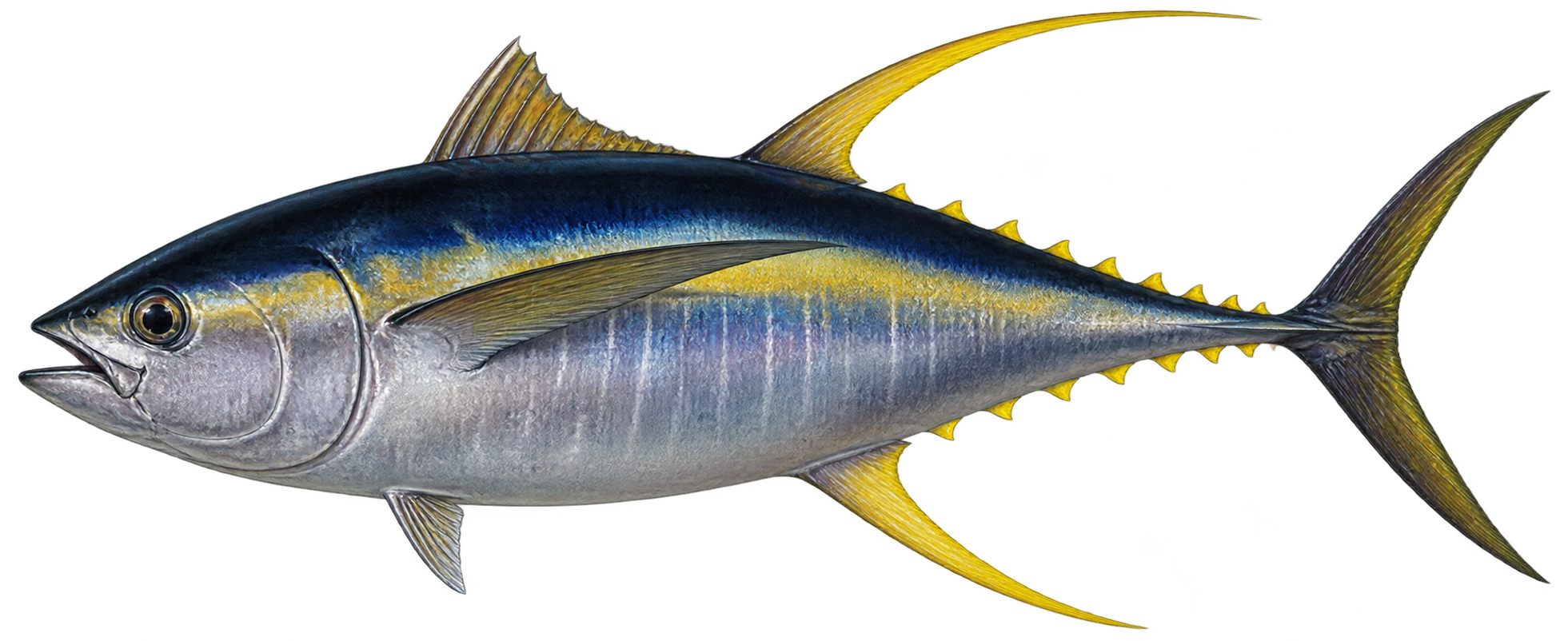
Large yellowfin carry bright yellow second-dorsal and anal fins that can extend into long, curved lobes. Yellow finlets follow them toward the tail, while a golden stripe separates the dark upper body from paler sides. The body is streamlined rather than deep and bulky. Young fish do not always have the dramatic adult fin extensions, so yellow color alone is not enough to separate every small tuna. FWC yellowfin profile
When recording a possible sighting, try for a full side view that includes the pectoral fins, second dorsal fin and tail. Keep the original photograph rather than relying on a heavily saturated crop. Juvenile yellowfin can school with other tunas, so identify each visible fish separately rather than assigning one name to the whole school.
Florida context and biology
FWC describes yellowfin as an offshore species. NOAA places it in tropical and subtropical oceans, usually near the surface, with long migrations across open water. This is regional offshore context, not evidence of a resident fish at a Stuart or Palm Beach dive site. NOAA Atlantic yellowfin biology
Fish, squid and crustaceans form its diet. Most yellowfin begin reproducing at two or three years old. Females release repeated batches of eggs during a spawning season. NOAA’s Gulf and Caribbean spawning schedules differ, so neither should be presented as an exact southeast Florida calendar.
FWC lists 60 inches as a common length, not a maximum, and does not name the measurement method in that summary. Do not turn it into a species ceiling or confuse it with the curved measurement used for legal retention.
Three memorable details
- The long yellow fins are a grown-up feature, not a reliable juvenile name tag.
- A school can contain yellowfin, skipjack and young bigeye tuna together.
- Reproduction is a repeat performance: a female can spawn several times during the season, rather than producing only one batch. NOAA life history
Responsible observation and fishing
Observe without feeding or pursuing the school. Offshore currents, boat traffic and fishing lines deserve more attention than getting a closer photograph.
On November 11, 2026, NOAA’s recreational table listed yellowfin open, with a 27-inch curved fork-length minimum and three per person per day or trip. HMS vessel permits and additional retention restrictions apply. Curved fork length follows the body’s curve from jaw tip to tail fork; it is not ordinary straight-line length. Check the live requirements before fishing. NOAA recreational tuna rules
Make your next dive happen
Dive With Us
Explore local charters and plan a dive suited to your experience.
View dive calendarTrain With Us
Build your fish identification, buoyancy and diving skills.
Explore trainingTravel With Us
Discover upcoming dive adventures and trip details.
Explore dive travelShop With Us
Browse equipment for your diving and ask our team for help choosing.
Explore dive gearReview current dates, availability, prices, inclusions and requirements on each listing before booking or buying.
Call us now
Ask about fish identification training
Reef Fish Identification
Ask about dates, prerequisites or your next step. An inquiry does not reserve a place. Please provide your own contact details; do not include medical, payment or a child's personal information.
We use these details to respond to your inquiry. This form does not sign you up for marketing.
Explore more with Stuart Scuba
Open Water course options · Advanced Adventure training · Technical training · Professional training · All courses · Local dives · Dive trips · Facebook · Instagram · YouTube
Your surface-interval essentials
Questions for Stuart Scuba? info@stuartscuba.com
Check the Stuart Scuba Weather Center · Play scuba trivia
Weather and wildlife vary. Confirm current conditions, trip requirements and departure details with the operator.
Plan Your Next Dive with Stuart Scuba
Dive With Us
Explore upcoming local charters and choose a dive that fits your experience.
Before you book
Check the individual listing for departure time, requirements and availability.
Travel With Us
Find upcoming dive adventures and start planning your next trip.
Plan your trip
Review dates, inclusions and trip details on the travel calendar.
Stay Connected with Stuart Scuba
 Follow pageShare
YouTube
SubscribeWatch & shareFollow on InstagramView & share post
Follow company news, training updates, and dive stories.
Follow on LinkedInGoogle Reviews
See Stuart Scuba’s current Google rating and review count below. Open the listing in Google Maps to browse customer reviews.



