

Fish identification archive / Yellow Stingray
Yellow Stingray
Urobatis jamaicensis
I saw this
Spotted this fish? Share the guide with your dive buddies. Review your caption before posting.
For Instagram, copy the caption and link into your own post or message. Nothing is posted automatically and this does not record a verified sighting.
Fun facts for your next surface interval
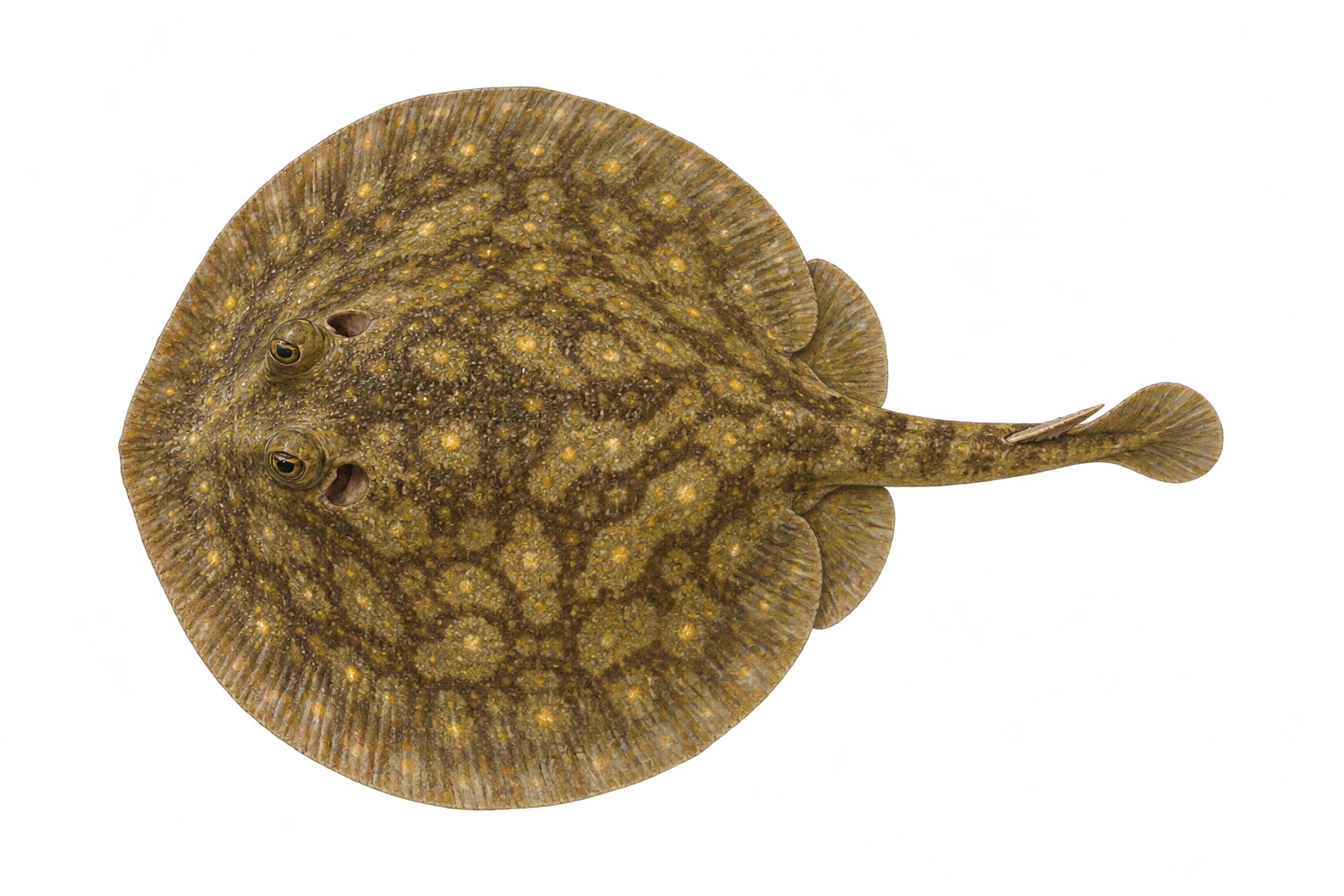
- A tail with a finishing touch: a real tail fin is one of this small ray’s best identification clues.
- A menu audit with 117 diners: Bahamas diet research examined that many individuals rather than guessing from a related species.
- A busy nursery calendar: southeast Florida research documents two reproductive cycles per year.
Palm Beach connection
Lake Worth Lagoon / Blue Heron Bridge: Verified species row in Florida Museum local checklist.
Documented regional presence is not a guarantee of an encounter or a measure of how common this fish is at your dive site.
How to recognize this fish
Look for a small, nearly circular disc with intricate brown, yellowish or greenish mottling. The short tail ends in a noticeable fin, a particularly useful feature when the body pattern blends into the sand. There is no dorsal fin. Eyes and spiracles sit above the disc, while the mouth and gill openings belong on its underside.
Size and life stages
A research review describes an average around 33.5 cm in total length and 16 cm across the disc. Its authors recorded a largest female of 48 cm total length in their own studies and questioned older reports exceeding 60 cm. These are study measurements, not a universal size ceiling. Always distinguish disc width from snout-to-tail length when comparing records.
Habitat and where to look
Shallow sandy or muddy bottoms offer resting and feeding habitat, often alongside seagrass and reefs. A partially buried ray can be difficult to distinguish from the surrounding sediment. Scan ahead without disturbing the bottom, and look for the disc outline and raised eyes. Avoid sweeping sand aside to reveal the rest of an animal.
Range and local context
The yellow stingray is a western Atlantic coastal species, occurring around Florida and through the Caribbean and Gulf of Mexico. The regional Lake Worth Lagoon checklist records it locally. That makes it relevant to Palm Beach identification, but a checklist does not tell you how many are present, how often divers see them, or which patch of sand will be occupied.
What is on the menu?
Species-specific stomach-content research in the Bahamas provides firmer evidence than older guesses based on other rays. In a study of 117 yellow stingrays near southern Eleuthera, polychaete worms and decapod crustaceans dominated the recovered prey. This supports a diet centered on small bottom invertebrates. It does not establish identical dietary proportions for every Florida habitat or season.
Daily habits and behavior
Resting partly within the substrate helps the patterned upper surface disappear against the bottom. A stationary ray may be easier to recognize by its outline than by color. Observe without prompting a swimming display. For notes or photographs, document the natural setting as well as the animal, because a close crop can remove the short tail that helps confirm its identity.
Mating and the next generation
Yellow stingrays bear live young. Southeast Florida reproductive research documents a cycle capable of producing two broods in a year, rather than one brood every two years. Developing embryos receive nourishment from uterine secretions as well as early yolk resources. Timing and reproductive output should be understood in the context of the populations studied, not imposed as a universal dive-site calendar.
Look-alikes and identification traps
The rounded disc and finned, relatively short tail separate this profile from larger, angular rays with long whip-like tails. Pattern alone is unreliable because individuals vary. Modern taxonomy places the species in Urotrygonidae; the older Urolophidae label still appears in some useful identification references. Use the scientific name to keep those older records connected to the correct fish.
Observe without disturbing
Do not touch, uncover, chase or feed the ray. Its defensive tail spine deserves space even when the animal looks small and still. Keep fins and dangling equipment off the seabed, and avoid kneeling where a ray may be concealed. Let a departing animal choose its path rather than moving ahead to stop it for another picture.
Harvest, protection and eating safety
Aquarium live collection only; no food harvest
Can it be hunted or harvested?
Yellow stingray is regulated as marine life, not an ordinary food fish. Recreational collection requires the applicable saltwater license, suitable aeration or circulating live-well equipment, and keeping the animal alive. Limits are five of this species within 20 marine-life organisms per person daily; the two-day possession cap is ten within 40 total. Recreational sale is prohibited.
Florida seasons and areas
FWC lists no species-specific seasonal opening. State marine-life rules also apply in federal waters. Location closures still matter, including the Blue Heron Bridge dive site and restrictions in parks, refuges and the Florida Keys National Marine Sanctuary. Verify the collection site before taking any animal.
Can it be speared?
No spearfishing for recreational collection: allowable marine-life methods require live capture, such as hand collection or specified nets, not piercing the animal.
Is it safe to eat?
Not a food-harvest species. Recreational collection requires keeping yellow stingrays alive, so live-collection permission does not allow killing one for a meal. FDA’s skate category does not establish food safety for yellow stingray.
Before you act: This recreational overview is not permission to collect or spear at your dive site. Confirm the species, date, management area, state or federal waters, gear, licenses and current local closures. A fish illustration cannot establish an identification or guarantee seafood safety.
Official rules and health guidance
Reviewed 2026-11-10. Rules and advisories can change; check the linked authorities before harvesting or eating.
Sources and review
Reviewed 2026-11-10.
- Documented Palm Beach regional occurrence
- O’Shea and colleagues: Yellow Ray Feeding Ecology
- Schieber and colleagues: Yellow Stingray Age and Growth
- Spieler and colleagues: Yellow Stingray Synoptic Review
- Florida Museum: Yellow Stingray anatomy
- Save Our Seas Foundation: Yellow Stingray habitat
- Fahy: Yellow Stingray Biannual Reproduction
Make your next dive happen
Dive With Us
Explore local charters and plan a dive suited to your experience.
View dive calendarTrain With Us
Build your fish identification, buoyancy and diving skills.
Explore trainingTravel With Us
Discover upcoming dive adventures and trip details.
Explore dive travelShop With Us
Browse equipment for your diving and ask our team for help choosing.
Explore dive gearReview current dates, availability, prices, inclusions and requirements on each listing before booking or buying.
Call us now
Ask about fish identification training
Reef Fish Identification
Ask about dates, prerequisites or your next step. An inquiry does not reserve a place. Please provide your own contact details; do not include medical, payment or a child's personal information.
We use these details to respond to your inquiry. This form does not sign you up for marketing.
Explore more with Stuart Scuba
Open Water course options · Advanced Adventure training · Technical training · Professional training · All courses · Local dives · Dive trips · Facebook · Instagram · YouTube
Your surface-interval essentials
Questions for Stuart Scuba? info@stuartscuba.com
Check the Stuart Scuba Weather Center · Play scuba trivia
Weather and wildlife vary. Confirm current conditions, trip requirements and departure details with the operator.
Plan Your Next Dive with Stuart Scuba
Dive With Us
Explore upcoming local charters and choose a dive that fits your experience.
Before you book
Check the individual listing for departure time, requirements and availability.
Travel With Us
Find upcoming dive adventures and start planning your next trip.
Plan your trip
Review dates, inclusions and trip details on the travel calendar.
Stay Connected with Stuart Scuba
 Follow pageShare
YouTube
SubscribeWatch & shareFollow on InstagramView & share post
Follow company news, training updates, and dive stories.
Follow on LinkedInGoogle Reviews
See Stuart Scuba’s current Google rating and review count below. Open the listing in Google Maps to browse customer reviews.



