

Fish identification archive / Yellow box crab
Yellow box crab
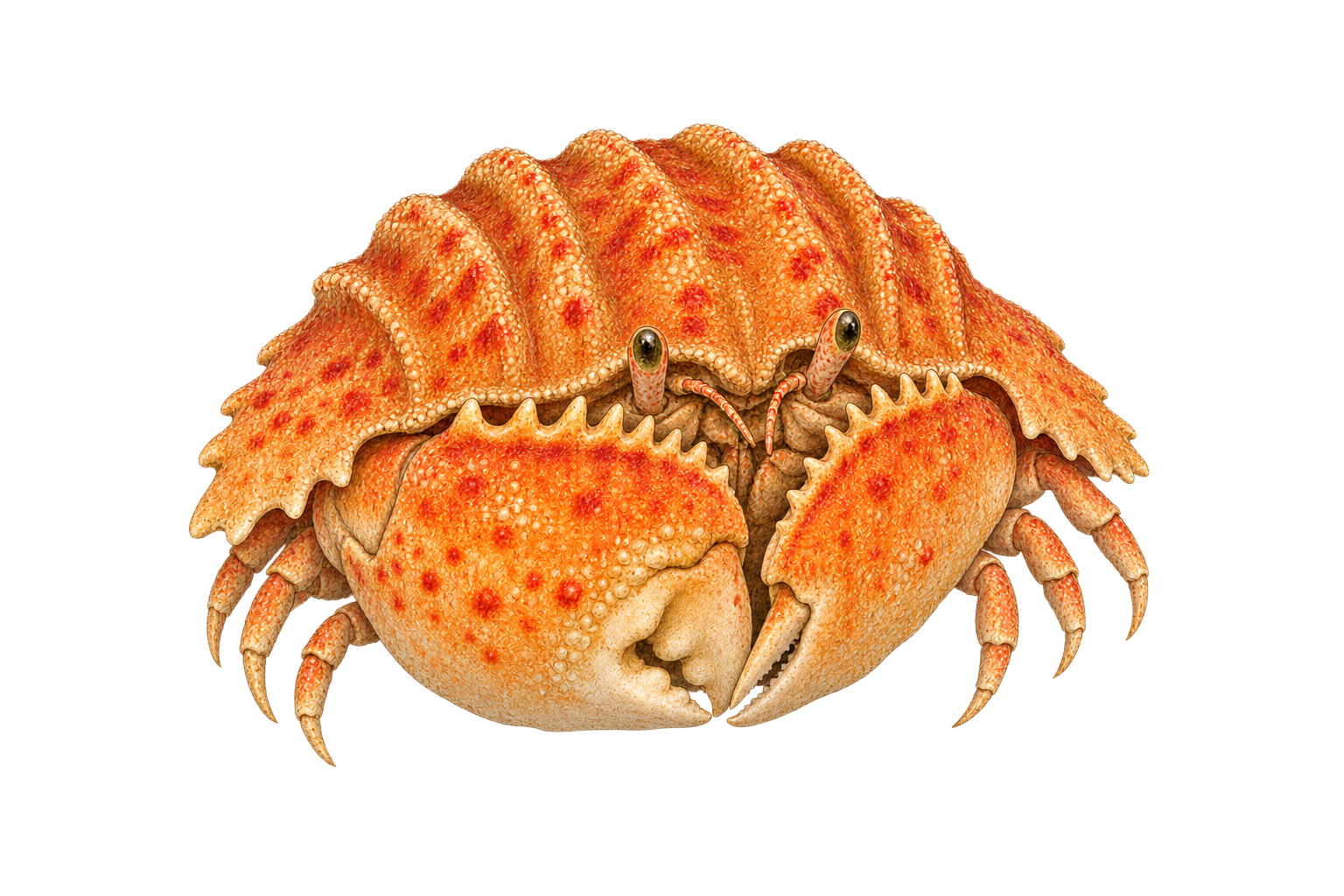
Calappa sulcata
Fun facts for your next surface interval
Florida and local context
Florent Charpin’s species gallery identifies the photographed animal as Calappa sulcata and explicitly captions the photograph Blue Heron Bridge, Florida.
A documented past record does not establish present abundance or guarantee an encounter.
Sources: Florent’s Guide: Yellow box crab at Blue Heron Bridge
How to recognize this animal
Start with the broad, oval shell and the oversized, flattened claws folded across the front. Yellow box crabs are not reliably yellow: recorded colors include pink and dark brown. The shell is wider than long, with a rounded front and a comparatively straight rear edge. Spines edge the sides, with the rearward spine especially prominent. Raised bumps and teeth on the claws provide better clues than a single color impression.
Sources: Texas A&M University at Galveston: Yellow box crab identification
Size and life stages
Texas A&M’s identification guide reports a maximum shell width of 14.5 cm, about 5.7 inches. That measurement is across the carapace, not from the tips of extended legs or claws. A small individual should not automatically be assigned to a different species; size is supporting information rather than an identification on its own.
Sources: Texas A&M University at Galveston: Yellow box crab identification
Habitat and where to look
This is a bottom-associated crab of marine shelf habitats, including muddy ground. Published depth summaries extend from shallow water to roughly 180–200 m, well beyond recreational diving. For a local dive guide, the important evidence is the species-labeled Blue Heron Bridge photography, rather than the assumption that a broadly distributed crab must occur at every nearby reef.
Sources: Reeflex: Calappa sulcata; Florent’s Guide: Yellow box crab at Blue Heron Bridge
Range and local context
The species occurs in the western Atlantic, including Florida, the Gulf of Mexico and Caribbean waters, with records along northern South America and Brazil. Florent’s Guide explicitly places photographed yellow box crabs at Blue Heron Bridge, Florida. That is a documented local occurrence, not a measure of abundance or a prediction for a particular dive.
Sources: Reeflex: Calappa sulcata; Florent’s Guide: Yellow box crab at Blue Heron Bridge
What is on the menu?
Published natural-history accounts describe animal prey including snails, bivalves and hermit crabs, as well as scavenging. The large claws are functional feeding tools. One claw has an enlarged tooth that fits into a depression on the opposing finger; shell-opening adaptations help explain the unusual shape. Do not bait an animal to demonstrate its feeding technique.
Sources: Reeflex: Calappa sulcata; Texas A&M University at Galveston: Yellow box crab identification
Daily habits and behavior
The familiar “shamefaced” posture comes from holding the claws close to the front of the body. Watch the relationship between the shell and folded claws before trying to photograph individual markings. A stationary animal may offer a useful view without intervention. This guide does not assign a local daily activity schedule, which was not established by the reviewed records.
Sources: Reeflex: Calappa sulcata
Mating and the next generation
A species-specific West Palm Beach breeding season, clutch size and larval duration were not verified. Related calappid crabs have planktonic larval stages before becoming bottom-living juveniles, but that family context should not be read as a measured development timetable for this species. A photograph of an adult cannot establish its age or reproductive condition.
Sources: Negreiros-Fransozo and colleagues (2007): box-crab megalopa and juvenile development
Look-alikes and identification traps
The flame box crab, Calappa flammea, is a particularly relevant comparison. Its irregular flame-like lines contrast with the yellow box crab’s less patterned shell. Photograph the shell surface and claw structure together when possible; a partial, sand-covered view may be insufficient for a confident species identification.
Sources: Texas A&M University at Galveston: Yellow box crab identification
Observe without disturbing
Keep fins and equipment clear of the bottom. Never dig out, lift, turn over or reposition a crab for a cleaner photograph. If it retreats or becomes obscured, let it remain there. A useful sighting record includes the date, named dive site and an unaltered image showing the visible identifying features.
Harvest, protection and eating safety
Unknown: exact harvest rules need verification
The neutral gray status means the rules or scope have not been fully verified. Precise take allowance, annual season and food suitability for Calappa sulcata remain unestablished. Do not borrow blue-crab, stone-crab, horseshoe-crab or listed ornamental-crab rules. This is an observation-focused listing, not harvest or spearfishing permission. No local-menu evidence is available.
This color is a qualified summary, not permission to collect or a guarantee that a particular animal is safe to eat.
Can it be hunted or harvested?
Calappa sulcata is a box crab in family Calappidae. It is not a blue crab, stone crab, horseshoe crab or one of the enumerated ornamental crabs in the reviewed marine-life list. Do not copy those species’ seasons, claw rules, size limits or five-per-species aquarium limit onto this animal. Florida requires appropriate licensing and lawful gear for recreational take; no species-specific size or numerical take allowance is established here.
Florida seasons and areas
No annual collection season is asserted. The mapped Blue Heron Bridge closure applies to its defined tropical-ornamental categories, and the park has separate sport-fishing restrictions; neither should be generalized into a statewide box-crab rule. Leave this crab in place on local dives. Before any collection elsewhere, confirm the exact taxon, site, state/federal jurisdiction and any protected-area rule with FWC. Monroe County, Gulf waters and Florida Keys sanctuary areas require separate checks.
Can it be speared?
No species-specific spearfishing clearance is supplied. Do not infer one from the separate blue-crab and stone-crab prohibitions or from their absence for box crabs. General location and gear restrictions still apply.
Is it safe to eat?
No edible or safe-to-eat claim and no recipe are provided. Familiar food-crab advice cannot establish the safety of an unidentified or unreviewed box crab. A collection allowance, if one applies, is not food-safety approval.
Palm Beach is Atlantic Florida. Do not transfer Atlantic guidance to the Gulf, Monroe County, or federal waters without checking the applicable rules.
Before you act: Confirm the species, date, exact management area, state or federal waters, gear, licenses and current local closures. A local occurrence record never grants permission to take an animal.
Official rules and health guidance
- FWC recreational marine-life requirements and species list
- Florida Rule 68B-42.001: listed marine-life species
- FWC: default recreational rules for species without specific limits
- Palm Beach County: Phil Foster Park fishing and collection notice
- FWC spearing restrictions
- Florida Department of Health: seafood toxin warnings
- NOAA: Florida Keys sanctuary zones
Reviewed 2026-11-11. Rules and advisories can change; check the linked authorities before acting.
Identification and source cautions
- Local reproductive timing and species-specific larval duration are not verified.
- Published depth limits differ slightly; neither is a local dive-depth recommendation.
Sources and review
Biology and taxonomy reviewed 2026-11-11. Photographs on cited sites are reference material and are not reproduced here.
Make your next dive happen
Dive With Us
Explore local charters and plan a dive suited to your experience.
View dive calendarTrain With Us
Build your fish identification, buoyancy and diving skills.
Explore trainingTravel With Us
Discover upcoming dive adventures and trip details.
Explore dive travelShop With Us
Browse equipment for your diving and ask our team for help choosing.
Explore dive gearReview current dates, availability, prices, inclusions and requirements on each listing before booking or buying.
Call us now
Ask about marine life identification
Marine Life Identification
Ask about dates, prerequisites or your next step. An inquiry does not reserve a place. Please provide your own contact details; do not include medical, payment or a child's personal information.
We use these details to respond to your inquiry. This form does not sign you up for marketing.
Explore more with Stuart Scuba
Open Water course options · Advanced Adventure training · Technical training · Professional training · All courses · Local dives · Dive trips · Facebook · Instagram · YouTube
Your surface-interval essentials
Questions for Stuart Scuba? info@stuartscuba.com
Check the Stuart Scuba Weather Center · Play scuba trivia
Weather and wildlife vary. Confirm current conditions, trip requirements and departure details with the operator.
Plan Your Next Dive with Stuart Scuba
Dive With Us
Explore upcoming local charters and choose a dive that fits your experience.
Before you book
Check the individual listing for departure time, requirements and availability.
Travel With Us
Find upcoming dive adventures and start planning your next trip.
Plan your trip
Review dates, inclusions and trip details on the travel calendar.
Stay Connected with Stuart Scuba
 Follow pageShare
YouTube
SubscribeWatch & shareFollow on InstagramView & share post
Follow company news, training updates, and dive stories.
Follow on LinkedInGoogle Reviews
See Stuart Scuba’s current Google rating and review count below. Open the listing in Google Maps to browse customer reviews.



