

Fish identification archive / Whale Shark
Whale Shark
Rhincodon typus
Fun facts for your next surface interval
- Big fish, little bites: the biggest living fish feeds largely on very small prey.
- The name can fool you: a whale shark is a fish with gills, despite the whale in its name.
- A remarkable pregnancy record: one examined female carried about 300 embryos, a famous observation that still leaves many reproductive questions unanswered.
Florida and local context
Rare or irregular Florida visitor; documented 2023 Panhandle aggregation; no guaranteed Palm Beach sighting: Destin–Fort Walton Beach’s official account documents a 2023 northwest Florida nearshore occurrence. This dated regional event does not establish Palm Beach presence, regularity or a yearly viewing season.
Documented regional presence is not a guarantee of an encounter or a measure of how common this animal is at your dive site.
How to recognize this animal
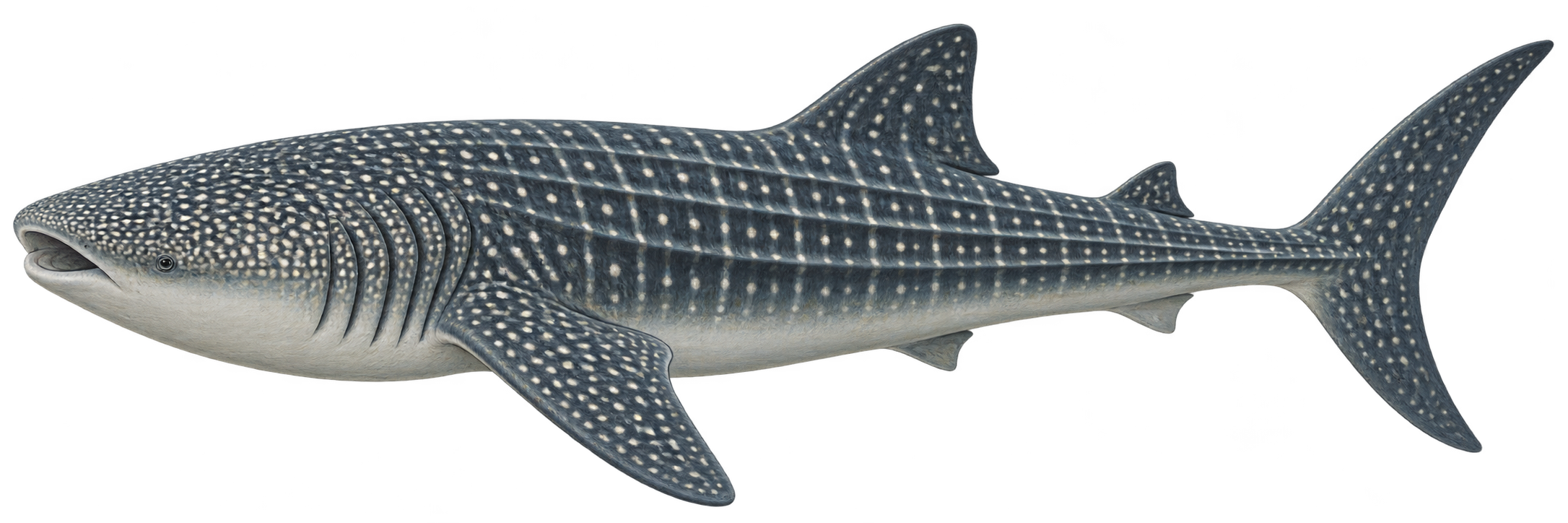
A whale shark has a broad flattened head, an enormous mouth across the front, five large gill openings and pale spots arranged among light lines. Long ridges run along the body. The first dorsal sits well back, and the powerful tail has an especially long upper lobe in younger animals. The spotted pattern is far more useful than size alone.
Size and life stages
This is the largest living fish. Large individuals can exceed 40 feet (12 meters), while extreme maximum estimates vary among sources and should not be treated as a precise Florida expectation. Newborn-sized animals are only around 22–25 inches (55–64 centimeters). A very large shark is not necessarily an adult whose age or reproductive state can be determined from a photograph.
Habitat and where to look
Whale sharks use warm offshore and coastal waters, sometimes appearing near the surface where food is concentrated. They can also travel and dive far beyond a shallow encounter site. A nearshore sighting does not mean the species is restricted to beaches or reefs. Surface feeding can put an animal close to boats, making careful vessel operation especially important.
Range and local context
Florida records are real but encounters are irregular and exceptional. Destin–Fort Walton Beach’s official tourism account documents a 2023 nearshore appearance in northwest Florida. That regional event is not evidence of routine Palm Beach sightings or a predictable annual aggregation. Preserve the distinction between a dated Florida observation and the species’ much broader tropical-ocean distribution.
What is on the menu?
Whale sharks filter small prey, including plankton and small fishes, rather than using their tiny teeth to bite large animals. They may feed by swimming with the mouth open or drawing water into it. A huge mouth therefore does not imply a diet of large prey. Never pour food into the water to create a feeding encounter.
Daily habits and behavior
Long-distance movement connects feeding areas across large ocean regions. An animal may remain briefly where food is abundant and then leave, so a spectacular encounter can be short-lived. Surface swimming is only part of its behavior. Watch from a respectful distance without blocking the head or tail, and do not interpret slow feeding as permission to touch.
Mating and the next generation
Whale sharks give birth to live young, but many details of reproduction remain poorly known. A female examined in Taiwan in 1995 contained about 300 embryos; this remarkable observation is not a reliable ‘typical litter’ for every female. Gestation should not be assigned a confident duration here. Male claspers can identify sex when naturally visible beneath the rear body.
Look-alikes and identification traps
A basking shark also filter-feeds and can be very large, but it lacks the whale shark’s white spot-and-line pattern and broad terminal mouth. Small spotted sharks have very different proportions and fin arrangements. A distant large shadow is not enough for identification. Look for the flat head, front-facing mouth, long body ridges and orderly spotting together.
Observe without disturbing
Do not ride, grab, feed or chase a whale shark, and keep clear of its sweeping tail. Leave open water ahead so it can continue feeding or traveling. For a useful record, photograph the flank pattern from a distance and note date and location. Keep boats away from the animal’s path and avoid turning a rare encounter into a crowd.
Harvest, protection and eating safety
Protected: no state-water harvest
Florida state waters: protected year-round, with no ordinary recreational harvest season. Release accidental catches without delay with gills submerged. Federal species and HMS-vessel rules must also be checked. Shark mercury advice does not create a harvest exception.
This color is a qualified summary, not permission to collect or a guarantee that a particular catch is safe to eat. Read the current rules and health guidance below.
Protected in Florida state waters: no recreational harvest
Can it be hunted or harvested?
Do not harvest, possess or land this species from Florida state waters. No size, bag allowance or harvest permit creates an exception for ordinary recreational fishing. Release an accidental catch without delay, keeping the shark in the water with its gills submerged and following FWC handling requirements.
Florida seasons and areas
Florida state-water protection applies year-round. This is not a claim that every federal shark rule is identical: federal species restrictions and HMS vessel-permit conditions must also be followed for the trip. Marine parks, sanctuaries and local closures may be stricter.
Can it be speared?
No. Florida prohibits spearing sharks, including this protected species. Never use a spear, powerhead or bangstick to collect it.
Is it safe to eat?
Not a food-harvest recommendation: retention is prohibited in Florida state waters. FDA lists shark among the highest-mercury Choices to Avoid for people who are pregnant, might become pregnant or are breastfeeding, and children ages 1–11. Other consumers should consult current Florida DOH species and catch-area advisories; no individual shark is certified safe by this profile. The June 2021 guide currently linked by Florida DOH says not to eat coastal-water sharks 43 inches or longer, for any listed population. Below 43 inches, it advises women of childbearing age and young children not to eat them, and other consumers to limit them to one meal per month. This is an older currently linked guide, not a new 2026 table; recheck the current advisory before eating. The guide defines a meal as six ounces of cooked fish; consult current advice for age-appropriate portions and count other fish eaten as well.
Before you act: This recreational overview is not permission to collect or spear at your dive site. Confirm the species, date, management area, state or federal waters, gear, licenses and current local closures. Identification artwork cannot establish an identification or guarantee seafood safety.
Official rules and health guidance
- FWC current recreational shark rules
- NOAA current HMS recreational guide landing page and permit guidance
- FWC prohibited species, gear and spearing locations
- FDA advice about eating fish
- Florida DOH current fish-consumption advisory portal
- Florida DOH June 2021 guide, currently linked from its advisory portal
Reviewed 2026-11-10. Rules and advisories can change; check the linked authorities before harvesting or eating.
Sources and review
Reviewed 2026-11-10.
- Official Destin–Fort Walton Beach account of the 2023 Florida sighting
- NOAA shark identification guide: diagnostic anatomy, size, habitat and range
- Florida Museum species account: anatomy and life history
- UF/IFAS Florida Sea Grant: claspers and shark/ray reproductive anatomy
- Eschmeyer’s Catalog of Fishes: current taxonomy and synonymy
Make your next dive happen
Dive With Us
Explore local charters and plan a dive suited to your experience.
View dive calendarTrain With Us
Build your fish identification, buoyancy and diving skills.
Explore trainingTravel With Us
Discover upcoming dive adventures and trip details.
Explore dive travelShop With Us
Browse equipment for your diving and ask our team for help choosing.
Explore dive gearReview current dates, availability, prices, inclusions and requirements on each listing before booking or buying.
Call us now
Ask about marine life identification
Marine Life Identification
Ask about dates, prerequisites or your next step. An inquiry does not reserve a place. Please provide your own contact details; do not include medical, payment or a child's personal information.
We use these details to respond to your inquiry. This form does not sign you up for marketing.
Explore more with Stuart Scuba
Open Water course options · Advanced Adventure training · Technical training · Professional training · All courses · Local dives · Dive trips · Facebook · Instagram · YouTube
Your surface-interval essentials
Questions for Stuart Scuba? info@stuartscuba.com
Check the Stuart Scuba Weather Center · Play scuba trivia
Weather and wildlife vary. Confirm current conditions, trip requirements and departure details with the operator.
Plan Your Next Dive with Stuart Scuba
Dive With Us
Explore upcoming local charters and choose a dive that fits your experience.
Before you book
Check the individual listing for departure time, requirements and availability.
Travel With Us
Find upcoming dive adventures and start planning your next trip.
Plan your trip
Review dates, inclusions and trip details on the travel calendar.
Stay Connected with Stuart Scuba
 Follow pageShare
YouTube
SubscribeWatch & shareFollow on InstagramView & share post
Follow company news, training updates, and dive stories.
Follow on LinkedInGoogle Reviews
See Stuart Scuba’s current Google rating and review count below. Open the listing in Google Maps to browse customer reviews.



