

Fish identification archive / Western Atlantic Torpedo
Western Atlantic Torpedo
Tetronarce occidentalis · Torpedinidae
I saw this
Spotted this fish? Share the guide with your dive buddies. Review your caption before posting.
For Instagram, copy the caption and link into your own post or message. Nothing is posted automatically and this does not record a verified sighting.
Identification and comparisons
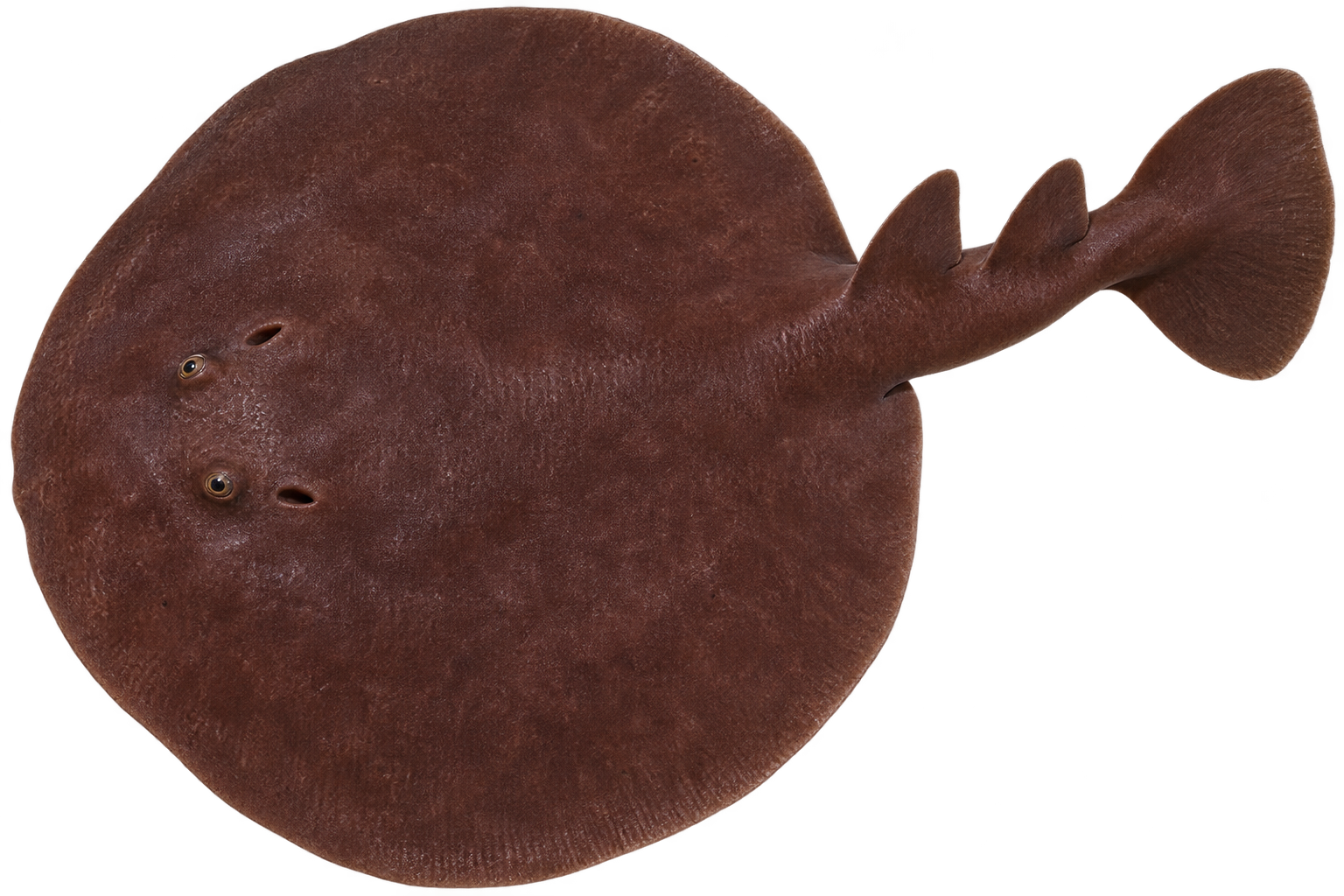
This electric ray has a broad, nearly circular disc, a short stout tail, two dorsal fins and a substantial tail fin. The upper surface is usually uniformly dark brown to purplish brown, with a pale underside. Its small eyes and smooth-edged spiracles help distinguish the torpedo outline from several other rays. It does not have the long whip-like tail associated with many stingrays. Smithsonian identification.
A corrected name and Florida occurrence
Older guides often call the Atlantic torpedo Torpedo nobiliana or Tetronarce nobiliana. Modern references distinguish the Western Atlantic population as Tetronarce occidentalis. The separation involved genetic evidence; appearance alone does not neatly resolve every comparison with eastern Atlantic relatives. Rays of the World, Western Atlantic torpedo account.
The National Park Service lists Atlantic torpedo among fishes reported in Biscayne National Park using the historical name Torpedo nobiliana. That supports a historical local report under the earlier naming system, not a new genetic identification or a promise of frequent sightings. The directory treats this as one revised profile, not two species additions. Biscayne reported-fish list.
Habitat, feeding, breeding and size
The modern Smithsonian account describes soft-bottom habitat and notes that adults may also swim above the bottom. Its species data identify animal prey, including fishes and invertebrates, and live birth. Detailed breeding timing remains poorly resolved. No Florida birth season or litter-size figure is borrowed from older worldwide accounts that combined different torpedo species.
Rays of the World documents at least 154 centimeters total length, including the tail, for this Western Atlantic species. That documented size is not a guaranteed biological ceiling. Electric organs help stun prey and provide defense, according to the New York DEC species assessment.
Three things worth noticing
- A torpedo ray has electric organs, not an electric-eel identity.
- Its stout tail looks very different from a stingray’s whip.
- Historical scientific names can change without creating another local species.
Observation and harvest caution
Do not touch, lift or corner an electric ray. Give a resting animal space and avoid disturbing the sediment around it. No voltage figure is necessary to justify that precaution.
This page does not authorize collection or harvest. Check FWC recreational regulations and the rules of the exact park or sanctuary before any fishing activity. A historical species report establishes neither permission to collect nor current population abundance.
Current observation and collection guidance
This identification guide does not establish permission to collect or harvest this species. Check current FWC rules for Florida waters and possession or landing in Florida, and applicable federal rules for fishing in federal waters. Those jurisdictions are not interchangeable. Biscayne National Park and Florida Keys sanctuary zones can impose additional restrictions or closures. Verify the exact species, location and activity before any proposed take; no food-safety recommendation is made here. FWC recreational saltwater fishing regulations FWC recreational fishing maps FWC guidance for species without individual bag limits Florida shark rule 68B-44.004 Florida Administrative Register notice 30356458 Biscayne National Park fishing regulations Florida Keys National Marine Sanctuary regulations
Make your next dive happen
Dive With Us
Explore local charters and plan a dive suited to your experience.
View dive calendarTrain With Us
Build your fish identification, buoyancy and diving skills.
Explore trainingTravel With Us
Discover upcoming dive adventures and trip details.
Explore dive travelShop With Us
Browse equipment for your diving and ask our team for help choosing.
Explore dive gearReview current dates, availability, prices, inclusions and requirements on each listing before booking or buying.
Call us now
Ask about fish identification training
Reef Fish Identification
Ask about dates, prerequisites or your next step. An inquiry does not reserve a place. Please provide your own contact details; do not include medical, payment or a child's personal information.
We use these details to respond to your inquiry. This form does not sign you up for marketing.
Explore more with Stuart Scuba
Open Water course options · Advanced Adventure training · Technical training · Professional training · All courses · Local dives · Dive trips · Facebook · Instagram · YouTube
Your surface-interval essentials
Questions for Stuart Scuba? info@stuartscuba.com
Check the Stuart Scuba Weather Center · Play scuba trivia
Weather and wildlife vary. Confirm current conditions, trip requirements and departure details with the operator.
Plan Your Next Dive with Stuart Scuba
Dive With Us
Explore upcoming local charters and choose a dive that fits your experience.
Before you book
Check the individual listing for departure time, requirements and availability.
Travel With Us
Find upcoming dive adventures and start planning your next trip.
Plan your trip
Review dates, inclusions and trip details on the travel calendar.
Stay Connected with Stuart Scuba
 Follow pageShare
YouTube
SubscribeWatch & shareFollow on InstagramView & share post
Follow company news, training updates, and dive stories.
Follow on LinkedInGoogle Reviews
See Stuart Scuba’s current Google rating and review count below. Open the listing in Google Maps to browse customer reviews.



