

Fish identification archive / West Indian Sea Egg
West Indian Sea Egg
Tripneustes ventricosus
Fun facts for your next surface interval
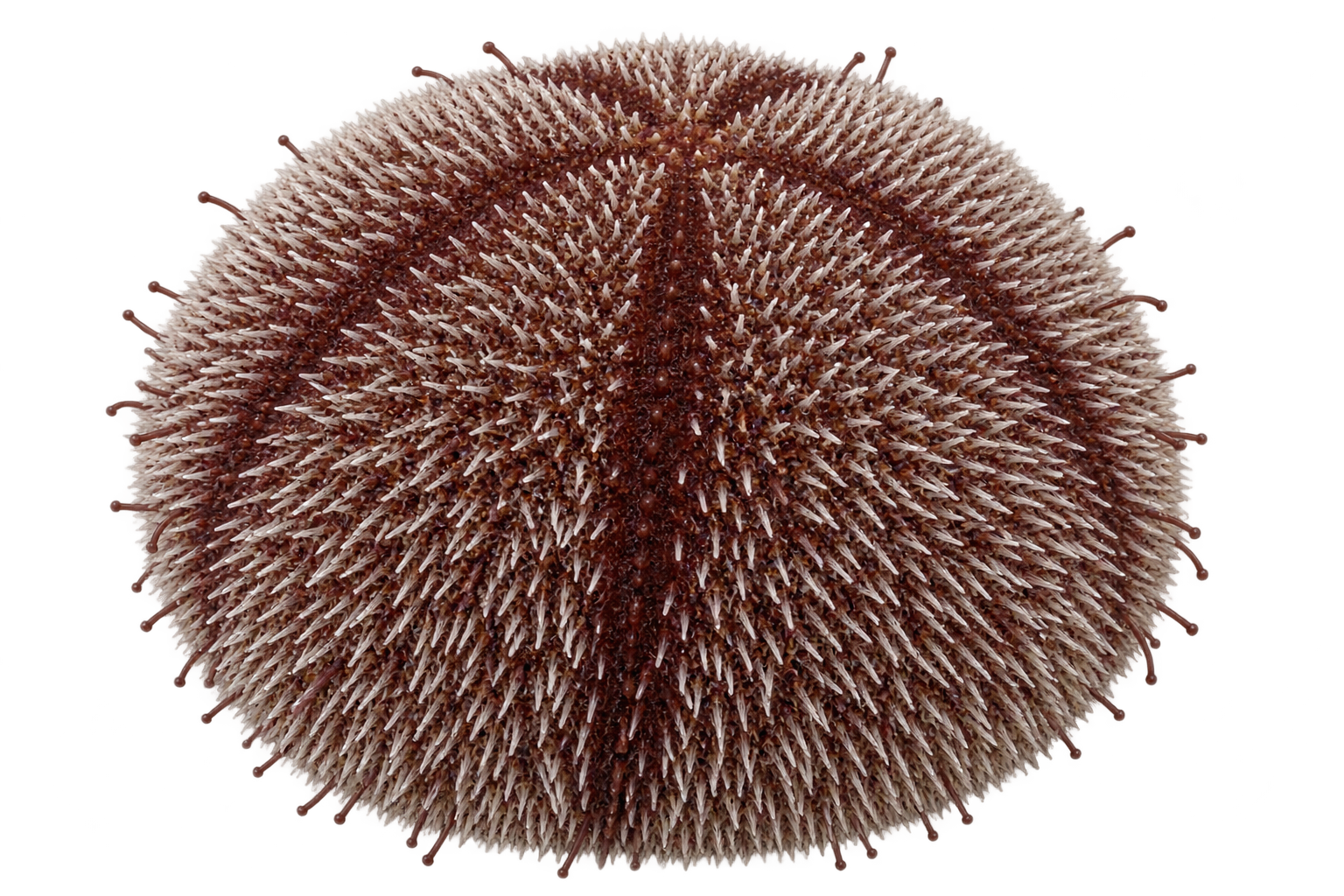
- Not breakfast: the “egg” is a dome-shaped sea urchin.
- Same neighborhood, lighter wardrobe: adults carried less cover than nearby variegated urchins in a Keys study.
- Florida paperwork included: Smithsonian holds a sea-egg specimen from the Florida Keys.
Florida and local context
Florida, regional occurrence: Smithsonian specimen explicitly Florida Keys
Documented regional presence is not a guarantee of an encounter or a measure of how common this animal is at your dive site.
How to recognize this animal
The sea egg has a substantial, rounded brown test clothed in numerous short white spines. Its domed upper surface and relatively flat underside create a compact silhouette. Darker areas show between the spine-covered zones. Compare that combination with the changing green, purple or pale colors of a variegated urchin rather than identifying from the word white alone.
Size and life stages
A Smithsonian Florida Keys account describes an adult test around eleven centimeters in horizontal diameter, a little over four inches, before adding the short projecting spines. Field guides commonly describe animals around ten to thirteen centimeters across. Juveniles can be far smaller and more concealed, so size is a useful supporting feature rather than a standalone diagnosis.
Habitat and where to look
Look in shallow seagrass, on sand close to grass and around algae-covered rocky areas. Historical Florida Keys observations found adults in offshore grass beds and juveniles underneath rocks or within rubble clusters. Those juvenile refuges should remain undisturbed. A photograph of an animal already in the open is more useful than one obtained by turning its shelter over.
Range and local context
The species occurs in the tropical western Atlantic, including Florida, the Bahamas and Caribbean. Smithsonian educational collections explicitly document Florida Keys specimens, and Harvard also holds a Miami specimen. These records establish genuine Florida occurrence. They do not establish current abundance at Stuart, Jupiter or Blue Heron Bridge, and this profile makes no local sighting promise.
What is on the menu?
Algae are an important food, with seagrass and the growth attached to it also relevant in grassy habitats. Smithsonian authors carefully distinguished observed feeding from their interpretation of animals climbing grass. That distinction matters underwater too: an urchin perched on a blade may be grazing the blade or the attached film, which a distant photograph cannot separate.
Daily habits and behavior
It crawls slowly using tube feet and movable spines, and may carry loose material on its upper surface. In the Smithsonian Keys study, adults generally carried less cover than neighboring variegated urchins, although juveniles could be heavily concealed among debris. This is a comparative observation, not an absolute rule that every uncovered urchin must be a sea egg.
Mating and the next generation
Males and females release eggs and sperm into the water, followed by planktonic development and settlement of young urchins. The species has a documented history of Caribbean fisheries and aquaculture research. Reproductive cycles differ among places, so island fishery seasons should never be imported as a Florida breeding or harvest calendar. Reproduction and legal season are separate questions.
Look-alikes and identification traps
Variegated urchins are the most likely shallow-grass confusion. Check the brown test, white short spines and larger rounded form together. Long-spined urchins have an entirely different needlelike outline. A dead white test lacks the living animal’s color and spine arrangement, so a shell-shop specimen should not be the only reference for identifying a live sea egg.
Observe without disturbing
Keep fins above the vegetation and never pick the animal up to inspect its mouth. Photograph the test and spine pattern from an exposed side, preserving the naturally carried material. The legal treatment of a living urchin is different from collecting an empty object, and site protection can prohibit collection even where a statewide category permits it.
Harvest, protection and eating safety
LIVE COLLECTION ONLY — NO FOOD HARVEST
Florida state and adjacent federal waters: limited licensed live collection may be lawful, with live landing/holding, life support, species size rules and bag/possession limits. No species-specific annual closed months are listed, but Blue Heron Bridge, Biscayne and other area closures override that allowance. This is not a blanket ban on lawful live collection or an eating recommendation. Lee prohibits harvest and coastal-water possession; Manatee limits harvest and coastal-water possession to two per species.
This color is a qualified summary, not permission to collect or a guarantee that a particular catch is safe to eat. Read the current rules and health guidance below.
Conditional live collection; marine-life rules
Can it be hunted or harvested?
West Indian Sea Egg falls within FWC’s regulated marine-life group for urchins, Class Echinoidea. Recreational collection requires a Florida saltwater fishing license unless a statutory exemption applies. The daily limit is five of this species within twenty total marine-life organisms per person; two-day possession is ten of this species within forty total. No species-specific size limit is listed. Animals must be landed and kept alive with an adequately sized circulating livewell, aeration or oxygenation system. Recreationally collected marine life cannot be sold.
Florida seasons and areas
No species-specific annual closed season is listed, but this is not permission to collect everywhere. Florida marine-life rules also apply in adjacent federal waters on both the Atlantic and Gulf coasts. Collection is prohibited within the designated Blue Heron Bridge dive-site boundary and throughout Biscayne National Park. Other parks, refuges and Florida Keys sanctuary zones may prohibit collection. Western Dry Rocks is closed to all fishing April 1–July 31. Lee County prohibits harvest of these living mollusks or echinoderms and prohibits possession in or on county Florida waters seaward of mean high water. Manatee County allows no more than two of this species harvested per day and no more than two in possession in or on county Florida waters seaward of mean high water. These local restrictions override the general ten-specimen marine-life possession allowance.
Can it be speared?
No. Recreational marine-life harvest is restricted to authorized non-spearing methods, including hand collection and the listed handheld, drop or barrier nets and slurp gun. A spear is not an authorized collection method; quinaldine is prohibited. The live-landing and live-holding requirements still apply.
Is it safe to eat?
Not presented as a recreational food target. Florida’s marine-life rules require these animals to be landed and kept alive, and an aquarium-collection allowance is not a food-safety finding. No species-specific Florida consumption assessment is established here. Do not infer edibility or safety from the absence of an advisory or from another related species being eaten.
Before you act: This recreational overview is not permission to collect or spear at your dive site. Confirm the species, date, management area, state or federal waters, gear, licenses and current local closures. Identification artwork cannot establish an identification or guarantee seafood safety.
Official rules and health guidance
- FWC: Recreational Marine Life requirements and regulated groups
- FWC: Biscayne National Park fishing regulations
- FWC: Western Dry Rocks April–July fishing closure
- FAC 68B-26.002: Living mollusk and echinoderm definition
- FWC: Recreational Sea Shell Collecting
- Florida Department of Health: Seafood poisoning
- FAC 68B-26.004: Exact Lee and Manatee harvest and in-water possession restrictions
Reviewed 2026-11-10. Rules and advisories can change; check the linked authorities before harvesting or eating.
Sources and review
Reviewed 2026-11-10.
- https://qrius.si.edu/browse/object/10008969
- Smithsonian: Kier and Grant, Echinoid Distribution and Habits, Key Largo Coral Reef Preserve (1966)
- Florent’s Guide: West Indian Sea Egg identification and diagnostic photographs
- FAO: Biology and fishery management of Tripneustes ventricosus
- FWC: Recreational Marine Life requirements and regulated groups
- Harvard Museum of Comparative Zoology: Cataloged specimen
Make your next dive happen
Dive With Us
Explore local charters and plan a dive suited to your experience.
View dive calendarTrain With Us
Build your fish identification, buoyancy and diving skills.
Explore trainingTravel With Us
Discover upcoming dive adventures and trip details.
Explore dive travelShop With Us
Browse equipment for your diving and ask our team for help choosing.
Explore dive gearReview current dates, availability, prices, inclusions and requirements on each listing before booking or buying.
Call us now
Ask about marine life identification
Marine Life Identification
Ask about dates, prerequisites or your next step. An inquiry does not reserve a place. Please provide your own contact details; do not include medical, payment or a child's personal information.
We use these details to respond to your inquiry. This form does not sign you up for marketing.
Explore more with Stuart Scuba
Open Water course options · Advanced Adventure training · Technical training · Professional training · All courses · Local dives · Dive trips · Facebook · Instagram · YouTube
Your surface-interval essentials
Questions for Stuart Scuba? info@stuartscuba.com
Check the Stuart Scuba Weather Center · Play scuba trivia
Weather and wildlife vary. Confirm current conditions, trip requirements and departure details with the operator.
Plan Your Next Dive with Stuart Scuba
Dive With Us
Explore upcoming local charters and choose a dive that fits your experience.
Before you book
Check the individual listing for departure time, requirements and availability.
Travel With Us
Find upcoming dive adventures and start planning your next trip.
Plan your trip
Review dates, inclusions and trip details on the travel calendar.
Stay Connected with Stuart Scuba
 Follow pageShare
YouTube
SubscribeWatch & shareFollow on InstagramView & share post
Follow company news, training updates, and dive stories.
Follow on LinkedInGoogle Reviews
See Stuart Scuba’s current Google rating and review count below. Open the listing in Google Maps to browse customer reviews.



