

Fish identification archive / West Indian Manatee
West Indian Manatee
Trichechus manatus
Fun facts for your next surface interval
- A conveyor belt for teeth: manatee molars continually move forward and are replaced throughout life.
- An unexpected milk station: a calf nurses from teats located just behind its mother’s flippers.
- A very patient breath: a resting manatee can hold its breath for as long as twenty minutes.
Florida and local context
Florida coastal and inland waters: Florida subspecies T. m. latirostris; marine/estuarine and fresh water
Documented regional presence is not a guarantee of an encounter or a measure of how common this animal is at your dive site.
How to recognize this animal
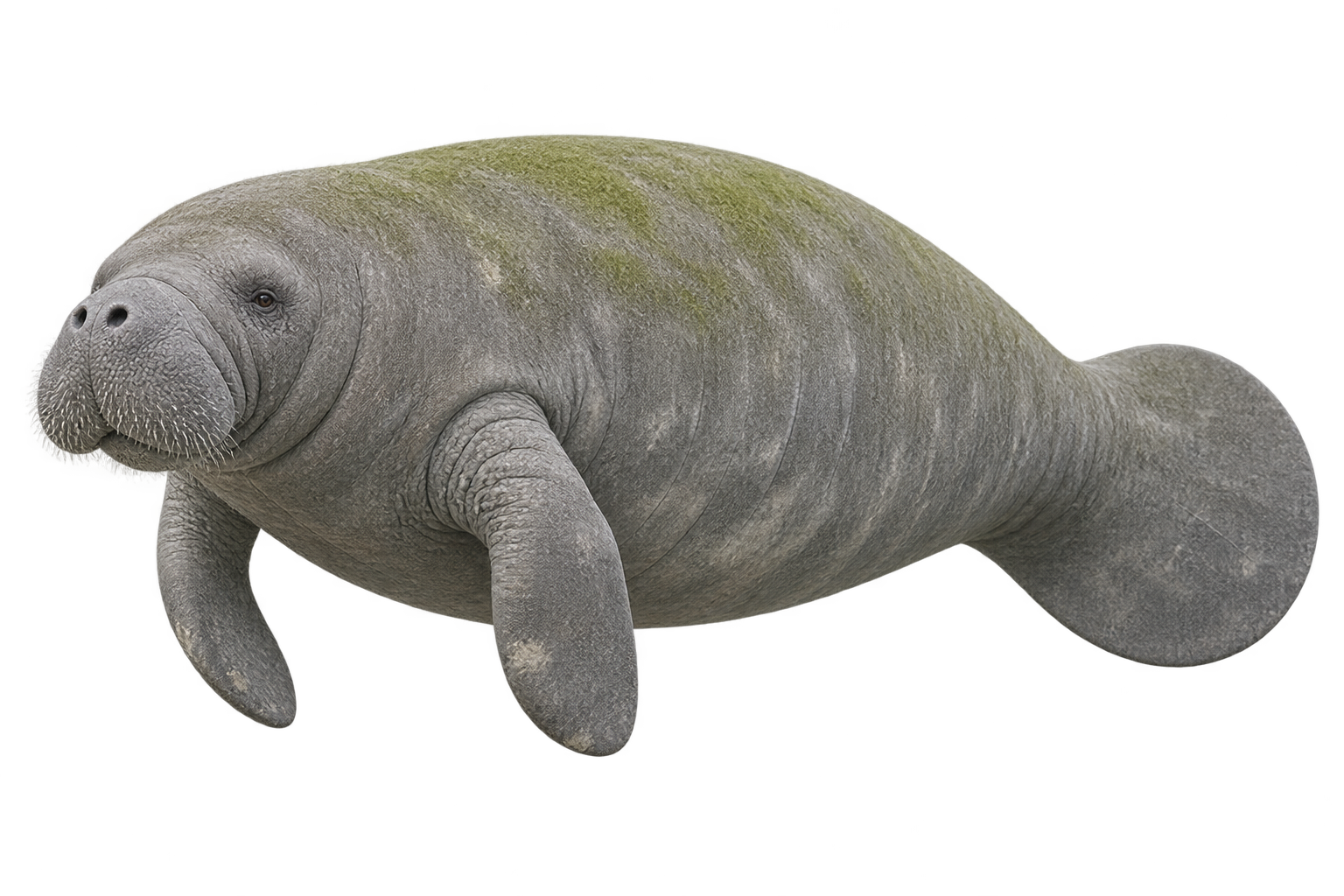
Florida's native manatee is Trichechus manatus latirostris, a subspecies of the West Indian manatee. Look for a heavy gray-brown body, two foreflippers, a whiskered muzzle and one broad, rounded paddle tail. It has no dorsal fin or external ear lobes. Algae can make the back appear greenish, so surface color is less reliable than the body and tail outline.
Size and life stages
Adults are typically nine to ten feet, about 2.7–3 meters, measured from snout to tail, and weigh around 1,000 pounds. Larger animals can exceed thirteen feet. Newborn calves are already roughly four to four-and-a-half feet long. These are whole-body measurements, not shell or disc dimensions, and an animal seen through murky water may be much larger than its visible portion.
Habitat and where to look
Florida manatees use freshwater, brackish and marine habitats, including springs, rivers, estuaries and coastal seagrass beds. Warm-water refuge is crucial during cold weather because prolonged exposure below approximately 68°F, or 20°C, is dangerous. Springs, thermal basins and some power-plant outfalls provide winter shelter. Their presence here reflects coastal habitat use rather than a claim that they are open-ocean specialists.
Range and local context
West Indian manatees occur in the southeastern United States, Caribbean and parts of Central and South America. The Florida subspecies primarily occupies Florida's coastal and inland waters, with some animals traveling farther along both U.S. coasts in warm months. Statewide occurrence is verified here; an individual Palm Beach location, current aggregation or guaranteed winter sighting is not established by these range sources.
What is on the menu?
Manatees graze on seagrasses and other aquatic vegetation, sometimes spending up to eight hours a day feeding. The flexible upper lip helps gather food, and flippers can hold vegetation. Molars are continually replaced as older teeth wear down and move forward. Loss of seagrass therefore removes a substantial daily food supply, not merely a resting place or background habitat.
Daily habits and behavior
A manatee's paddle tail moves up and down to propel it. When active it commonly surfaces every three to five minutes; resting animals can remain submerged considerably longer. Winter gatherings concentrate animals near warm water, but manatees need not remain in permanent herds. A quiet animal on the bottom may be resting rather than requiring someone to push it upward.
Mating and the next generation
A mother normally gives birth to a single calf after a gestation of about thirteen months. The calf nurses from teats behind the foreflippers and may remain with her for up to two years. During that period it learns routes and locations of food and warm water. Do not separate a calf from its mother, even briefly for a photograph.
Look-alikes and identification traps
A dolphin has a different head profile and a tail divided into flukes, whereas the manatee has a single rounded paddle. A surfacing back or swirl alone may not show enough anatomy for certainty. The Florida and Antillean subspecies belong to the same West Indian species; this Florida account is not intended as a visual key for separating those subspecies.
Observe without disturbing
FWC recommends passive observation: look without touching, chasing, feeding or supplying water. Leave the animal's path open, keep noise and splashing down, and never isolate a mother and calf. Stay outside posted no-entry refuges and obey boat-speed restrictions. At sites that permit in-water viewing, follow site rules rather than assuming a statewide right to swim close to manatees.
Harvest, protection and eating safety
Protected: no recreational take
Florida and applicable federal protection apply year-round: no ordinary recreational harvest season, open-area exception or spearing allowance. Nesting, breeding or viewing seasons do not authorize take. This is not a lawful recreational food target.
This color is a qualified summary, not permission to collect or a guarantee that a particular catch is safe to eat. Read the current rules and health guidance below.
Threatened; protected marine mammal, no recreational take
Can it be hunted or harvested?
West Indian Manatee is not a recreational harvest target. The Florida subspecies is protected under the federal Endangered Species Act and Marine Mammal Protection Act, and the Florida Manatee Sanctuary Act. Hunting, capturing, harming and harassing manatees are prohibited; a fishing license provides no exemption.
Florida seasons and areas
There is no Florida recreational harvest season, open area, bag limit or edible-size exception for this protected animal. Protection applies year-round in Florida and under applicable federal law. Posted manatee refuges, sanctuary access restrictions and boat-speed zones may impose additional seasonal or year-round limits on people and vessels.
Can it be speared?
No. Spearing, shooting, injuring or killing this protected marine mammal is not an authorized recreational activity. An otherwise open spearfishing area does not create an exception for the animal.
Is it safe to eat?
Not a lawful recreational food target. This guide provides no assurance that its meat or other tissues are safe to eat; protected status and the absence of a named consumption advisory are not a food-safety assessment.
Before you act: This recreational overview is not permission to collect or spear at your dive site. Confirm the species, date, management area, state or federal waters, gear, licenses and current local closures. Identification artwork cannot establish an identification or guarantee seafood safety.
Official rules and health guidance
- U.S. Fish and Wildlife Service: West Indian manatee biology and subspecies
- FWC: manatee viewing guidelines and legal protection
Reviewed 2026-11-10. Rules and advisories can change; check the linked authorities before harvesting or eating.
Sources and review
Reviewed 2026-11-10.
Make your next dive happen
Dive With Us
Explore local charters and plan a dive suited to your experience.
View dive calendarTrain With Us
Build your fish identification, buoyancy and diving skills.
Explore trainingTravel With Us
Discover upcoming dive adventures and trip details.
Explore dive travelShop With Us
Browse equipment for your diving and ask our team for help choosing.
Explore dive gearReview current dates, availability, prices, inclusions and requirements on each listing before booking or buying.
Call us now
Ask about marine life identification
Marine Life Identification
Ask about dates, prerequisites or your next step. An inquiry does not reserve a place. Please provide your own contact details; do not include medical, payment or a child's personal information.
We use these details to respond to your inquiry. This form does not sign you up for marketing.
Explore more with Stuart Scuba
Open Water course options · Advanced Adventure training · Technical training · Professional training · All courses · Local dives · Dive trips · Facebook · Instagram · YouTube
Your surface-interval essentials
Questions for Stuart Scuba? info@stuartscuba.com
Check the Stuart Scuba Weather Center · Play scuba trivia
Weather and wildlife vary. Confirm current conditions, trip requirements and departure details with the operator.
Plan Your Next Dive with Stuart Scuba
Dive With Us
Explore upcoming local charters and choose a dive that fits your experience.
Before you book
Check the individual listing for departure time, requirements and availability.
Travel With Us
Find upcoming dive adventures and start planning your next trip.
Plan your trip
Review dates, inclusions and trip details on the travel calendar.
Stay Connected with Stuart Scuba
 Follow pageShare
YouTube
SubscribeWatch & shareFollow on InstagramView & share post
Follow company news, training updates, and dive stories.
Follow on LinkedInGoogle Reviews
See Stuart Scuba’s current Google rating and review count below. Open the listing in Google Maps to browse customer reviews.



