

Fish identification archive / Warty sidegill slug
Warty sidegill slug
Pleurobranchus areolatus
Fun facts for your next surface interval
Florida and local context
A July 2025 three-dive BHB diary photographs and names a warty sidegill slug, estimated at four inches.
A documented past record does not establish present abundance or guarantee an encounter.
Sources: Laura Kushner: Thirteen nudibranch species… (27 July 2025)
How to recognize this animal
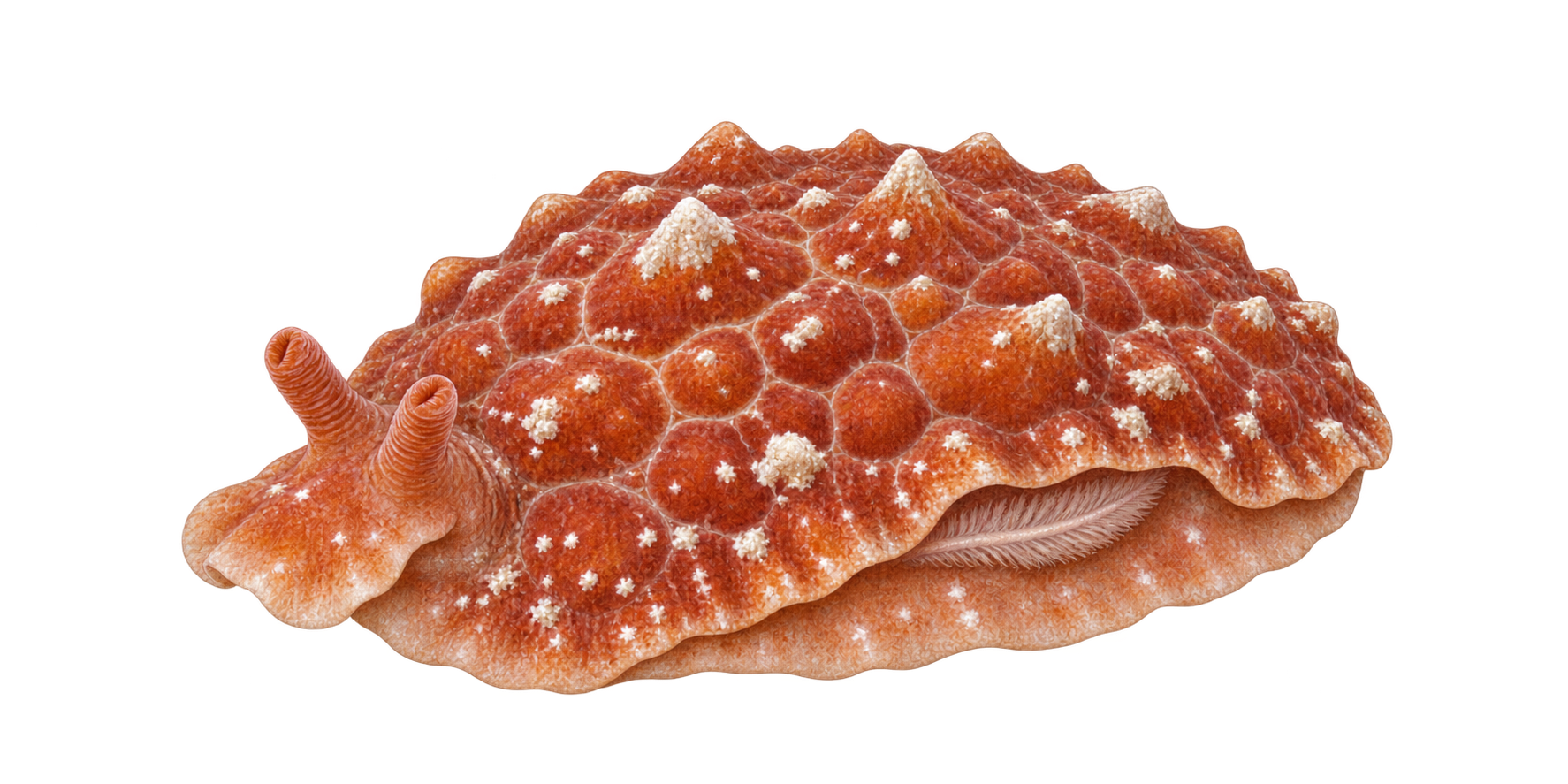
The warty sidegill slug is a broad, oval sea slug with many small, flattened polygonal bumps across its back. Color varies considerably, from brownish tones to deep violet, with variable white pigment. Its paired rhinophores are rolled and joined at their bases. Unlike a dorid nudibranch’s exposed dorsal gill rosette, the gill of Pleurobranchus lies on the right side beneath the mantle. A top view may therefore hide a defining part of its anatomy.
Sources: Goodheart and colleagues (2016): Sea slugs of Bocas del Toro; Goodheart and colleagues (2015): Systematics and biogeography of Pleurobranchus
Size and life stages
The peer-reviewed Caribbean identification guide gives an upper length of 150 mm, about six inches. In July 2025, a Blue Heron Bridge diver estimated a photographed individual at about four inches. Keep the distinction between a published species maximum and an approximate observation; neither is a promise of the size you will encounter on a particular dive.
Sources: Goodheart and colleagues (2016): Sea slugs of Bocas del Toro; Laura Kushner: Thirteen nudibranch species… (27 July 2025)
Habitat and where to look
The Caribbean guide reports this species beneath rocks and coral rubble. That association explains why a large slug can still escape notice on a casual survey. For recreational observation, look into already open spaces and along accessible edges. Turning over occupied habitat merely to reveal an animal is unnecessary and can disrupt much more than the intended subject.
Sources: Goodheart and colleagues (2016): Sea slugs of Bocas del Toro
Range and local context
Modern accounts document a broad tropical western Atlantic distribution, including Caribbean islands, Central American coasts, Brazil, the Bahamas and Bermuda. The local Florida evidence is a specifically named Blue Heron Bridge photo diary. Older Sea Slug Forum material suggested an eastern Pacific presence, but later research distinguishes Pacific Pleurobranchus digueti. This guide does not extend the modern species’ range by recycling those older Pacific identifications.
Sources: Goodheart and colleagues (2015): Systematics and biogeography of Pleurobranchus; Laura Kushner: Thirteen nudibranch species… (27 July 2025)
What is on the menu?
The peer-reviewed Caribbean guide says this species probably feeds on ascidians, or sea squirts. The word probably matters: the cited account does not establish a complete prey list. A slug sitting near an encrusting organism is not by itself proof of feeding, and no particular Blue Heron Bridge prey species was verified for this profile.
Sources: Goodheart and colleagues (2016): Sea slugs of Bocas del Toro
Daily habits and behavior
Researchers describe most Pleurobranchus species as nocturnal and cryptically colored. This is genus-level context rather than a measured activity schedule for Florida warty sidegills. A sighting in daylight is not inconsistent with that general pattern. Record time of day and whether the individual is exposed, sheltering or actually feeding instead of assuming its behavior from appearance.
Sources: Goodheart and colleagues (2015): Systematics and biogeography of Pleurobranchus
Mating and the next generation
Published anatomical work documents both male and female reproductive structures in this species. That supports describing it as hermaphroditic, but it does not establish a local breeding calendar. Egg-ribbon dimensions, clutch size and larval duration were not verified here. Avoid assigning an unattended egg mass to a sidegill solely because an adult was found nearby.
Sources: Goodheart and colleagues (2015): Systematics and biogeography of Pleurobranchus
Look-alikes and identification traps
Color forms and historical names have repeatedly complicated identification. Pleurobranchus atlanticus is now treated as this species, not a second local sidegill. Brazilian literature also warns that some animals formerly called P. areolatus were actually P. reticulatus. Compare surface structure and the whole animal, and retain an identification caveat when a photograph lacks the necessary detail.
Sources: Comparative Morphology and Redescription of Pleurobranchus Species from Brazil; WoRMS / MolluscaBase: Pleurobranchus areolatus
Observe without disturbing
Do not lift the mantle to expose the gill or remove the animal from shelter. Photograph visible features, note the real site and approximate depth, and leave its surroundings intact. If the view is incomplete, a cautious sidegill identification is better than forcing a species name or disturbing the animal to obtain one.
Harvest, protection and eating safety
Live-only ornamental collection; no collection at Blue Heron Bridge
Yellow means legal or safety conditions require attention. It is not an edible badge or permission to take an animal.
This color is a qualified summary, not permission to collect or a guarantee that a particular animal is safe to eat.
Can it be hunted or harvested?
Warty sidegill slug falls under Florida’s expressly named nudibranch/sea-slug category. A recreational saltwater fishing license is required unless exempt. Where collection is lawful, the animal must be landed alive and maintained alive in a suitably sized circulating, aerated or oxygenated system. The recreational limit is five of this species within 20 marine-life organisms per person per day; the two-day possession limit is ten of this species within 40 total. Recreational sale is prohibited. No species-specific size limit is stated in the reviewed marine-life table.
Florida seasons and areas
The designated Blue Heron Bridge Special Marine Life Area, including Phil Foster Park and its mapped surrounding waters, is closed to collection of listed tropical ornamental marine life. Narrow motorized-vessel transit and landing exceptions concern animals lawfully taken elsewhere, not collection here. The Florida marine-life requirements also apply in adjacent federal waters. No species-specific annual closed months are stated in the reviewed marine-life table. Biscayne National Park, state parks, wildlife refuges and Florida Keys sanctuary zones can impose additional closures; check the actual location before collecting.
Can it be speared?
No recreational spearing under these live-only marine-life requirements. Collection uses authorized nonlethal hand/net/slurp-gun methods, subject to species and site restrictions. Quinaldine is prohibited.
Is it safe to eat?
This is live-only ornamental collection, not food harvest. Do not kill a collected animal for a meal. No recipe or safe-to-eat claim is provided.
The regulatory wording uses the older umbrella “Subclass Opisthobranchia.” Modern taxonomy uses different higher groups; the rule expressly names nudibranchs/sea slugs. This is not permission to collect substrate, host colonies or other animals. Pleurobranchus areolatus is a side-gill sea slug, not a nudibranch; it is covered by the sea-slug wording.
Palm Beach is Atlantic Florida. Do not transfer Atlantic guidance to the Gulf, Monroe County, or federal waters without checking the applicable rules.
Before you act: Confirm the species, date, exact management area, state or federal waters, gear, licenses and current local closures. A local occurrence record never grants permission to take an animal.
Official rules and health guidance
- FWC recreational marine-life requirements and species list
- Florida Rule 68B-42.001: listed marine-life species
- Florida Rule 68B-42.0036: mapped marine-life collection closures
- Palm Beach County: Phil Foster Park fishing and collection notice
- FWC spearing restrictions
- NOAA: Florida Keys sanctuary zones
- Florida Rule 68B-42.005: final-adopted recreational bag rule register
Reviewed 2026-11-11. Rules and advisories can change; check the linked authorities before acting.
Identification and source cautions
- Ascidians are probable prey, not a fully verified species-specific prey list.
- Local record is an identified diver photograph, not a sequenced voucher.
- Species-specific local spawning season and activity schedule unverified.
Sources and review
Biology and taxonomy reviewed 2026-11-11. Photographs on cited sites are reference material and are not reproduced here.
- Goodheart and colleagues (2016): Sea slugs of Bocas del Toro
- Goodheart and colleagues (2015): Systematics and biogeography of Pleurobranchus
- Laura Kushner: Thirteen nudibranch species… (27 July 2025)
- Comparative Morphology and Redescription of Pleurobranchus Species from Brazil
- WoRMS / MolluscaBase: Pleurobranchus areolatus
Make your next dive happen
Dive With Us
Explore local charters and plan a dive suited to your experience.
View dive calendarTrain With Us
Build your fish identification, buoyancy and diving skills.
Explore trainingTravel With Us
Discover upcoming dive adventures and trip details.
Explore dive travelShop With Us
Browse equipment for your diving and ask our team for help choosing.
Explore dive gearReview current dates, availability, prices, inclusions and requirements on each listing before booking or buying.
Call us now
Ask about marine life identification
Marine Life Identification
Ask about dates, prerequisites or your next step. An inquiry does not reserve a place. Please provide your own contact details; do not include medical, payment or a child's personal information.
We use these details to respond to your inquiry. This form does not sign you up for marketing.
Explore more with Stuart Scuba
Open Water course options · Advanced Adventure training · Technical training · Professional training · All courses · Local dives · Dive trips · Facebook · Instagram · YouTube
Your surface-interval essentials
Questions for Stuart Scuba? info@stuartscuba.com
Check the Stuart Scuba Weather Center · Play scuba trivia
Weather and wildlife vary. Confirm current conditions, trip requirements and departure details with the operator.
Plan Your Next Dive with Stuart Scuba
Dive With Us
Explore upcoming local charters and choose a dive that fits your experience.
Before you book
Check the individual listing for departure time, requirements and availability.
Travel With Us
Find upcoming dive adventures and start planning your next trip.
Plan your trip
Review dates, inclusions and trip details on the travel calendar.
Stay Connected with Stuart Scuba
 Follow pageShare
YouTube
SubscribeWatch & shareFollow on InstagramView & share post
Follow company news, training updates, and dive stories.
Follow on LinkedInGoogle Reviews
See Stuart Scuba’s current Google rating and review count below. Open the listing in Google Maps to browse customer reviews.



