

Fish identification archive / Vermilion Snapper
Vermilion Snapper
Rhomboplites aurorubens · Lutjanidae
I saw this
Spotted this fish? Share the guide with your dive buddies. Review your caption before posting.
For Instagram, copy the caption and link into your own post or message. Nothing is posted automatically and this does not record a verified sighting.
What to look for
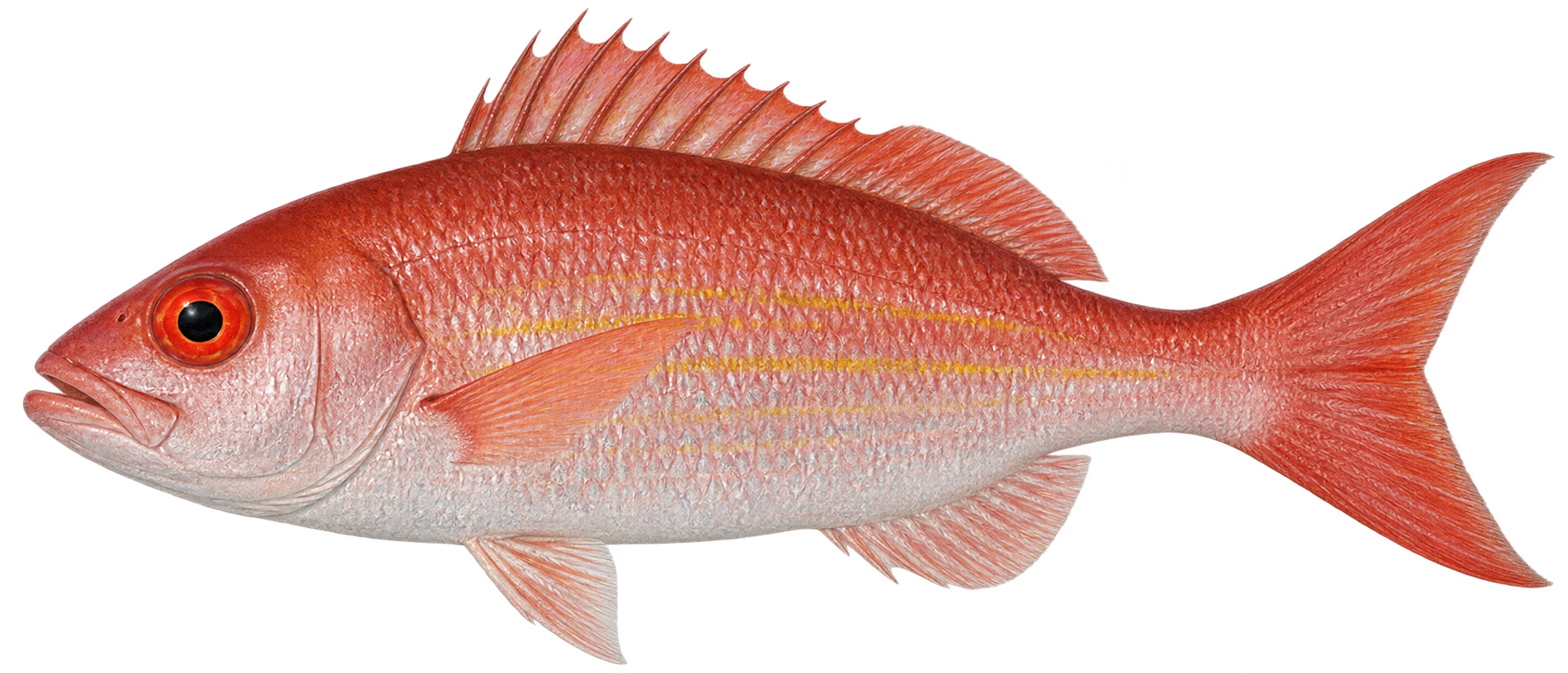
Vermilion snapper are relatively slender, rosy-red fishes with large reddish eyes and fine yellow-gold streaks along the sides. The rear anal-fin outline is rounded rather than sharply pointed, and the mouth lacks the large canine teeth associated with several other snappers. Red snapper are more robust, while silk snapper show a yellow iris. FWC vermilion identification
Compare body shape and eye color before relying on overall redness. A photograph showing the complete side profile is more valuable than a head-only portrait. Do not manipulate the mouth to inspect teeth: visible external features should guide ordinary observation.
Range and biology
NOAA describes a western Atlantic distribution from North Carolina to southeastern Brazil, including the Gulf and Caribbean. Vermilion use offshore rock, gravel and sand habitats and can form large schools. NOAA gives a broad depth range of 60–400 feet. That range is habitat information, not a recommended diving depth, and inclusion here does not establish a sighting at any named southeast Florida reef. NOAA vermilion snapper account
Food includes small fishes, crustaceans, worms, squid and plankton. Spawning takes place repeatedly during a warm-season interval. FWC and NOAA summaries differ on maturity age, so this guide deliberately avoids giving one fixed age as settled for every population.
FWC describes fish commonly around 14 inches and reaching 24 inches, but does not define the length axis. These are biological size references rather than legal measuring instructions. A school of small fish should not be assumed to consist entirely of immature individuals.
Three memorable details
- Beeliner and mingo are other names for this same species, not extra kinds of snapper.
- It is a snapper without the large canine teeth that many people associate with that family.
- Reproduction is repeated through the season rather than confined to one egg release. FWC identification and NOAA reproduction
Responsible observation and harvest
Let schools keep their shape. Swimming through the middle for a picture scatters fish and usually makes identification harder. Maintain buoyancy and keep equipment clear of the bottom.
FWC’s Atlantic table checked November 12, 2026 listed a 12-inch total-length minimum and five per person, outside the ten-snapper aggregate. Its listed year-round season is not a guarantee against later changes. Gulf limits differ. FWC snapper rules
Before fishing, confirm the live federal or state rules, protected-area boundaries and required reef-fish release equipment. A correct species identification is only the first part of a lawful decision, not a complete authorization to take fish.
Make your next dive happen
Dive With Us
Explore local charters and plan a dive suited to your experience.
View dive calendarTrain With Us
Build your fish identification, buoyancy and diving skills.
Explore trainingTravel With Us
Discover upcoming dive adventures and trip details.
Explore dive travelShop With Us
Browse equipment for your diving and ask our team for help choosing.
Explore dive gearReview current dates, availability, prices, inclusions and requirements on each listing before booking or buying.
Call us now
Ask about fish identification training
Reef Fish Identification
Ask about dates, prerequisites or your next step. An inquiry does not reserve a place. Please provide your own contact details; do not include medical, payment or a child's personal information.
We use these details to respond to your inquiry. This form does not sign you up for marketing.
Explore more with Stuart Scuba
Open Water course options · Advanced Adventure training · Technical training · Professional training · All courses · Local dives · Dive trips · Facebook · Instagram · YouTube
Your surface-interval essentials
Questions for Stuart Scuba? info@stuartscuba.com
Check the Stuart Scuba Weather Center · Play scuba trivia
Weather and wildlife vary. Confirm current conditions, trip requirements and departure details with the operator.
Plan Your Next Dive with Stuart Scuba
Dive With Us
Explore upcoming local charters and choose a dive that fits your experience.
Before you book
Check the individual listing for departure time, requirements and availability.
Travel With Us
Find upcoming dive adventures and start planning your next trip.
Plan your trip
Review dates, inclusions and trip details on the travel calendar.
Stay Connected with Stuart Scuba
 Follow pageShare
YouTube
SubscribeWatch & shareFollow on InstagramView & share post
Follow company news, training updates, and dive stories.
Follow on LinkedInGoogle Reviews
See Stuart Scuba’s current Google rating and review count below. Open the listing in Google Maps to browse customer reviews.



