

Fish identification archive / Variegated Sea Urchin
Variegated Sea Urchin
Lytechinus variegatus
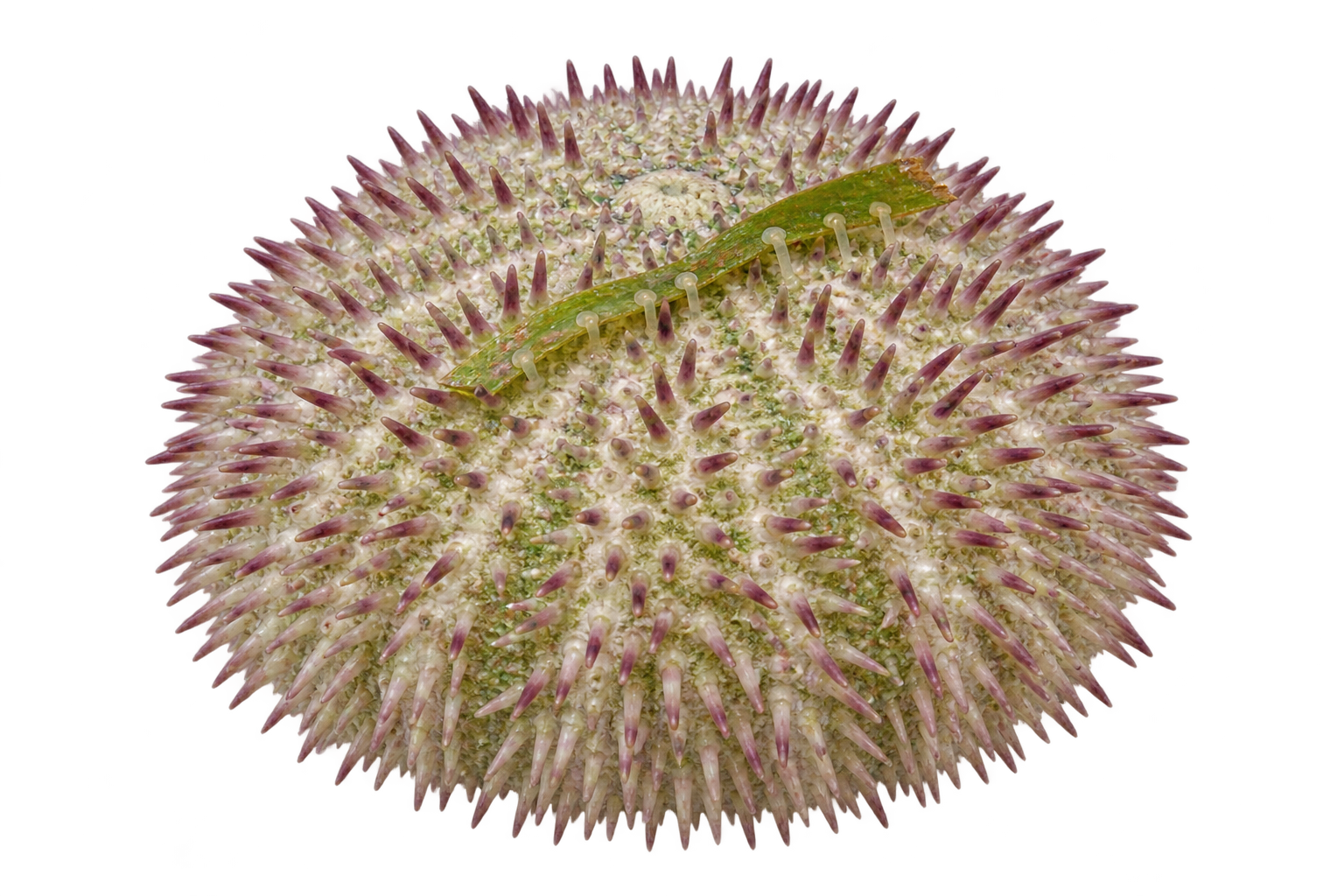
Fun facts for your next surface interval
- Underwater wardrobe: tube feet hold loose leaves and shells over its back.
- Green is optional: its test and spines may also be red, purple or white.
- Grass-climber: researchers watched it moving up between turtle-grass blades.
Florida and local context
Blue Heron Bridge, Palm Beach County: Florent’s published species photograph is explicitly labeled Blue Heron Bridge, Florida. This is an individual photographic occurrence record, not an abundance estimate.
Documented regional presence is not a guarantee of an encounter or a measure of how common this animal is at your dive site.
How to recognize this animal
A rounded test covered in short spines can be green, cream, white, reddish or purple, sometimes combining several shades. Loose shells, seagrass or leaves carried on top are a strong behavioral clue, not permanent body parts. Look between those objects for the pale body and short spines; never remove its covering to reveal them.
Size and life stages
Smithsonian’s Florida Keys observations described adults around nine centimeters across including the spines, roughly three and a half inches. Smaller field-guide figures often describe a more limited body span. Record the measurement convention before comparing sizes. Young urchins may remain in rubble and shell clusters near grass instead of sitting openly among the larger grazing adults.
Habitat and where to look
Seagrass beds are a particularly useful search habitat, including sandy patches at their edges. Florida Keys researchers found it moving on the bottom and climbing between turtle-grass blades. Do not assume every clean sand flat is equivalent habitat: the same survey found a strong association with vegetation rather than broad, completely grassless expanses.
Range and local context
This western Atlantic urchin occurs along the southeastern United States, through Florida and the Caribbean, and farther south. Florent’s species account includes photographs explicitly labeled Blue Heron Bridge, Florida, giving local photographic corroboration. That is a documented occurrence, not a density estimate or a guarantee that an urchin seen there belongs to this species.
What is on the menu?
Its menu includes seagrass, algae and associated material. Smithsonian observations and dissections in the Florida Keys documented turtle grass as an important food. The five-toothed feeding apparatus is on the underside, while the objects on the back may be shade or camouflage rather than lunch. A carried shell is therefore not proof of a mollusk meal.
Daily habits and behavior
The covering habit is especially conspicuous. Tube feet hold loose material against the upper surface, and broad leaves or shell pieces can hide much of the body. Experiments discussed in the Smithsonian account connect this behavior with light avoidance, while also noting the camouflage it creates. The covering changes as the animal moves through different available materials.
Mating and the next generation
The sexes are separate, and eggs and sperm are released for fertilization outside the body. Laboratory work and field studies make this a well-studied developmental model. Reproductive timing varies among populations and conditions, so a Florida Gulf study is not a universal calendar for Atlantic dives. A discharge cloud needs context before being labeled spawning.
Look-alikes and identification traps
West Indian sea eggs can share seagrass habitat but usually have a larger brown test with many short white spines. Variegated urchins have much more variable colors and often carry heavier cover. Color alone remains insufficient: compare the overall test, spine proportions, covering behavior and location. A bare dead test is a different identification problem from a living animal.
Observe without disturbing
Leave every shell fragment and seagrass blade where the urchin placed it. Avoid settling a camera or knee into nearby grass, and take a wider photograph showing the habitat before attempting detail. At Blue Heron Bridge, marine-life collection is prohibited within the protected dive-site boundary; a photograph is the appropriate souvenir.
Harvest, protection and eating safety
LIVE COLLECTION ONLY — NO FOOD HARVEST
Florida state and adjacent federal waters: limited licensed live collection may be lawful, with live landing/holding, life support, species size rules and bag/possession limits. No species-specific annual closed months are listed, but Blue Heron Bridge, Biscayne and other area closures override that allowance. This is not a blanket ban on lawful live collection or an eating recommendation. Lee prohibits harvest and coastal-water possession; Manatee limits harvest and coastal-water possession to two per species.
This color is a qualified summary, not permission to collect or a guarantee that a particular catch is safe to eat. Read the current rules and health guidance below.
Conditional live collection; marine-life rules
Can it be hunted or harvested?
Variegated Sea Urchin falls within FWC’s regulated marine-life group for urchins, Class Echinoidea. Recreational collection requires a Florida saltwater fishing license unless a statutory exemption applies. The daily limit is five of this species within twenty total marine-life organisms per person; two-day possession is ten of this species within forty total. No species-specific size limit is listed. Animals must be landed and kept alive with an adequately sized circulating livewell, aeration or oxygenation system. Recreationally collected marine life cannot be sold.
Florida seasons and areas
No species-specific annual closed season is listed, but this is not permission to collect everywhere. Florida marine-life rules also apply in adjacent federal waters on both the Atlantic and Gulf coasts. Collection is prohibited within the designated Blue Heron Bridge dive-site boundary and throughout Biscayne National Park. Other parks, refuges and Florida Keys sanctuary zones may prohibit collection. Western Dry Rocks is closed to all fishing April 1–July 31. Lee County prohibits harvest of these living mollusks or echinoderms and prohibits possession in or on county Florida waters seaward of mean high water. Manatee County allows no more than two of this species harvested per day and no more than two in possession in or on county Florida waters seaward of mean high water. These local restrictions override the general ten-specimen marine-life possession allowance.
Can it be speared?
No. Recreational marine-life harvest is restricted to authorized non-spearing methods, including hand collection and the listed handheld, drop or barrier nets and slurp gun. A spear is not an authorized collection method; quinaldine is prohibited. The live-landing and live-holding requirements still apply.
Is it safe to eat?
Not presented as a recreational food target. Florida’s marine-life rules require these animals to be landed and kept alive, and an aquarium-collection allowance is not a food-safety finding. No species-specific Florida consumption assessment is established here. Do not infer edibility or safety from the absence of an advisory or from another related species being eaten.
Before you act: This recreational overview is not permission to collect or spear at your dive site. Confirm the species, date, management area, state or federal waters, gear, licenses and current local closures. Identification artwork cannot establish an identification or guarantee seafood safety.
Official rules and health guidance
- FWC: Recreational Marine Life requirements and regulated groups
- FWC: Biscayne National Park fishing regulations
- FWC: Western Dry Rocks April–July fishing closure
- FAC 68B-26.002: Living mollusk and echinoderm definition
- FWC: Recreational Sea Shell Collecting
- Florida Department of Health: Seafood poisoning
- FAC 68B-26.004: Exact Lee and Manatee harvest and in-water possession restrictions
Reviewed 2026-11-10. Rules and advisories can change; check the linked authorities before harvesting or eating.
Sources and review
Reviewed 2026-11-10.
- https://reefguide.org/keys/pixhtml/variegatedurchin4.html
- Smithsonian: Kier and Grant, Echinoid Distribution and Habits, Key Largo Coral Reef Preserve (1966)
- Florent’s Guide: Variegated Sea Urchin identification and diagnostic photographs
- PLOS ONE: Miami coral restoration and urchin grazing study (2025)
- Gulf and Caribbean Research: Lytechinus variegatus reproductive study
- FWC: Recreational Marine Life requirements and regulated groups
- ITIS: Lytechinus variegatus taxonomy and supporting references
Make your next dive happen
Dive With Us
Explore local charters and plan a dive suited to your experience.
View dive calendarTrain With Us
Build your fish identification, buoyancy and diving skills.
Explore trainingTravel With Us
Discover upcoming dive adventures and trip details.
Explore dive travelShop With Us
Browse equipment for your diving and ask our team for help choosing.
Explore dive gearReview current dates, availability, prices, inclusions and requirements on each listing before booking or buying.
Call us now
Ask about marine life identification
Marine Life Identification
Ask about dates, prerequisites or your next step. An inquiry does not reserve a place. Please provide your own contact details; do not include medical, payment or a child's personal information.
We use these details to respond to your inquiry. This form does not sign you up for marketing.
Explore more with Stuart Scuba
Open Water course options · Advanced Adventure training · Technical training · Professional training · All courses · Local dives · Dive trips · Facebook · Instagram · YouTube
Your surface-interval essentials
Questions for Stuart Scuba? info@stuartscuba.com
Check the Stuart Scuba Weather Center · Play scuba trivia
Weather and wildlife vary. Confirm current conditions, trip requirements and departure details with the operator.
Plan Your Next Dive with Stuart Scuba
Dive With Us
Explore upcoming local charters and choose a dive that fits your experience.
Before you book
Check the individual listing for departure time, requirements and availability.
Travel With Us
Find upcoming dive adventures and start planning your next trip.
Plan your trip
Review dates, inclusions and trip details on the travel calendar.
Stay Connected with Stuart Scuba
 Follow pageShare
YouTube
SubscribeWatch & shareFollow on InstagramView & share post
Follow company news, training updates, and dive stories.
Follow on LinkedInGoogle Reviews
See Stuart Scuba’s current Google rating and review count below. Open the listing in Google Maps to browse customer reviews.



